
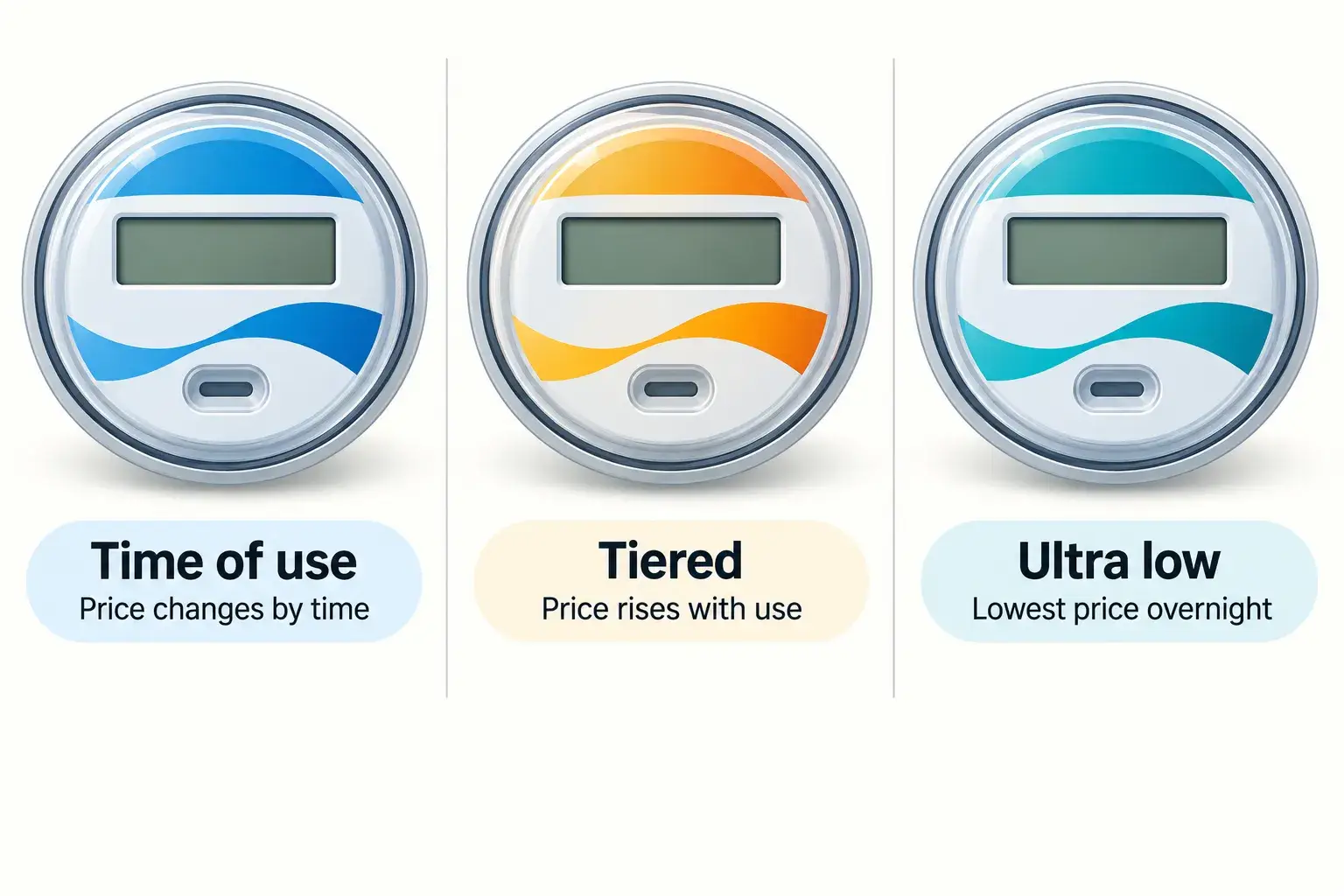
Ontario’s electricity rate structures give most homes and small businesses three regulated choices: time-of-use, tiered and ultra-low overnight pricing. Each plan has its own price per kWh and its own hours, and the cheapest choice depends on your own usage, your other bill charges and how easily you can switch.
What Ontario electricity rates apply under each plan?
Each plan charges for the same electricity in a different way. Time-of-use and ultra-low overnight plans charge by the hour you use power. Tiered pricing charges by how much you use in a month. The prices below come from the Ontario Energy Board schedule effective November 1, 2025, and they cover the electricity line only.

Time-of-use prices and seasonal hours
Under TOU pricing, the price changes with the hour, the day and the season. Weekday mid-peak and on-peak hours swap places twice a year, so any 2026 chart of Ontario time-of-use rates needs to show both a summer layout and a winter layout. Off-peak hours stay the same all year.
- Off-peak, 9.8¢/kWh: weekdays from 7 p.m. to 7 a.m., and all day on weekends and designated electricity-pricing holidays.
- Summer mid-peak, 15.7¢/kWh: from May 1 to October 31, weekdays from 7 a.m. to 11 a.m. and from 5 p.m. to 7 p.m.
- Summer on-peak, 20.3¢/kWh: weekdays from 11 a.m. to 5 p.m.
- Winter periods: from November 1 to April 30, mid-peak (15.7¢) covers 11 a.m. to 5 p.m. On-peak (20.3¢) covers 7 a.m. to 11 a.m. and 5 p.m. to 7 p.m.
In practice, a weekday afternoon costs the most in summer. In winter, the morning and early-evening routines in a Mississauga or Markham home are the most expensive hours.
Ultra-low overnight prices and hours
The ultra-low overnight plan widens the gap between the cheapest and the most expensive hours. Its hours stay the same in summer and winter, which makes the plan easier to schedule around than TOU.
- Overnight, 3.9¢/kWh: every day from 11 p.m. to 7 a.m.
- Weekday mid-peak, 15.7¢/kWh: from 7 a.m. to 4 p.m. and from 9 p.m. to 11 p.m.
- Weekday on-peak, 39.1¢/kWh: from 4 p.m. to 9 p.m.
On weekends and designated holidays, the ULO price from 7 a.m. to 11 p.m. is 9.8¢/kWh. The 11 p.m. to 7 a.m. window keeps its ultra-low rate on those days as well. Overnight loads benefit most from this plan. Weekday evening use costs about double the TOU on-peak price.
Tiered prices and monthly thresholds
Tiered pricing does not depend on the clock. Under the prices effective November 1, 2025, Tier 1 costs 12.0¢/kWh and Tier 2 costs 14.2¢/kWh. The plan suits households that cannot easily move their usage to cheaper hours.
- Summer residential threshold: 600 kWh per month from May 1 to October 31.
- Winter residential threshold: 1,000 kWh per month from November 1 to April 30.
- Non-residential threshold: 750 kWh per month in both seasons for eligible customers.
- Tier 2 scope: the higher price applies only to the kWh above the threshold, never to the earlier consumption.
Here is how that works in a real month. A residential customer who uses 700 kWh in a summer month pays $86.20 CAD for electricity. That total is 600 kWh at 12.0¢ plus 100 kWh at 14.2¢.
The same 700 kWh in a winter month stays entirely in Tier 1 because the threshold is higher. Check your monthly totals against the threshold for each season before you rule this plan in or out.
Which pricing plan costs less for your usage?
The plan with the lowest price per kWh is not always the cheapest plan for you. Your result depends on how much you use, when you use it and how much of it you can realistically move. Your smart-meter data shows where your electricity usage falls across the price periods.

Calculate each plan from the same usage
A fair comparison starts with one set of smart-meter intervals and prices that same usage under each plan. If you change the consumption between plans, the comparison is no longer accurate.
- Assign intervals: place every usage interval in the correct TOU and ULO price period.
- Apply the season: use summer or winter TOU hours to match the billing month.
- Multiply and add: multiply the kWh in each period by that period’s price, then add the results.
- Price the tiers: charge usage up to the monthly threshold at Tier 1 and only the excess at Tier 2.
The Ontario Energy Board offers a bill calculator that compares all three plans. It uses your utility’s own delivery and regulatory charges and the rebate that applies to you, so it goes beyond the electricity line alone.
| Plan | What sets the price | How to calculate the charge |
| Time-of-use | Hour, day and season | kWh in each period × period price, then added together |
| Ultra-low overnight | Hour and day, same hours all year | kWh in each period × period price, then added together |
| Tiered | Monthly consumption against a threshold | Tier 1 up to the threshold, Tier 2 above it |
What a worked comparison shows
Take a simplified 600 kWh month. Say 240 kWh is used overnight and 180 kWh falls in the weekday 4–9 p.m. window. The remaining 180 kWh is billed at the ULO mid-peak price. At the published prices, the ULO electricity charge comes to $108.00 CAD.
Now apply TOU pricing to the same month. If 420 kWh falls in TOU off-peak and 180 kWh in on-peak, the charge is $77.70 CAD. That is $30.30 CAD less than ULO. These numbers depend on the interval assumptions and do not represent a typical household. They do show how heavy evening use can cancel out cheap overnight power.
| Usage in the 600 kWh example | ULO | TOU |
| Overnight / off-peak | 240 kWh at 3.9¢ | 420 kWh at 9.8¢ |
| Weekday 4–9 p.m. / on-peak | 180 kWh at 39.1¢ | 180 kWh at 20.3¢ |
| Mid-peak | 180 kWh at 15.7¢ | — |
| Electricity charge | $108.00 CAD | $77.70 CAD |
How flexible loads change the comparison
That $30.30 CAD gap comes from evening use. Loads that can move to other hours can close that gap or reverse it. The equipment we install, including EV chargers, heat pumps, solar and batteries, shapes when your household draws from the grid.
- EV charging: overnight home charging can favour ULO. Plugging in on arrival around 6 p.m. puts that load in ULO’s most expensive hours. Include charging frequency, charger-input kWh and your other loads.
- Managed charging: the IESO’s July 2025 EV technical paper found that managed charging can flatten demand. Charging that bunches into the same low-price hours can create secondary peaks.
- Heat pumps: a heat pump raises electricity use while cutting another heating fuel. Cold weekday evenings may still need heating in ULO’s costly window, so compare costs across fuels and seasons.
- Solar: solar power used directly reduces grid imports. Exports, later imports and net-metering credits are counted separately, so an exported kWh is not a saving at the retail price.
New Dawn Energy Solutions designs battery systems that store solar or grid electricity. They can automatically charge when rates are low and discharge when rates are high. When paired with panels, a solar battery can reserve generated power for higher-priced hours. Your savings depend on usable capacity, controls, round-trip losses, degradation and the price gap between periods.
What changes the cost beyond electricity rates?
The prices per kWh above cover only one line of your electricity bill. Two customers paying the same energy prices can still receive very different totals. Delivery, regulatory charges, credits and tax all affect the final amount.
Delivery and other bill charges
An Ontario bill can include delivery, transmission and regulatory charges, along with credits, rebates and tax. Delivery charges pay for moving power through transmission and distribution infrastructure. These charges are separate from the regulated energy prices.
They also differ from one utility to the next. A rural distribution network in Uxbridge or Caledon serves fewer customers per kilometre of line than one in North York. Rate class makes a difference too.
- Fixed charges: a monthly customer charge or a fixed delivery amount stays the same even when you cut or shift usage.
- Variable delivery: some transmission and distribution costs rise and fall with the kWh you use.
- Regulatory charges: these fund the administration of Ontario’s wholesale market and grid reliability.
- Global Adjustment: an estimate is already built into TOU, ULO and Tiered prices, so do not add it a second time.
Moving kWh to cheaper hours lowers the energy line, but fixed charges remain. Size your savings expectations to the variable portion of your bill.
Rebates, tax and bill assistance
Credits and tax come after the energy and delivery charges are added up. To compare plans fairly, treat these items the same way under each plan.
- Ontario Electricity Rebate: 23.5% effective November 1, 2025 for eligible customers. It reduces the eligible pre-tax bill and does not change the price per kWh.
- HST: 13%, according to the Canada Revenue Agency. Apply it consistently when you compare total bills.
- Low-income support: the Ontario Electricity Support Program gives monthly credits to eligible households. The Low-Income Energy Assistance Program offers emergency help to eligible customers who are behind on payments.
The Ontario Energy Board estimated that an eligible residential customer using 700 kWh per month would see the rebate lower the bill by about $36 CAD. This is an estimate, and it is not a guaranteed credit for every household.
When a regulated rate comparison does not apply
The TOU, ULO and Tiered comparison only applies to customers on the Regulated Price Plan. Some customers are billed in a different way.
- Retailer contract: with a licensed retailer, you pay the contract price instead of the regulated energy price.
- Unregulated pricing: the Ontario Energy Board does not regulate that contract price.
- Separate Global Adjustment: the charge may appear on its own line, so the advertised rate does not show the full cost.
- Larger businesses: at monthly peak demand of at least 50 kW, the wholesale electricity market price and Global Adjustment appear separately in the commodity charge.
Before you weigh a retailer offer against a regulated plan, add up its full price, its Global Adjustment treatment, its term and its cancellation terms.
For a medium or large business in Vaughan or Brampton, the comparison is different. It depends on the Ontario Electricity Market Price and Global Adjustment rather than the three residential and small-business plans.
Who can switch plans, and when?
For most customers, switching plans is an administrative step and not a long-term commitment.

Who can choose a regulated plan
Eligible residential and small-business customers on the Regulated Price Plan can choose TOU, Tiered or ULO. The Board sets all three to recover the same forecast average cost of supply for a typical consumer, but each plan spreads that cost differently across usage patterns. If your meter cannot support time-based billing, you may stay on Tiered until the problem is fixed. Sub-metered condo residents cannot choose their own plan because the building’s principal consumer decides.
How to request a change
For most eligible residential customers, the switch is an election made through the local utility. It is not a new supply contract. The steps are:
- Identify your setup: note your current plan, your local distributor and your billing arrangement.
- Get the form: utilities must provide an election form.
- Submit it: utilities must accept the form at least by email or by mail.
- Time it: send it at least 10 business days before your next billing period.
A completed form received by that deadline means the new plan must start with the next billing period. If the form arrives later, the change may start one period after that if the utility cannot process it sooner.
What to check after switching
Electricity used before the effective date is still billed under your old plan. Check your next bill to confirm that it shows the new plan and the correct start date. You can switch to a different regulated plan again later, since no plan requires a permanent commitment.
Run the comparison again after any major change. Examples include adding an EV, a heat pump or an electric water heater, or a change in occupancy or working hours. Bills covering both summer and winter, together with hourly smart-meter data, give you the most reliable basis for the decision.
Frequently Asked Questions
How do designated electricity-pricing holidays affect Time-of-Use and Ultra-Low Overnight prices?
On designated holidays, TOU off-peak at 9.8¢/kWh applies all day. Under ULO, the 3.9¢/kWh rate applies from 11 p.m. to 7 a.m., and 9.8¢/kWh applies from 7 a.m. to 11 p.m. This list of pricing holidays is not necessarily the same as the statutory holidays under employment law.
Will the current Regulated Price Plan prices still apply after October 31, 2026?
The verified price schedule runs through October 31, 2026. Winter TOU hours return on November 1. Prices for November 2026 onward have not been verified, so check the current schedule before you compare plans.
How much does moving electricity use out of the weekday evening peak save under Ultra-Low Overnight pricing?
At the published ULO prices, moving one kWh from the 4–9 p.m. window (39.1¢) to overnight (3.9¢) lowers the electricity charge by 35.2¢. Moving usage to a different time is a separate strategy from reducing total kWh through efficiency, so calculate each one on its own.