Government grants for solar panels changed a lot in 2025 and 2026. This guide shows which programs still accept homeowners, what each one pays in CAD, who qualifies and the order of approvals that protects your rebate.
Is federal solar-panel funding available in 2026?
For most homeowners, no. The main federal programs for solar are now closed, and the assistance that remains targets specific households or businesses. You need to know what the old programs offered so that you can recognize outdated promises in quotes and online articles.
The closed Canada Greener Homes Grant
The federal Canada Greener Homes Grant no longer accepts new applicants. The final deadline for submitting documents was December 31, 2025, so no one can claim its solar grant in 2026. Under the program, eligible solar photovoltaic panels and inverters received $1,000 CAD per installed kW, up to $5,000 CAD.
That $5,000 CAD limit applied to all retrofits combined. It was not a separate amount for each upgrade. Households could also get up to $600 CAD for EnerGuide evaluations, which brought the maximum to $5,600 CAD. The evaluation money was paid only once the grant process ended with at least one eligible retrofit.
The former loan and current affordability program
The grant had strict conditions. Applicants generally had to own and live in the home as their primary residence and complete an EnerGuide evaluation before and after the work. Work done before the pre-retrofit evaluation did not qualify, and neither did work done before December 1, 2020.
The companion Canada Greener Homes Loan took its last applications on October 1, 2025. Loans already approved are not affected. The program offered $5,000–$40,000 CAD in interest-free financing over 10 years. That money had to be repaid, so it was never a solar grant.
No new nationwide solar grant replaces the old one on the same terms. Instead, the Canada Greener Homes Affordability Program works through participating partners to provide no-cost energy upgrades to eligible low-to-median-income homeowners and tenants. Solar panels can be part of these retrofits, but they are not guaranteed.
Where federal assistance applies
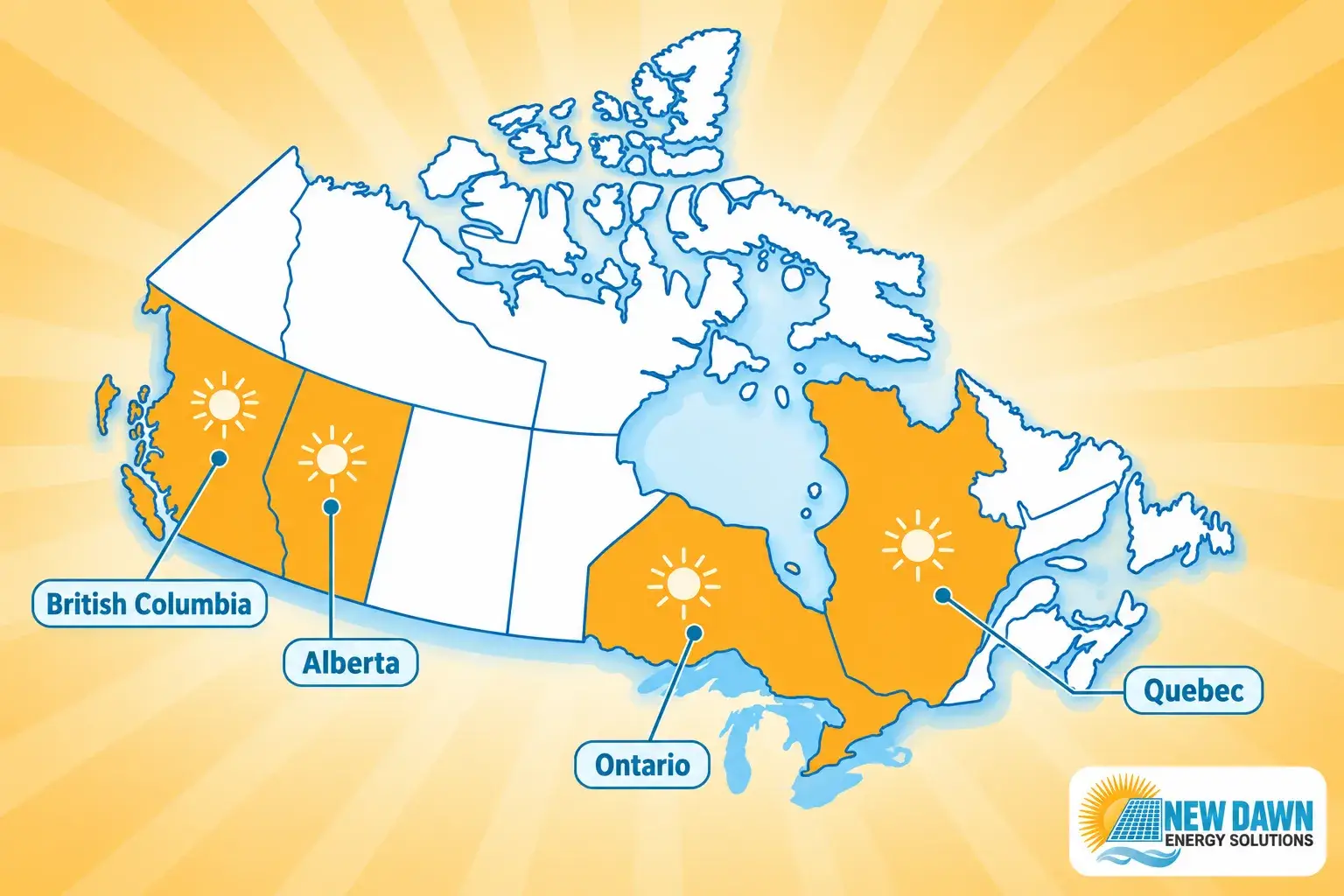
Natural Resources Canada lists British Columbia, Manitoba, Nova Scotia, Prince Edward Island and Quebec as participating jurisdictions for the Affordability Program. Ontario and Alberta are not on that list, so households there need to look to provincial programs.
The Clean Technology Investment Tax Credit can cover up to 30% of qualifying solar electricity equipment, according to the Canada Revenue Agency. Eligible claimants include taxable Canadian corporations and certain trusts, and personal-use residential property does not qualify. This makes it a tool for commercial solar installation projects in Toronto and elsewhere, not for home rooftops.
Which solar rebates are available across Canada?
Provinces and territories now provide most of the support. Each program sets its own rate, cap and conditions, so two homes with the same system can get very different amounts. Start by identifying the program for your province.
Ontario’s solar and battery rebates
Ontario’s Home Renovation Savings Program started on January 28, 2025. It has two separate streams: one for panels and one for battery energy storage.
- Solar PV: $1,000 CAD per kW DC, up to $5,000 CAD and no more than 50% of eligible costs.
- Battery storage: $300 CAD per kWh, up to $5,000 CAD and no more than 50% of eligible costs.
- Combined ceiling: up to $10,000 CAD when both solar and storage qualify.
There is one important condition. A system that receives this rebate must be used for load displacement, which means it powers your own home. It cannot join net metering or be paid for exported electricity later. That makes battery storage for solar homes a practical way to use your surplus power. Applicants must be at least 18, own the home and be connected to the Ontario grid. No home energy assessment is required. Cornwall Electric customers are excluded because their grid connects to Quebec.
| Province or territory | Solar rate | Maximum or limit |
| Ontario | $1,000 CAD per kW DC | $5,000 CAD, 50% of costs |
| Manitoba | $0.50 CAD per DC watt | $5,000 CAD per home |
| Quebec | $1,000 CAD per installed kW | 40% of eligible costs |
| Yukon | $800 CAD per kW | $5,000 CAD |
| Northwest Territories | 50% of project | Non-hydro communities |
Other active provincial and territorial offers
In British Columbia, eligible customers of the participating utility can apply for solar and battery rebates on approved grid-connected self-generation. The installation and connection must both be completed after June 27, 2024. Manitoba pays $0.50 CAD per DC watt, up to $5,000 CAD per home, and never more than your eligible equipment costs. You do not need program pre-approval there, but the utility must approve the interconnection before installation.
Quebec pays $1,000 CAD per installed kW, up to 40% of eligible purchase and installation costs. Installations completed on or after June 30, 2025 can qualify. Yukon includes solar PV among its renewable energy technologies and pays $800 CAD per kW, up to $5,000 CAD. Requirements differ for grid-connected and off-grid systems. In non-hydro communities of the Northwest Territories, property owners can get 50% of an eligible renewable-generation project covered.
Alberta and offers closed to new applicants
If you are looking for government grants for solar panels in Alberta, there is no province-wide installation grant for ordinary homeowners. The Clean Energy Improvement Program offers financing instead, in participating municipalities. You repay it through your property taxes over terms of up to 25 years, and availability depends on your municipality.
Several other programs have closed or paused, which narrows Canada’s solar incentives in 2026. Prince Edward Island’s program ($500 CAD per kW, 40% of installed costs, $5,000 CAD maximum) is paused until 2026–27 funding is settled. Nova Scotia’s SolarHomes stopped taking new applications on April 17, 2025. New Brunswick’s $200 CAD per kW incentive is limited to people enrolled by May 27, 2026. The Canadian Renewable Energy Association’s March 2026 summary lists no residential incentive for Saskatchewan. Ontario’s old microFIT and FIT programs have also ended.
Who is eligible for a residential solar incentive?
The type of home matters, but so does who owns it, who holds the electricity account and how the home is connected. These details decide whether you get a rebate or a rejection.
Renters, landlords and shared buildings
Renters should not assume they qualify for homeowner programs. Ontario’s solar stream requires the applicant to own the home. The federal Affordability Program, by contrast, can serve eligible tenants. In British Columbia, a rented home can qualify for the utility rebate, but the payment goes to the registered property owner.
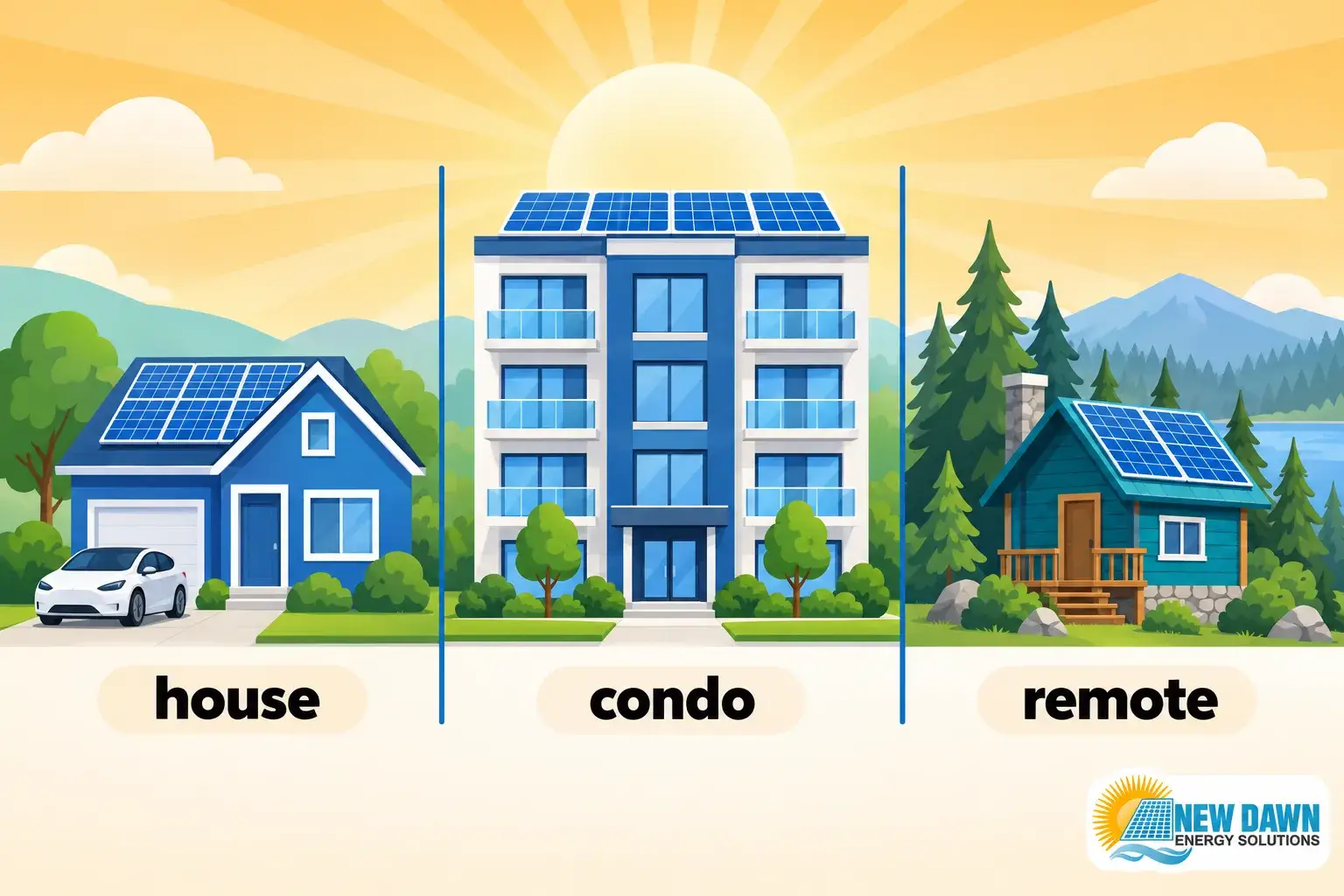
Shared buildings raise different questions. Quebec’s rules include multiplexes and residential buildings of up to 19 units. For a condo, eligibility depends on who owns the roof or installation surface, which meter serves the system and whether the program accepts one application for the whole building. British Columbia handles strata common-area accounts separately from individually metered homes.
Remote microgrids and off-grid homes
In British Columbia, a home in a remote microgrid community still needs an account with the participating utility and must meet that community’s connection rules. Single-family solar systems there are limited to 10 kW of installed DC capacity.
The system design is also restricted. A solar-only system can export power to the grid. A system with a battery must be non-exporting and can charge its battery only from solar energy. The utility reviews each connection individually and caps total self-generation at 15% of the community’s average load.
A fully off-grid home cannot count on rebates that require a grid connection. Instead, check programs that set separate requirements for off-grid systems, such as Yukon’s.
How do you secure and estimate your rebate?
The order of steps matters as much as the dollar amount. If you buy equipment too early, you can lose eligibility. If you rely on the advertised maximum, you may overestimate your payback period. Here is how to handle both.
Check the project before committing
The advertised maximum is not a guaranteed payment. Your actual rebate is limited by several caps at once. Before installing solar panels, calculate your amount against each of these limits:
- Installed capacity: the per-kW or per-watt rate multiplied by your system size.
- Percentage cap: for example, 50% of eligible costs in Ontario or 40% in Quebec.
- Absolute cap: often $5,000 CAD for the solar portion.
- Eligible costs: only the costs the program defines, not your whole project budget.
Your roof condition, angle and shading, along with your annual electricity use and electrical capacity, determine the right system size. At New Dawn Energy Solutions, we assess your roof and energy needs, then prepare a tailored proposal with cost and savings estimates. Export rules also affect the choice. Ontario’s net metering lets unused credits carry forward for up to 12 months, subject to the rebate condition described earlier. In British Columbia, new customers have been on a self-generation rate since July 1, 2026, which pays 10¢ CAD per kWh of surplus electricity.
Obtain approvals before buying or installing
In Ontario, your contractor first confirms that your household, property and grid connection are eligible. The contractor then sizes the load-displacement system and prepares the pre-installation application. You need written pre-approval from the program and approval from your local distributor before you buy or install anything.
In British Columbia, you submit a self-generation application and wait for technical acceptance before installing. The utility advises waiting for that acceptance before you buy equipment. Keep in mind that rebate pre-approval and electrical interconnection approval are two separate steps.
From June 1, 2026, British Columbia requires eligible projects to be designed and installed by a member of the utility’s designated contractor network. Self-installations do not qualify. Equipment must be new and purchased in Canada, and solar equipment must meet the required Canadian Standards Association certifications.
Complete installation and document the claim
In British Columbia, you need final inspection records, a paid invoice and interconnection approval to receive the rebate. Replacing an existing system does not qualify, but added capacity can. In Ontario, payment follows the municipal, distributor and electrical-safety approvals and the submission of post-installation documents. Our residential solar installation service in Ontario covers permits, installation and guidance on incentives. In Alberta, systems under 150 kW need a distributor connection, municipal permits and an interconnection agreement. They earn monthly credits at your retail rate through your retailer, which is separate from any installation grant.
Frequently Asked Questions
What solar incentives are available in Alberta in 2026?
Alberta has no province-wide solar grant. The Clean Energy Improvement Program provides financing in participating municipalities, repaid through property taxes over up to 25 years. Eligible seniors can get low-interest home-equity loans of up to $40,000 CAD for repairs and energy-efficiency work. The $100 CAD Alberta Energy Rebate, open from July 1 to September 30, 2026, helps with everyday essentials and does not cover solar.
Which types of homes qualify for Ontario’s solar and battery rebate?
Detached, semi-detached, row and townhomes qualify, as do mobile homes on permanent foundations. A typical project is 5–10 kW with a 13.5-kWh battery. The right size depends on your household’s electricity demand, and larger systems may need extra justification.
Can solar panels on a detached garage qualify for the British Columbia rebate?
Yes, if the system serves the primary residence through the same qualifying account and meter. A structure with its own separate meter does not qualify under the home’s rebate.