Most solar panel problems have a practical solution once you know whether the cause is weather, shade, dirt, damaged equipment or a fault in the electrical system. Reading the warning signs comes first, followed by checks you can safely do from the ground and hazards that call for distance, until our monitoring and maintenance team takes over diagnosis, repair and prevention.
Is the production drop a solar fault?
Not always. A dip in output can come from the sky, the seasons or the data feed as easily as from failed equipment. Start by separating normal variation from real solar panel problems.
Which changes are warning signs?
Patterns matter more than single readings. One low number does not mean you have a faulty solar panel. Passing clouds, snow, a low sun angle, inverter clipping (the inverter capping its own output) or delayed data can all create the same impression.
- Persistent sunny-day drop: output stays low for more than a few days when the weather does not explain it.
- New inverter error: a code or warning that was not there before.
- Repeated shutdowns: the system goes offline again and again.
- Recurring alerts: monitoring notices that keep coming back with no seasonal cause.
Check the units before you draw any conclusions. Instantaneous power is measured in kW, while energy produced over time is measured in kWh. A panel’s rated wattage comes from standard test conditions. It is not a promise of continuous production on a Mississauga or Markham rooftop.
Could weather, shade or dirt explain it?
Often, yes. Winter brings shorter days, a lower sun and snow cover, but your modules still generate electricity in cold weather. Compare January output in Newmarket or Aurora with past January results, not with a sunny day in July. Dips that repeat at the same time of day often point to new shading from a growing tree or nearby construction.
The impact of shade depends on how the array is wired, so a 10% shaded area does not mean a universal 50% loss of energy. Soiling also reduces efficiency. Pollen, bird droppings, leaves and stubborn grime build up over time, and severely dirty panels can produce up to 20% less electricity. Rain clears loose dust but often leaves stuck-on residue behind.
What do monitoring and bills show?
An app that shows zero production may simply be displaying stale data while your solar panel system is still running. Check the last-update timestamp and your internet connection first. Historical monitoring then shows whether you are looking at a seasonal swing or a lasting change in system performance, as explained in our guide to monitoring solar and battery systems.
For a well-functioning system, Natural Resources Canada gives an early-years annual performance ratio of 0.75–0.9. That ratio is not a percentage of rated power the panels must reach at every moment. A higher bill alone does not prove a fault either. Compare consumption, imports, exports, credits and billing periods with your generation history. Natural Resources Canada uses about 0.6% annual degradation and a service life of 25 years or longer as modelling benchmarks, not as predictions for a specific array.
How can you troubleshoot safely?
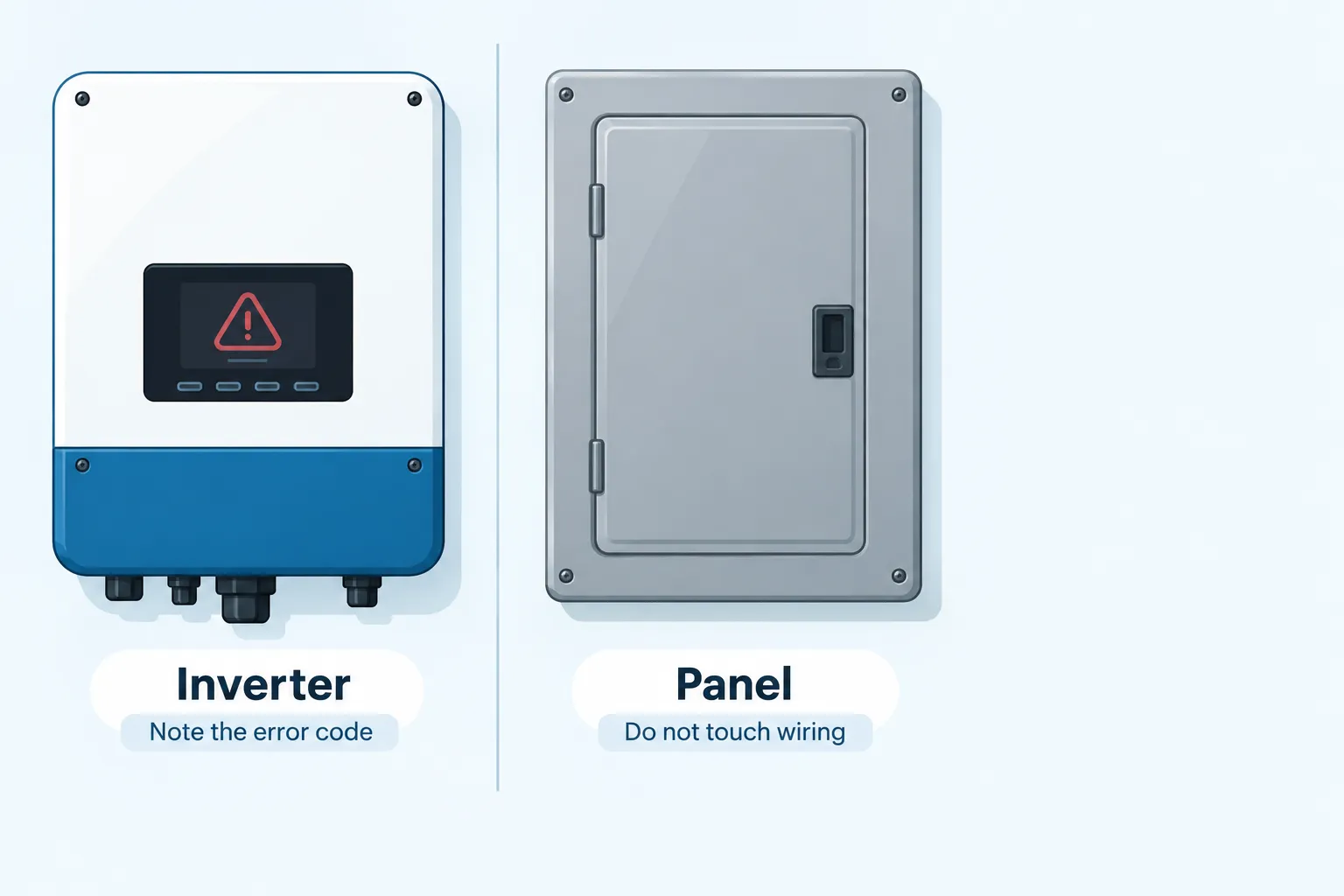
Safe troubleshooting means collecting information without touching anything electrical. Your notes, photos and production data help a technician tell whether the problem affects the whole system, a single string (a group of panels wired together) or only the communications link.
What can you check without roof access?
First, save your live and historical production, the times of any alerts and any zero-output readings. Compare them with days that had similar weather and seasonal conditions. Next, do a visual inspection from the ground and look for snow, leaves, fallen branches, new shade, cracked glass or mounting that has shifted. If you can reach the inverter display safely, photograph the exact error code, the warning lights and the time. Keep these photos with your weather notes and utility bills.
Are restarting and cleaning appropriate?
Sometimes, within limits. Resetting solar panels starts with knowing that the panels themselves have no universal reset button. An inverter, charge controller, battery or gateway may have its own restart procedure, and you should follow it only as far as the manufacturer allows.
- Outage first: if production stopped during a power cut, check your local electricity distributor’s outage information.
- Recovery sequence: once grid power returns, let the inverter run its manufacturer’s recovery procedure.
- Persistent fault: if production does not resume, record the message and report it.
- Cleaning limits: cleaning helps only when persistent soiling is reducing output. It cannot fix wiring or inverter faults.
Good solar panel maintenance follows the cleaning instructions for your specific solar modules. Avoid abrasive tools and pressure washers. Leave any cleaning that requires roof access to qualified workers.
Which actions and hazards require distance?
Some steps belong only to professionals. Ontario’s photovoltaic safety alert notes that residential arrays exposed to light can reach 600 V DC, even when the main breaker is off.
- Closed enclosures: never open an inverter, combiner box, disconnect, meter cabinet or battery enclosure.
- No probing: do not test any PV circuit with tools or meters.
- Connectors and devices: never unplug solar connectors while current is flowing, and never bypass a protective device.
- Tripping breaker: do not keep resetting it. A breaker that trips repeatedly needs professional investigation.
You can check from outside whether the inverter’s vents are blocked, as long as you do not touch any wiring. Stay away from exposed wires and damaged equipment. If you see fire or smoke, or face any immediate danger, move away and call 911.
What causes common solar system faults?
Faults usually fall into three groups: physical damage to the panels, electrical or inverter faults, and the effects of outages or batteries. Knowing which group a symptom belongs to tells you how urgent it is and who should handle it.
How do panels become damaged?
Common solar panel problems start with the weather. Hail, falling branches, wind-blown debris and heavy snow can crack glass or strain the mounting. Wildlife adds its own risks. Birds nesting under an array and rodents chewing cables can cause electrical or structural damage over time.
Micro-cracks in solar cells are often invisible from the ground, and daily heating and cooling can make them spread. In the research we cite, output stayed close to normal when cracks covered less than about 15% of a cell. A cell with about 20% cracking averaged 2.051 W, compared with 2.571 W for an undamaged reference cell. At 58% crack area, output fell to 0.9708 W.
A study on cell cracks and hot spots linked cracks covering 11%–34% of a cell with hot spots (small areas of overheating) and faster degradation. It did not show that these cracks create a fire risk. Snail trails on PV modules are thin, track-like discolourations that do not prove failure on their own. Bubbling, peeling or cloudy areas can signal delamination (layers of the panel separating) and moisture getting in. Only testing can confirm the effect on output.
What do electrical and inverter faults look like?
Wiring issues include damaged insulation, moisture, corrosion and loose connections. They can cause arcing, ground faults or a protective device that keeps tripping. Scorch marks, exposed wires and repeated arc-fault alerts call for a prompt professional assessment, not a DIY repair. A solar inverter converts the DC power from your panels into AC power your building can use. That is why inverter problems can stop usable output even in full sunlight. Persistent error codes may come from overheating, moisture, internal faults or disturbances on the grid.
Problems with solar panels that appear at the panel level can also start in an optimiser, a microinverter or the link that carries their data. Panel-level data, compared by a professional, can show whether a module is truly underperforming or a device has simply stopped reporting.
What changes during outages or battery faults?
A standard grid-tied system usually stops supplying AC power during a utility outage so it does not send electricity into the grid. Panels in sunlight can still produce DC power during that time. In this setup, having no backup power during an outage does not mean you have a faulty solar panel.
A solar battery provides outage power only when compatible isolation equipment, designated backup circuits and enough stored charge are in place. Watch for a battery that will not charge, drains quickly, overheats or shows alerts from its management system. First check the displayed settings. If the issue continues, arrange a professional diagnosis.
When is professional diagnosis and repair needed?
A technician should take over once your safe checks have ruled out weather, shade, dirt and data delays. From that point, accurate diagnosis needs test equipment, controlled electrical access and the right licences.
Which signs should prompt a service visit?
New Dawn Energy Solutions recommends a professional visit when output drops significantly with no explanation, when inverter warnings persist, or when alerts keep recurring after you have ruled out weather and seasonal causes. Some physical signs need prompt inspection:
- Cracked glass on any module.
- Burn marks near cables or connections.
- Shifted mounting or roof leaks under the array.
- Suspected pest damage to wiring.
Smoke, arcing or a burning smell are a different matter and call for the emergency steps described earlier. Our solar panel servicing guide for Markham covers these thresholds for homeowners.
How is a fault diagnosed and repaired?
A qualified technician first confirms the reported fault and checks for immediate hazards. Next, the technician reviews monitoring history, inverter logs, weather and utility events, and only then chooses which electrical tests to run.
Depending on the fault, professional troubleshooting can include inspecting enclosures and cables, AC/DC measurements, insulation-resistance testing, string comparisons, infrared imaging and I–V curve testing. An I–V curve test compares a panel’s electrical behaviour with its expected profile. Every result must be read against the sunlight intensity and temperature at the time of testing.
After a repair or replacement, the professional confirms that the system operates correctly, checks the protective functions and monitoring, records the test results and completes any required approvals. Only then does the system go back into service.
What affects Ontario repair and prevention plans?
Ontario’s Electrical Safety Authority (ESA) says almost all electrical work requires a notification of work, with an inspection where required. Circuit repairs need an appropriately licensed electrical contractor, not a general handyman or an owner acting as their own electrician. Toronto requires a building permit for PV collector areas larger than 5 m², but you should not assume that threshold applies in Vaughan, Brampton or Oakville.
| ESA 2026 Wiring Fee Guide item (effective 1 April 2026) | Fee |
| Minimum wiring-notification fee, subject to conditions | $92 CAD |
| New PV rated 10 kW or less, installed by a contractor | $336 CAD |
| Listed owner-installed category | $550 CAD |
None of these fees is a repair quote. For homeowners, New Dawn Energy Solutions recommends reviewing production every month and doing a visual check from the ground every six months. Where conditions justify it, clean once or twice a year. Follow your warranty instructions as part of your solar panel maintenance.
Industrial and institutional sites need a more structured plan. It can combine asset registers, alarm escalation, weather-adjusted monitoring, coordination with roofing work and risk-based electrical inspections. Our projects run from site assessment through each stage of the commercial solar installation process to monitoring and long-term maintenance.
Frequently Asked Questions
How can you get more energy from your solar panels?
Natural Resources Canada advises keeping panels free of shade, snow and dust, using safe methods. New Dawn Energy Solutions recommends trimming branches that reach over the array, because partial shade can cause disproportionate losses in systems without panel-level optimisers. Clean more often near trees, major roads or construction sites, and wash panels in the early morning or evening to avoid thermal shock on hot glass.
Should you clear snow off your solar panels in winter?
Usually not. Snow can stop generation for a while, but a week under snow does not necessarily mean the system has a fault. Let it melt or slide off on its own unless your installer recommends an approved, safe method. Never climb onto the roof or scrape the panels with hard tools. A ladder near an icy roof is a bigger risk than a few days of lost production.
How often should a professional inspect a solar system?
One professional visit a year is a reasonable starting point, but it is not a universal legal requirement. The right interval depends on the equipment instructions, how exposed the site is, the system’s condition, safety risks and how critical the system is to operations. New Dawn Energy Solutions recommends choosing the more cautious interval based on your property’s conditions and the manufacturer’s guidance.