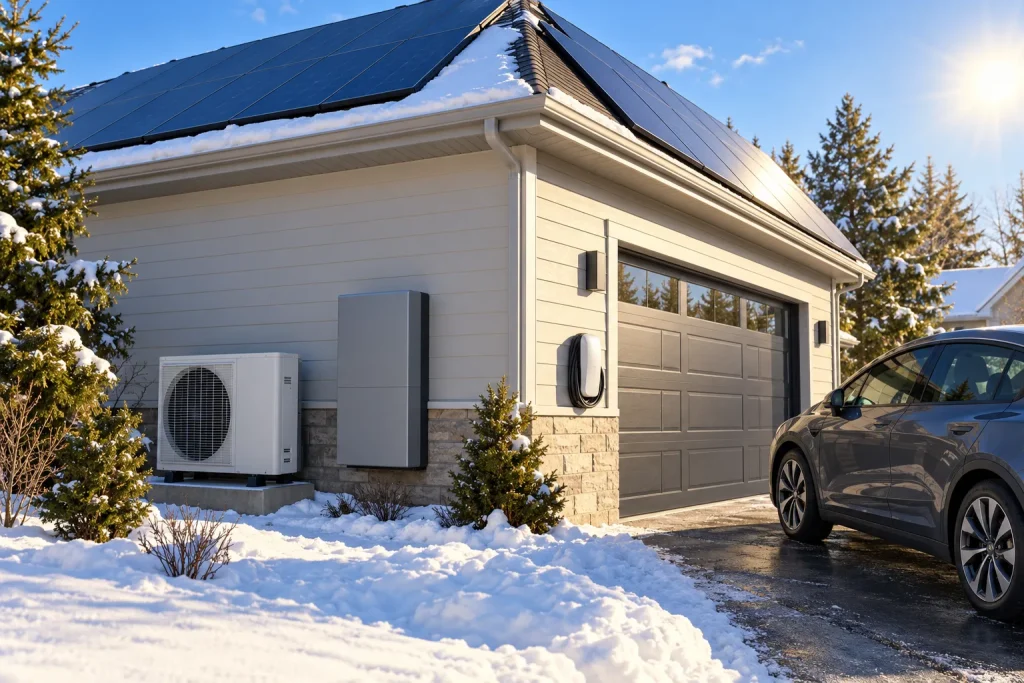
Yes. Some Canadian installers design and install solar panels, battery storage, EV charging and heat pumps as one integrated residential system, and New Dawn Energy Solutions is one of them. A sound result depends on how the array, charger and heat pump are sized and wired, how they behave in an Ontario winter, what they cost and which incentives currently apply.
Why design and size all four systems together?
An EV charger and a heat pump change how much electricity your home uses and when it uses it. Planning the solar array, the battery and the new loads as a single design avoids undersized equipment and surprise service upgrades.
One household electricity plan
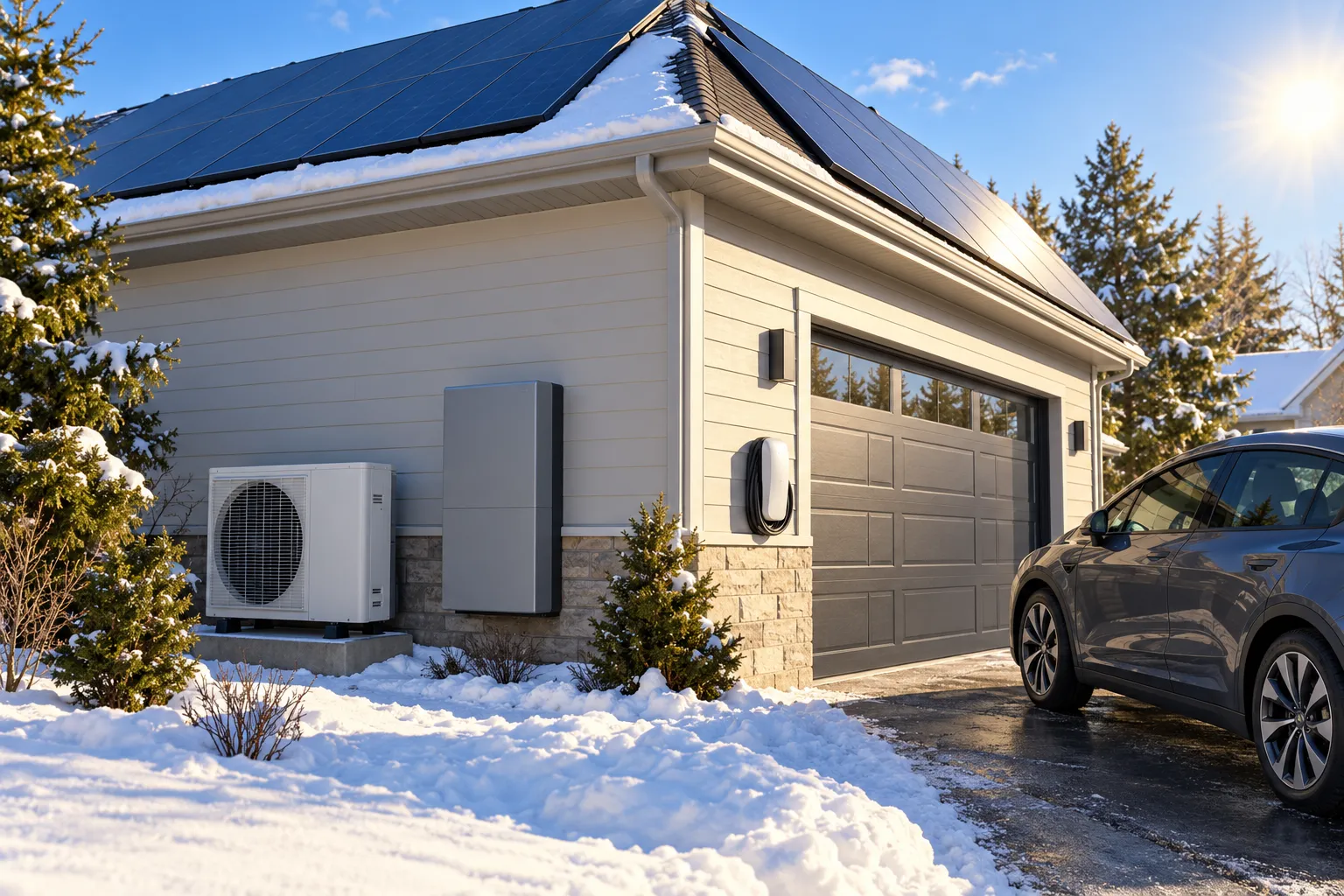
At New Dawn Energy Solutions, we design and install residential solar, battery storage, EV charging and heat pumps as one coordinated system. A home solar system turns sunlight into electricity through an inverter. The grid covers any shortfall and can receive permitted surplus, so even all four technologies together do not make a home grid-independent year-round.
The design starts with your real bills and any interval data from your utility. For assessing spare electrical capacity, BC Hydro recommends using 12 months of actual meter data, applied within the requirements of the electrical code.
Service capacity and managed charging
Before choosing equipment, assess the home’s heat loss, insulation, roof condition, shading, and the existing electrical panel and service. During a consultation, we evaluate roof size, tilt and sunlight to confirm that solar suits the property. An electrician’s load calculation then adds the heat pump, auxiliary electric heat, the EV charger and other major household loads.
No rule of thumb replaces that calculation: a 100 A service is not automatically inadequate, and a 200 A service is not automatically sufficient. Managed EV charging can pause or reduce charger output when other loads rise. What matters is whether the vehicle recovers the driving range you need during the hours it is parked.
Sizing annual demand and solar output
Future annual consumption equals your current use plus any EV and heat-pump electricity your bills do not already reflect, minus the savings from retiring less-efficient heating. EV demand comes from the vehicle’s energy-consumption rating multiplied by expected yearly mileage. A Québec-focused planning guide puts many drivers’ added use at about 2,500–4,500 kWh per year.
Solar output is estimated as array capacity times local yield. At a hypothetical 1,000 kWh per installed kW, a 10 kW array would produce about 10,000 kWh a year. Hydro-Québec estimates 1,200 kWh per installed kW in Québec, or roughly 6,000 kWh from 5 kW. Roof area and shade limit the number of solar panels, and monthly comparisons reveal winter deficits that annual totals hide. Our residential solar installation in Ontario follows this monthly sizing logic.
| Sizing input | Reference figure | Source or condition |
| Meter data for capacity review | 12 months | BC Hydro recommendation |
| Added EV demand | About 2,500–4,500 kWh/year | Québec-focused planning guide |
| Hypothetical yield example | 10 kW × 1,000 kWh/kW = 10,000 kWh/year | Illustration, not a site forecast |
| Québec average yield | 1,200 kWh/kW; about 6,000 kWh from 5 kW | Hydro-Québec estimate |
How does the integrated system work each day?
During the day, solar output first serves loads in the house. Surplus can go to the EV, a battery or the grid, and the grid fills any gap, especially in winter.
Can solar panels charge an electric car?
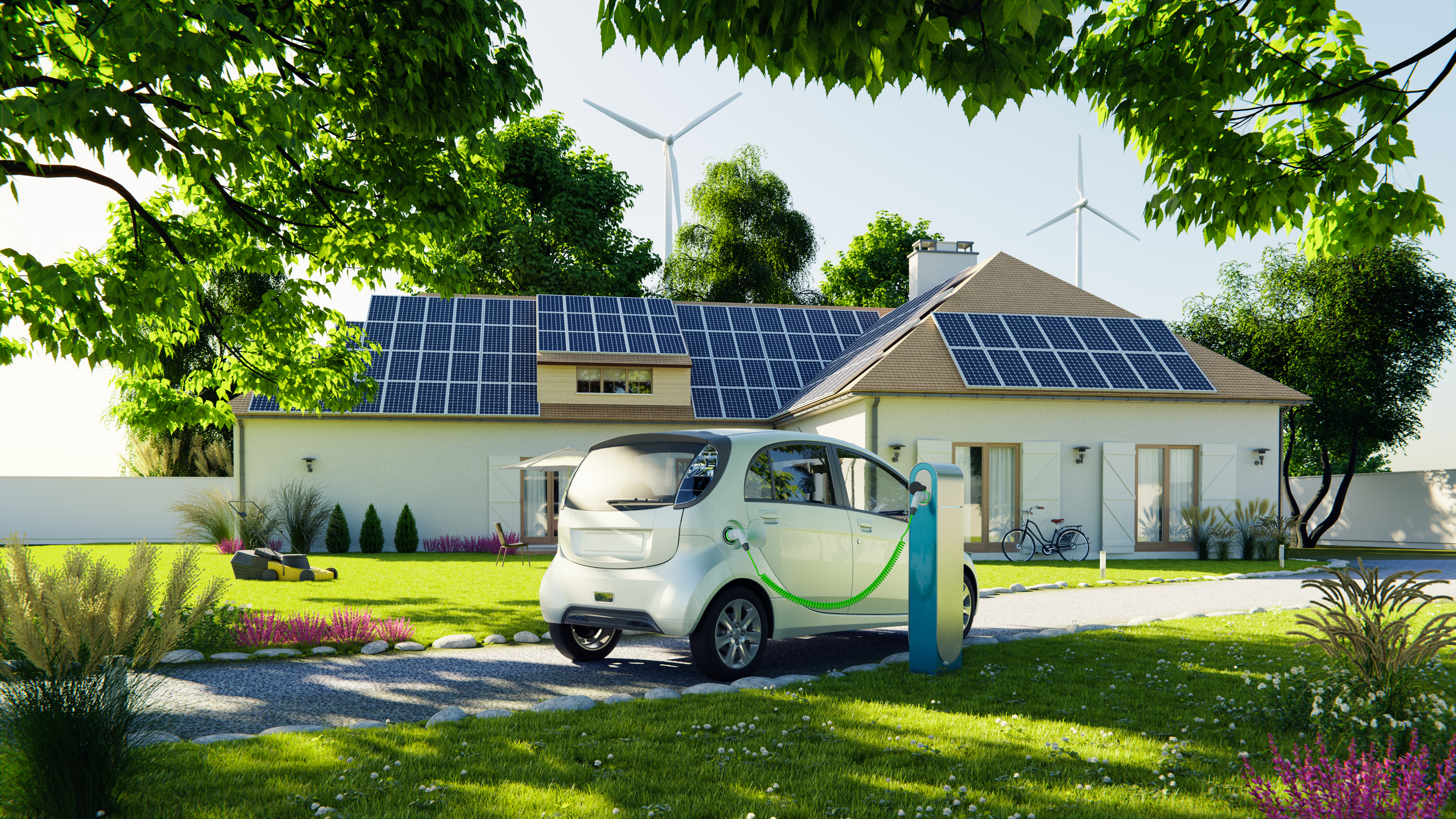
Yes. A rooftop array and inverter can feed a compatible home charger, with grid power covering any shortfall. We install residential charging stations and pair them with solar, and we are a certified Tesla EV-charging installer. The equipment choices are:
- Level 1: uses a standard 120 V household outlet and charges slowly.
- Level 2: uses a 240 V supply; the charger’s power and the car’s acceptance limit set the speed.
- Smart controls: schedule or modulate charging to match surplus generation.
Surplus-based charging works only while the vehicle is parked at home. Ordinary grid-connected charging does not need a home battery. Our home EV charging installations include chargers designed to work with rooftop solar.
Can solar power a heat pump in winter?
A heat pump moves heat into or out of the home rather than producing it. It uses solar energy when panels produce and draws from the grid when winter generation falls short. Cold-weather output, defrost cycles and auxiliary heat must be checked against the home’s heat-loss calculation. The cold-climate models we offer are rated to heat at outdoor temperatures as low as −25 °C.
For homes without ducts, additions, or rooms needing separate temperature control, we also install ductless mini-splits. Equipment selection should account for airflow, snow clearance around the outdoor unit and defrost drainage. Our heat pump installation for Ontario homes covers air-source, cold-climate and ductless options.
How Ontario rates affect operating costs
Under Ontario Energy Board energy rates effective November 1, 2025, Time-of-Use costs 9.8¢/kWh off-peak and 15.7¢/kWh mid-peak. On-peak reaches 20.3¢/kWh. Ultra-Low Overnight charges 3.9¢/kWh from 11 p.m. to 7 a.m. and 9.8¢/kWh weekend off-peak. Its mid-peak is 15.7¢/kWh, and weekdays from 4 p.m. to 9 p.m. cost 39.1¢/kWh. These prices exclude other delivered-bill charges.
Shifting 10 kWh from the overnight period to avoid weekday peak purchases creates a theoretical gross difference of $3.52 CAD. This is not a savings forecast. Battery losses and your home’s evening heating pattern change the real result.
What can the battery back up during outages?
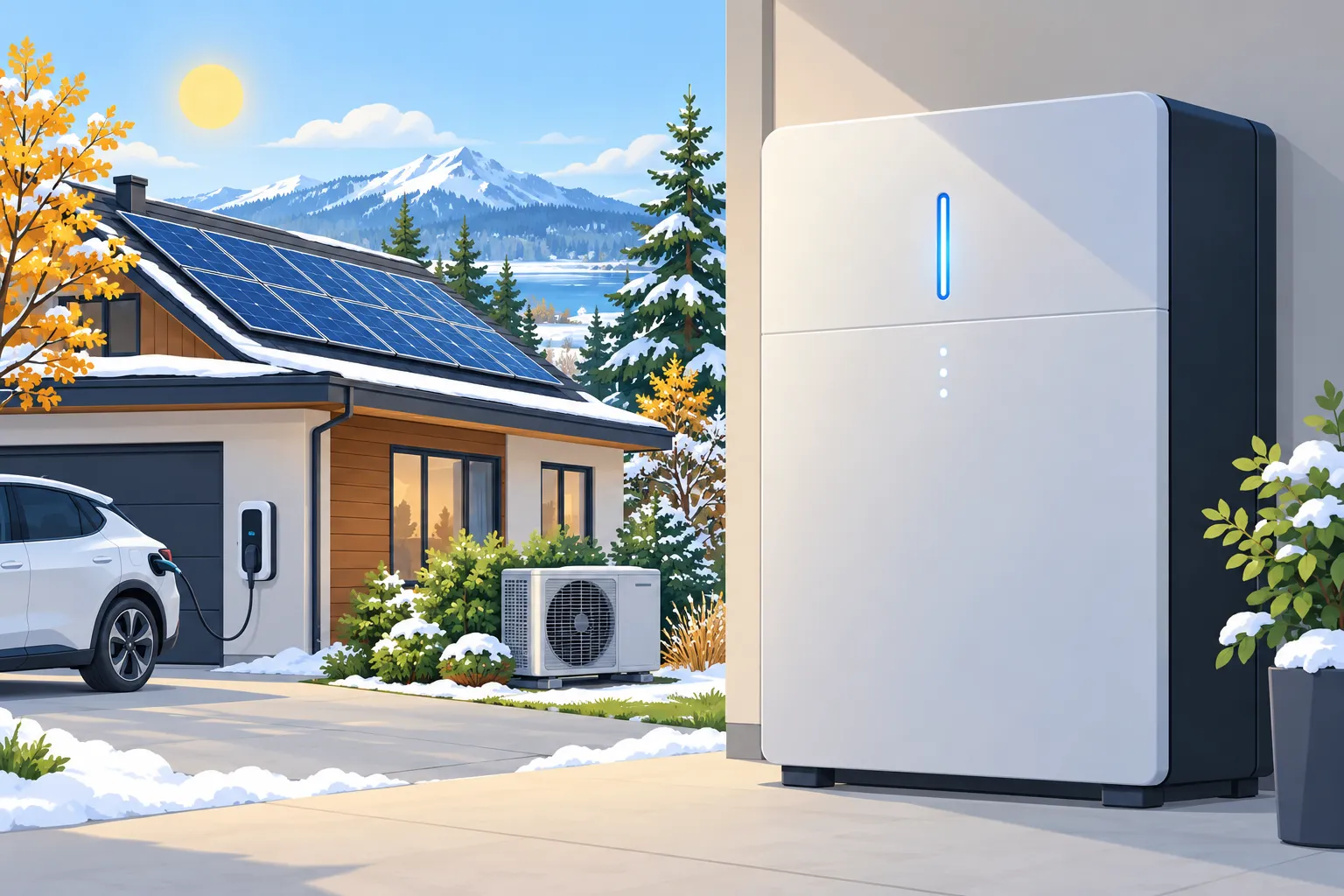
A battery stores electricity; it does not generate any. Its backup value depends on how much energy it holds, how much power the inverter delivers, and how the system isolates from the grid.
Energy and inverter limits
Backup energy is calculated by multiplying each selected load’s average power in kW by its operating hours. Essential loads averaging 1 kW for 12 hours need 12 kWh delivered.
That is why a nominal 12 kWh battery can fall short. Three factors reduce what it actually supplies:
- Usable capacity: not all nominal storage can be discharged.
- Conversion losses: part of the stored energy is lost through the inverter.
- Reserve settings: a held-back reserve is unavailable to loads.
Energy capacity does not determine simultaneous power. The inverter must also handle the combined load of selected circuits and the starting surge of motors such as a compressor.
Islanding and solar recharging
During an outage, backup equipment must isolate the home from the utility grid before energizing any circuit. Ordinary grid-dependent solar shuts down when the grid fails. Whether panels can recharge the battery depends on the inverter, battery and backup architecture.
Vehicle-to-home backup requires a compatible bidirectional vehicle, charging equipment and controls. An ordinary EV charger does not replace a stationary battery.
Choosing and testing backup circuits
Essential-load backup can cover refrigeration, selected lighting, communications, receptacles and suitably sized heating or water-pump circuits. Your installer should identify the heat-pump compressor and auxiliary-heater circuits, and state whether EV charging is allowed during an outage, since electric heat and charging drain storage fast. A one-line diagram and commissioning test should confirm the setup, as on the solar-plus-storage system we installed in Richmond Hill for outage backup.
How should homeowners choose an integrated installer?
Four technologies mean four trades, several approvals and one shared electrical service. The right installer makes responsibility for each piece explicit in writing.
One accountable project team
We cover assessment, design, permits, installation, monitoring and long-term maintenance, and you should still confirm which services and warranties a residential proposal includes. Reading installer reviews helps, but a review score cannot establish expected production or backup duration. Check that the proposal documents:
- Licensed electrical work: who performs it and who signs off.
- Array and inverter configuration: capacity, layout and backup mode.
- EV load management and heat-pump controls: how loads share the service.
- Panel or service changes: any upgrade and the backed-up circuits.
Roof work, heat-pump installation, commissioning and after-sales support should also carry a named owner before work begins.
Permits and electrical inspection
Ontario’s Electrical Safety Authority (ESA) says almost all electrical work requires a notification before it starts. The ESA issues a Certificate of Acceptance once the work passes inspection.
The ESA’s minimum residential notification fee is $92 CAD, effective April 1, 2026. It is a floor, not the total inspection cost of an integrated project.
Pairing solar with an EV charger and a heat pump in Ontario involves separate electrical, municipal and utility approvals. Ask that your proposal names who obtains each one and delivers the final records.
Utility connection and export
Ontario net metering begins with an application to your local distributor before you buy or install generation. Local distribution or export limits can restrict that approval.
Surplus credits can carry forward for up to 12 months, while fixed charges stay payable.
An Ontario Energy Board amendment dated December 18, 2025 raises the micro-embedded generation threshold to 12 kW effective May 1, 2026. This is a connection class, not a recommended array size.
What do projects cost and which incentives apply?
Integrated projects vary too much for one headline price. A clear budget and a verified incentive plan matter more than a quick estimate.
Build an itemized CAD budget
No single installed price in CAD describes every project. Energy demand, roof work, electrical service, outage goals and utility requirements all change the scope. Ask for an installation quote that separates:
- Roof and mounting work: racking, repairs and structural items.
- Panel or service changes: upgrades and cable runs.
- Heat-pump distribution work: ducting or mini-split line sets.
- Backup equipment, permits and commissioning: transfer gear, approvals and testing.
Ontario’s general HST rate is 13%. Do not assume an exemption for equipment retrofitted to an existing home.
Ontario upgrade incentives
Ontario’s Home Renovation Savings solar stream lists up to $5,000 CAD for panels, at $1,000 CAD per installed kW. Support is capped at 50% of eligible costs.
Paired battery storage can add up to another $5,000 CAD, at $300 CAD per kWh, under the same 50% cap.
That solar-and-storage stream bars the same project from a net-metering agreement. Heat pumps are also an eligible category, so verify measure-specific rules and application order before work begins.
Current federal program limits
The Canada Greener Homes Grant is closed; December 31, 2025 was the final documentation deadline for existing participants. The Canada Greener Homes Loan stopped taking applications on October 1, 2025, so its former offer of up to $40,000 CAD interest-free over 10 years is no longer available.
The Greener Homes Affordability Program, announced September 12, 2025, uses provincial or territorial delivery and direct installation for eligible lower- and middle-income households. We help homeowners identify the incentives and financing that actually apply to their project.
Frequently Asked Questions
Can a home solar system run a heat pump through a Canadian winter?
Partly. Solar produces more in brighter months, while heating demand peaks in winter, and short days, snow and clouds widen that gap. A battery shifts energy within a day but cannot cover a shortfall lasting weeks. Where comfort allows, some heating or hot-water production can move toward sunny or lower-rate hours.
Can solar panels charge an EV if the car is away from home during the day?
Direct solar charging only happens while the car is parked at home in daylight. A vehicle away during the day will generally charge at another time or from the grid. Before choosing a charger, check connector compatibility, charging power, the vehicle’s acceptance limit and whether controls respond to solar surplus.
Which Ontario electricity price plan suits a home with an EV and a heat pump?
Ultra-Low Overnight can favour EV charging that waits for the overnight window, but heavy weekday-evening heating may outweigh that benefit. Tiered pricing was 12.0¢/kWh and 14.2¢/kWh at Ontario Energy Board rates effective November 1, 2025. The OEB advises comparing plans against your own consumption pattern, and you can switch through your utility.