Choosing a solar contractor in Ontario starts with proof: a verifiable ESA electrical licence, comparable local projects, and a written turnkey scope covering design, permits, inspection and grid connection. After that, compare itemised quotes, warranties, financing terms and rebate advice side by side.
Which credentials and experience should a contractor prove?
Choosing solar is first a decision about accountability. Many solar companies sell systems, but the firm that holds the licence, carries the insurance and signs off the work is the one you rely on for the life of the system. Check the electrical licence, the engineering and the site-safety coverage before you look at panel brands.

Verify the electrical contractor
Electrical work done for hire in Ontario must generally be carried out by an Electrical Safety Authority (ESA) Licensed Electrical Contractor. A salesperson’s word is not proof. Look the firm up in ESA’s contractor lookup, which shows its ECRA/ESA licence status.
That licence has requirements behind it. ESA requires the firm to have a Master Electrician relationship and at least $2 million CAD in public-liability and property-damage insurance.
The company selling the system is not always the company wiring it. Ask which legal business signs your contract and which firm does the electrical work. Then get a current insurance certificate for the firm actually doing the work, with coverage for roofing, structural work and subcontractors.
Check engineering and site-safety responsibility
Structural and electrical design should carry a name. If a bidder offers engineering to the public, check the named professional engineer and the firm’s authorization with Professional Engineers Ontario.
Roof work brings its own risks. Ask each contractor and subcontractor involved for a current Workplace Safety and Insurance Board (WSIB) clearance. Then confirm in writing who is responsible for fall protection, roof protection and any property damage.
Certificates from other countries do not replace local licensing. The Canadian Renewable Energy Association states that NABCEP certification is not required in Canada and does not stand in for an Ontario electrical contractor licence.
Test experience against comparable projects
Ask how long the solar installer has worked in solar and how many comparable Ontario installations it has finished. Ask for recent references you can contact, ideally for a similar roof, system size and use in your municipality and distribution territory. Ask those references about leaks, permit delays, real versus modelled production, monitoring faults and warranty response. Online reviews and photos do not prove workmanship.
Relevant experience among Toronto solar companies should be something you can check. Our own work at New Dawn Energy Solutions includes a 100 kW east–west array on a Toronto flat roof, completed in December 2020, an office-roof installation at 60 Mobile Drive in Toronto, and a residential solar-and-storage project in Richmond Hill. Hold all solar panel installers, ourselves included, to the same standard of proof as you move toward renewable energy.
What should installing solar in Ontario include?
A turnkey scope covers each stage from start to finish: feasibility, design, utility application, permits, installation, inspection, grid-connection authorization, commissioning and monitoring handover. If a stage is missing from the proposal, someone still has to handle it, and that is usually you. Check every stage below against each bid.
Assess the site and design the system
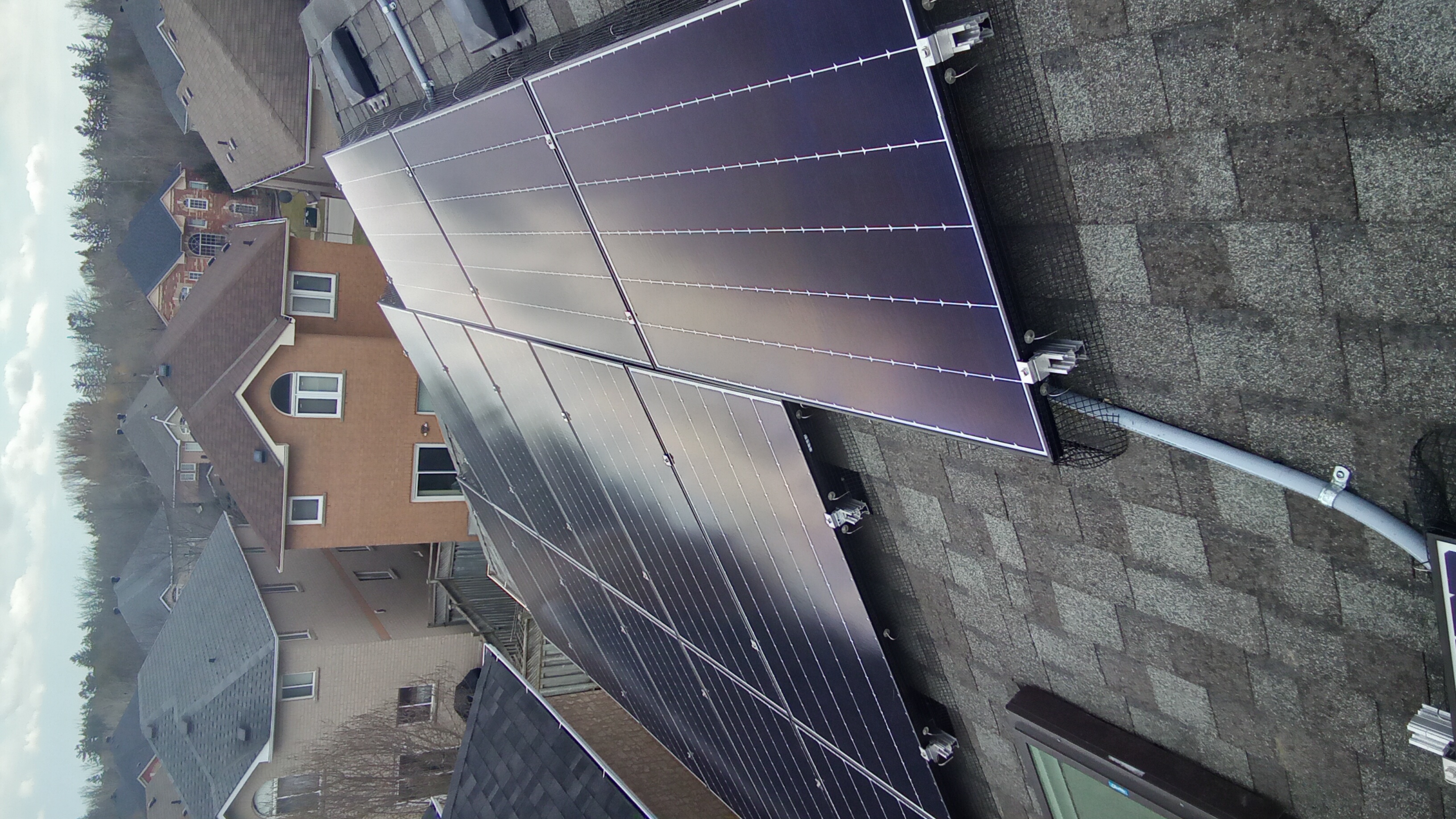
Accurate sizing starts with real data. Give every bidder 12 consecutive months of electricity use in kWh, and mention planned heat pumps or EV charging. A business should also share its operating hours and daytime demand. A proper rooftop assessment looks at usable area, orientation, tilt, shade, obstructions, roof condition, framing, structural capacity, attachments and waterproofing. A rural building may need an engineer to review its full load path.
Solar installation in Ontario should produce design documents you can compare. Ask for a dimensioned layout and a single-line electrical diagram, which is a simplified drawing of how the system connects to your panel. The quote should list DC array capacity, inverter AC capacity and battery capacity separately, so the system size is clear. The electrical contractor should also check panel space, service limits, grounding and conductor routes.
Secure utility and municipal approvals
Your local distribution company (LDC) controls interconnection, meaning permission to connect to the grid. For a net-metering system, get its approval before you buy or install equipment. A submitted application or a capacity-map result does not give you permission to connect. Ask the contractor what happens if the utility requires a smaller system, an export limit or a network upgrade, or refuses the connection.
The utility process can involve technical drawings, equipment specifications, studies, an offer to connect, agreements and meter work. Hydro One lists $3,762.74 CAD including HST for a connection impact assessment in its Small Projects Net Metering category. That amount pays for the study only. It is not a standard charge for household solar.
Municipal permits are a separate requirement from utility approval. Toronto requires a building permit for rooftop or wall-mounted solar collectors over 5 m² (about 54 sq. ft.), supported by structural plans, calculations and product specifications. Toronto’s permit fees for solar panels, effective 1 January 2026, are $214.79 CAD for a qualifying small-residential installation. Other building types pay $425.30 CAD per structure.
Complete electrical inspection and handover
The licensed electrical contractor should file the ESA Notification of Work before electrical work begins. It then arranges the inspection, fixes any deficiencies and gives you the final ESA Certificate of Acceptance. The 2026 ESA Wiring Fee Guide, effective 1 April 2026, lists $336 CAD for a contractor-installed photovoltaic project of 10 kW or less. The 2024 Ontario Electrical Safety Code, 29th edition, took effect on 1 May 2025.
ESA acceptance, any required municipal sign-off and the LDC’s permission to operate are three separate milestones. The system should not run in parallel with the grid until all of them are complete. At New Dawn Energy Solutions, our turnkey residential solar service for Ontario homes starts with a consultation and a custom proposal, and we handle permits and installation. That way, permits and installation for your Ontario solar project stay with one firm.
How should you compare proposals and long-term value?
Two proposals can show similar totals and still describe different projects. Comparing value means looking at the same scope, the same consumption data and the same assumptions. Then you can weigh equipment, production, warranties, backup and support. Each check below helps you compare offers on equal terms.
Compare like-for-like quotes and financing
Ontario’s consumer guidance recommends getting three written estimates for home renovations. Make each solar bid site-specific and based on the same annual electricity use and scope. Compare the total installed cost before HST and incentives, itemised across equipment, roof and electrical work, engineering, permits, utility work, monitoring, allowances and exclusions. A common Canadian residential range is $2.50 to $3.50 CAD per installed watt, but it does not replace a quote for your roof.
- Purchase or loans: you own the system; compare interest rates, maintenance obligations and what happens if you sell the property.
- Lease or power-purchase arrangement: a third party owns the equipment; check escalation clauses, transfer on sale and early-termination terms.
- Sales tax: Ontario HST is 13% on taxable supplies, and a GST/HST-registered business may qualify for input tax credits under Canada Revenue Agency rules.
Your financing options change the true upfront cost and how your solar savings build over time. We price outright and financed purchases of solar and storage, and our guide to estimating solar savings and payback recommends using the quoted price, not an average, to estimate costs and payback.
| Item to compare | What the quote should state |
| System capacity | DC array kW, inverter AC kW and battery kWh, listed separately |
| Installed cost | Total in CAD before HST and incentives, itemised |
| Reference price | $2.50–$3.50 CAD per installed watt, compared only after scope differences are identified |
| Tax | 13% HST shown on its own line |
| Exclusions | Roof repairs, service upgrades, utility studies and allowances |
Examine equipment, output and warranties
Ask for exact manufacturers, model numbers, quantities and ratings. Then confirm that the products delivered carry an Ontario-recognized electrical approval mark or an appropriate field-evaluation label. Compare monthly solar production estimates and the assumptions behind them: weather, shade, snow, inverter losses and degradation. Toronto’s solar map uses 1,150 kWh per installed kW per year as a modelling reference. It does not guarantee the output of a particular roof, especially in winter.
Warranties work best when you read them as separate documents. Compare the module product and performance warranties, inverter, battery, mounting and roof-penetration coverage, and the installer’s workmanship warranty. String-inverter warranties generally run 5 to 12 years, while panels are designed to last at least 25 years. For that reason, we recommend budgeting for at least one inverter replacement and getting labour terms in writing.
Define backup and after-sales support
A standard grid-tied solar panel system shuts down during an outage unless it has suitable storage and controls. A battery proposal should list the backed-up circuits, usable capacity, isolation arrangement and expected backup functions. We price battery storage separately from the panels. Our battery energy storage service for homes and businesses begins by assessing your loads and backup needs.
Before final acceptance, collect the as-built drawings, equipment serial numbers, final approvals, commissioning results, shutdown instructions, warranty documents and monitoring access in an account you control. Ask who handles inverter errors, investigates underperformance and arranges repairs, and what monitoring subscriptions or gateways cost. Routine care can include checking production, inspecting for damage and dealing with dirt, snow or vegetation when needed, which helps keep your electricity bill savings on track.
Which rebate and credit rules must installers explain?
Incentive programs can reduce the cost of a project, but only when the system meets their rules. A good contractor explains which programme applies to your property, what approvals are needed and in what order. A contractor who mixes up those rules can leave you with a smaller rebate or none at all.
Is Ontario giving solar rebates?
Yes. Ontario’s Home Renovation Savings offer lists $1,000 CAD per kW DC for eligible rooftop solar. The rebate is capped at $5,000 CAD and at 50% of eligible solar costs.
Storage has its own stream. A qualifying battery paired with new rooftop solar can receive $300 CAD per kWh, up to $5,000 CAD and 50% of eligible battery costs. A stand-alone battery is not funded.
Timing matters as much as eligibility. You need written programme pre-approval and LDC approval before you buy or install anything. The October 2025 requirements call for new, participant-owned equipment purchased in Canada and installed by a licensed electrical contractor. Ground-mounted systems, expansions, rentals and leases are excluded.
Distinguish rebates from net-metering credits
Ontario net metering gives you bill credits, not cash, for eligible excess electricity sent to the grid. Unused credits carry forward for up to 12 months, then expire. They do not offset every charge on your hydro bill; fixed monthly service charges are one example.
The two benefits do not combine. A quote should never pair the Home Renovation Savings solar rebate with net-metering credits on the same rebated system, because that programme requires load displacement with no LDC net-metering agreement. For condos and multi-unit buildings, Toronto guidance allows one net-metering application per meter, with no meter aggregation. Confirm who controls the roof and which meter benefits before accepting a household-style proposal.
Check business eligibility and current programmes
A small business should not assume a household offer applies to it. Your contractor should review your meter, tariff, daytime load and interconnection category first. Save on Energy’s business Retrofit measures list $1,000 CAD per kW DC for qualifying microgeneration at or below 10 kW DC. Systems above 10 kW AC receive $770 CAD per kW AC, down from $860 CAD effective 30 June 2026. Note that the DC and AC rates use different units. Projects need pre-approval and have 24 months to finish.
Some federal programmes have closed. According to Natural Resources Canada, new Canada Greener Homes Grant applications ended in February 2024, and new Canada Greener Homes Loan applications closed on 1 October 2025. At New Dawn Energy Solutions, we help clients identify and apply for grants and incentives. We confirm that a programme is open and that you qualify before subtracting any solar rebate from the projected cost.
Which red flags and questions decide the hire?
Most bad outcomes can be spotted before signing. They show up as missing names, missing documents and promises the equipment cannot keep. Use the warning signs and questions below to narrow your list to finalists you can hold accountable.
Walk away from missing accountability
Pause if a bidder cannot name a licensed electrical contractor you can verify, or asks you to file the ESA notification for work you are paying them to do. Check every proposal for these other gaps too:
- No site assessment: the price was set without an on-site visit and without roof findings.
- Vague equipment: no exact models or production assumptions are given.
- Unassigned costs: nobody is named in writing as responsible for permit and utility fees.
- Unnamed subcontractors: the agreement does not say who handles applications, inspections, corrections, change orders and payment milestones.
Any one of these gaps means a cost or a delay could become your problem later. Ask for the missing details in writing before you compare prices.
Challenge sales and contract claims
Be cautious of guaranteed bill elimination, guaranteed winter output, or outage backup without the equipment specified. A long panel warranty does not say who diagnoses faults, removes panels for roof repairs or fixes leaks. Those duties belong in the written contract.
Consumer protections have limits. Ontario’s 10% estimate limit applies when an estimate is included in a consumer agreement, though the price can change if you request and agree to additional or different work. The 10-calendar-day cooling-off guidance covers qualifying home-renovation contracts signed in the home. It does not automatically apply to business purchases.
Ask every finalist these questions
Who signs the contract, who does the electrical work, who designs the system, and who is responsible for roofing, subcontractors and final approval documents? When will utility approval be sought, and who pays for studies or upgrades? For special properties, ask how they will be handled: the owner of a tenanted home must apply under the provincial offer, a rural building may need structural review, and a condo needs roof-control and meter-benefit confirmation. Compare the answers in writing alongside the quotes.
Frequently Asked Questions
What details should you check in each solar warranty before signing?
Check when each warranty starts, whether it transfers to a new owner, and what it excludes. Confirm the remedy and whether labour, freight and access equipment are covered. Also find out who handles a claim if the installer goes out of business.
Does wall-mounted solar still qualify for Save on Energy business incentives?
No. Wall-mounted solar stopped qualifying for the Save on Energy prescriptive offering on 29 May 2026.
How can you tell whether a new solar system is underperforming?
Compare actual production with the agreed estimate, allowing for weather and snow. One cloudy month does not prove there is a defect. Confirm who responds to inverter errors and investigates underperformance, and what monitoring subscriptions or gateways cost.