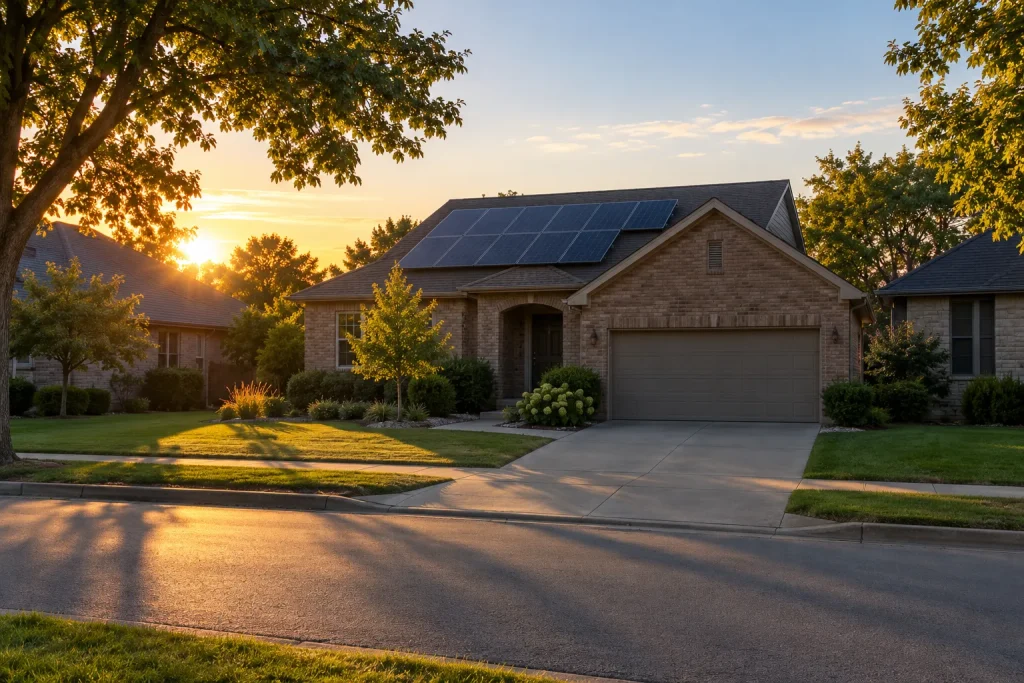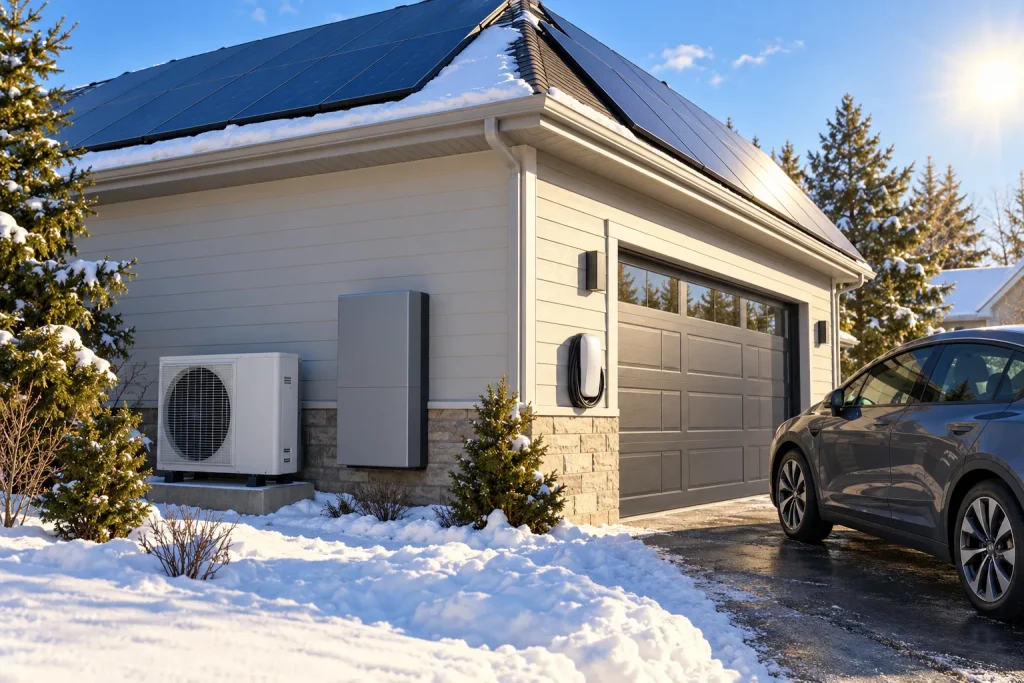
Will your solar panels work during a power outage in Canada? Standard grid-tied systems shut down when the grid goes dark, even at noon. Keeping power flowing takes compatible battery, inverter and isolation equipment, sized for how long you need backup and properly approved and tested.
Why solar panels stop powering homes during outages
Daylight on your roof does not guarantee electricity in your kitchen. The shutdown comes from how a standard installation interacts with the utility, and it protects people working on the lines. Knowing both sides helps you judge what your current system can and cannot do.
What happens when grid power fails?
On a normal day, a grid-tied solar home uses its own solar energy, exports excess solar generation and draws grid power when production falls short. Once the utility goes down, the panels can still produce DC electricity in sunlight. A standard grid-connected solar inverter, however, stops supplying ordinary household circuits.
The reason is technical. A conventional inverter relies on the utility grid as its stable voltage and frequency reference, and panels alone cannot create a regulated household power supply. Saskatchewan’s utility states that a net-metered generation system shuts down during an outage. Your solar system restarts only after utility power returns and its reconnection conditions are met.
Why is the shutdown necessary?
Anti-islanding is a safety feature built into grid-following inverters. It prevents a connected electrical system from energizing utility lines that utility workers expect to be dead during a blackout. The inverter monitors utility voltage and frequency, and it disconnects as soon as either falls outside permitted operating conditions.
Outage-capable installations solve this differently. They first isolate protected household circuits from the utility lines, then establish a local supply. Never override a solar inverter’s protective shutdown, and never energize household wiring through an ordinary wall outlet.
Which setups provide backup power during outages?
Several designs can deliver backup power, and each relies on different equipment. Grid-tied systems with storage, battery-free arrangements, off-grid systems and fuel-powered generators all behave differently when the utility fails. Matching the design to your needs starts with understanding what each one requires.
Solar storage, inverters and isolation
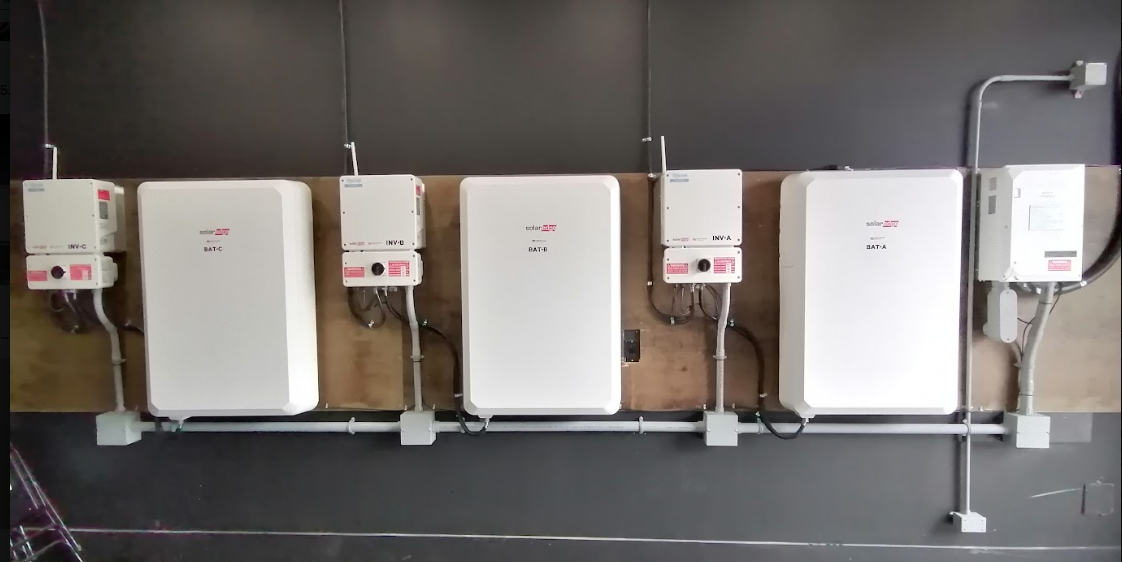
A solar battery with backup power functionality needs three elements: compatible storage, an outage-capable inverter and approved isolation or transfer equipment. Battery storage installed only to shift electricity use does not necessarily provide outage protection. Once isolated, the battery can supply critical loads or, with sufficient capacity, a larger share of the home. Compatible controls may also let the solar array serve loads or recharge the battery while the grid is down.
Equipment labels deserve scrutiny. A hybrid inverter coordinates solar, battery and grid energy, yet the word “hybrid” alone does not confirm islanded operation. The same applies to an Emergency Power Supply (EPS) function: check it against the equipment’s actual backup configuration before you rely on it.
Battery-free, off-grid and generator options
Not every outage solution centres on a grid-tied battery. Three other approaches exist, each with clear limits:
- Grid-forming microinverters: a specialized arrangement can supply prioritized loads without a battery when solar production is sufficient, but output drops in weak sunlight or under excessive demand, and it provides no solar power overnight.
- Off-grid systems: independent of the utility, they avoid the grid-tied shutdown, though their supply still depends on sunlight, stored energy and equipment capacity.
- Fuel-powered generator: it extends backup while fuel lasts, but needs maintenance and an approved home transfer panel and switch.
Generator placement is a safety matter. The Government of Canada advises placing portable fuel-burning generators at least 6 m (20 ft) from buildings, with exhaust directed away from doors, windows and other openings.
Adding backup to an existing installation
Many existing solar systems can be retrofitted with storage. Compatibility between the inverter, array, service panel and battery must be assessed, not assumed. A retrofit assessment identifies the appliances and circuits to protect, then confirms whether you need a new inverter, isolation equipment, additional controls or an essential-loads panel.
At New Dawn Energy Solutions, we design solar- or grid-charged battery systems for selected loads or whole-home backup, with automatic outage switching where the approved design permits it. Our battery energy storage systems in Ontario can also manage charging and discharging around time-of-use rates, so your investment delivers energy savings between outages.
How long will battery backup run your home?
Runtime depends on two separate numbers: stored energy and output power. Mixing them up leads to an undersized system.
Capacity, output and estimated runtime
Usable battery energy, measured in kilowatt-hours (kWh), governs runtime. Inverter continuous and surge output, measured in kilowatts (kW), decides which appliances can run or start. A basic estimate of how long a solar battery will last during a power outage divides usable kWh by the average supported load in kW, before losses and shifting demand.
The table applies that formula, ignoring additional losses.
| Average load | 5 kWh usable battery | 10 kWh usable battery |
| 200 W | About 25 hours | About 50 hours |
| 500 W | About 10 hours | About 20 hours |
| 1,000 W | About 5 hours | About 10 hours |
| 2,000 W | About 2.5 hours | About 5 hours |
Usable energy is lower than nameplate capacity. In a hypothetical calculation, a 13.5 kWh battery with a 90% usable-energy allowance provides 12.15 kWh. That covers about 24.3 hours at a 500 W average load. At 2 kW, it drops to roughly 6.1 hours, before other losses, reserve settings and load variation.
Essential circuits or the whole home?
An essential-loads panel concentrates battery power on the circuits that matter most instead of every circuit in the house. Common candidates include:
- Refrigeration: compressors draw a starting surge above their running power, which the inverter must handle.
- Lighting and internet: selected lights and communications equipment keep your household informed and safe.
- Heating controls: furnace controls stay powered so the heating system can operate.
- Pumps and medical devices: sump or well pumps where needed, plus medical or accessibility equipment.
Whole-home backup makes more circuits available but does not remove power or runtime limits. Electric heating, cooking, water heating, clothes drying and EV charging sharply increase the energy and inverter output required. As one project-specific example, the City of Toronto paired a 10 kW solar PV installation with 27 kWh of storage, designed to serve its critical loads for at least 20 hours from stored energy alone.
Nights and Canadian winter conditions
Solar panels provide no meaningful electricity after dark. Backed-up loads then depend on stored energy or another properly integrated source. You can also set the battery to reserve stored solar energy for outages instead of cycling it daily, an option available in our solar battery storage system configurations.
Replenishment after a storm is less predictable in winter. Short days, cloud, shading, snow-covered panels and higher heating demand all limit recharge. Cold alone does not stop photovoltaic generation, but battery charging and operation have temperature-dependent limits. The Government of Canada recommends being ready to manage without normal services for at least 72 hours, a preparedness target rather than a promise of runtime.
How to plan and install outage backup in Canada
Reliable solar battery backup is designed, approved and tested, not simply plugged in. A turnkey installation covers three stages: defining your loads, securing approvals and commissioning the system. Each stage protects your safety.
Define loads and choose compatible equipment
Sizing starts with your household, not with panel count or a generic battery size. Work through these four inputs before comparing equipment:
- Circuits to protect: list what must keep running during an outage.
- Daily energy use: estimate the kWh those circuits consume per day.
- Simultaneous and starting power: check what runs at once and which motors surge on start-up.
- Outage duration: choose how many hours or days you want to cover.
The site comes next. The existing solar inverter, electrical service, panel layout and proposed battery location should be reviewed before choosing a compatible battery system and deciding whether protected circuits need a separate panel.
We assess your electrical loads and backup needs before designing and quoting a tailored system. A written design can specify supported circuits, usable battery energy, continuous and surge ratings, and expected runtime under stated load and winter-recharge assumptions.
Secure electrical and utility approvals
Installation must follow the locally adopted Canadian Electrical Code, Part I, including its Section 64 requirements and provincial amendments. CSA C22.3 No. 9-2020 addresses how distributed energy resources interconnect with the grid. Permits, inspections and utility approval then depend on your province, utility and configuration.
Approval of grid-connected generation does not itself approve the physical backup installation. In Ontario, the Electrical Safety Authority issued Bulletin 64-8-2 in May 2024 on residential battery storage, covering location, separation, working space and capacity-related requirements. BC Hydro likewise limits outage backup to approved battery configurations whose wiring and commissioning support it.
Test transfer, recharge and restoration
Commissioning verifies that the system detects lost utility power, isolates safely from hydro lines, transfers to the intended circuits and runs the protected loads. Ask your installer to test whether solar can recharge the battery while islanded and how the system behaves at low charge. When storage is full or loads cannot absorb production, controls may curtail output or temporarily stop the solar inverter.
Restoration gets the same scrutiny. When the grid returns, backup controls confirm acceptable conditions before reconnecting, and the transfer may involve a delay or brief interruption. A system shut down by deep battery depletion may need a different restart procedure, set out in its equipment instructions. Our solar and battery storage installation in Ontario includes this commissioning sequence.
Frequently Asked Questions
What is the best backup power source for a power outage?
It depends on outage length and your priorities. A fuel-powered generator covers longer outages while fuel lasts, but needs fuel storage, maintenance, safe placement and proper connection equipment. A solar battery runs without on-site combustion and may recharge from compatible solar equipment, though stored energy, load and sunlight limit its duration. A combined solar-battery-generator design is possible, at the cost of added equipment and commissioning complexity.
Can a portable power station with solar panels replace home battery backup?
Not for household circuits. A portable power station can run phones, lighting, laptops, communications and some small appliances, but its limited output and energy normally rule out automatic circuit or electric-heating backup. If you pair one with a small panel, check its maximum solar input, connector compatibility and charging limits.
How should medical-device users plan for a power outage with solar battery backup?
Verify your device’s electrical needs and keep a separate contingency plan. Residential battery backup should not be assumed to guarantee continuity through an extended outage. An uninterruptible power supply can temporarily support essential medical equipment during an interruption.