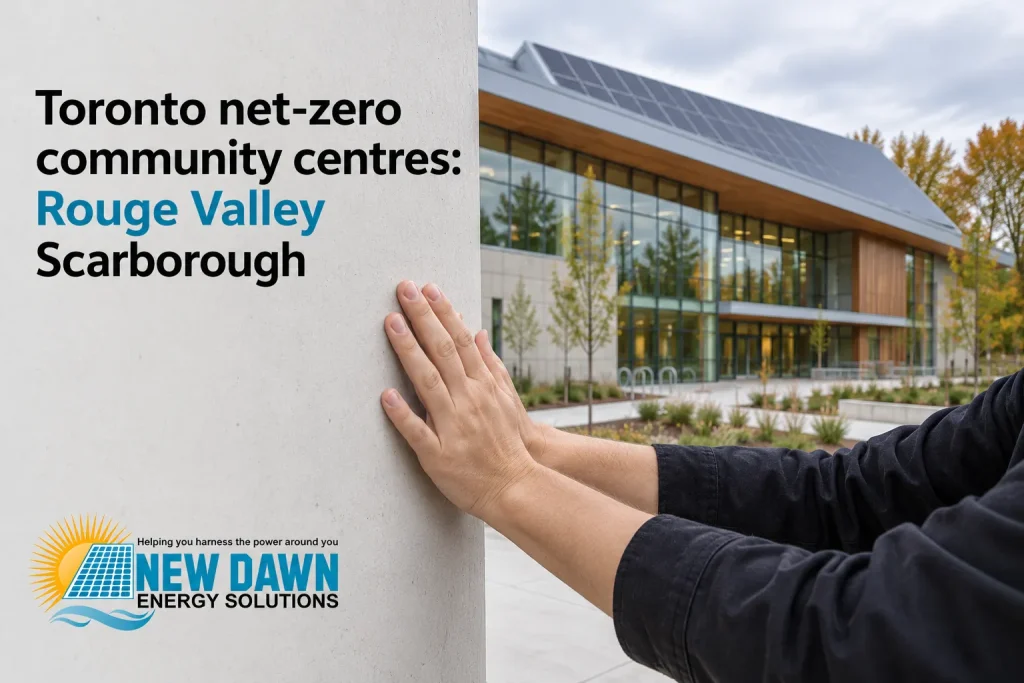
Toronto’s first net-zero community centre with an aquatic facility is Rouge Valley in Scarborough, and the City’s net-zero standards now apply to its new facilities. Below are the centre’s facilities, how its solar and heating systems work, and what “net zero” means once the doors open. The FAQ also gives an update on the Western North York centre now under construction.
What makes Rouge Valley Toronto’s first net-zero aquatic centre?
Rouge Valley puts a full aquatic centre and a community hub inside one low-carbon building. The City of Toronto calls it its first net-zero community aquatic facility. That title matters because pools have substantial energy demands for water heating, ventilation and humidity control.
Location and opening
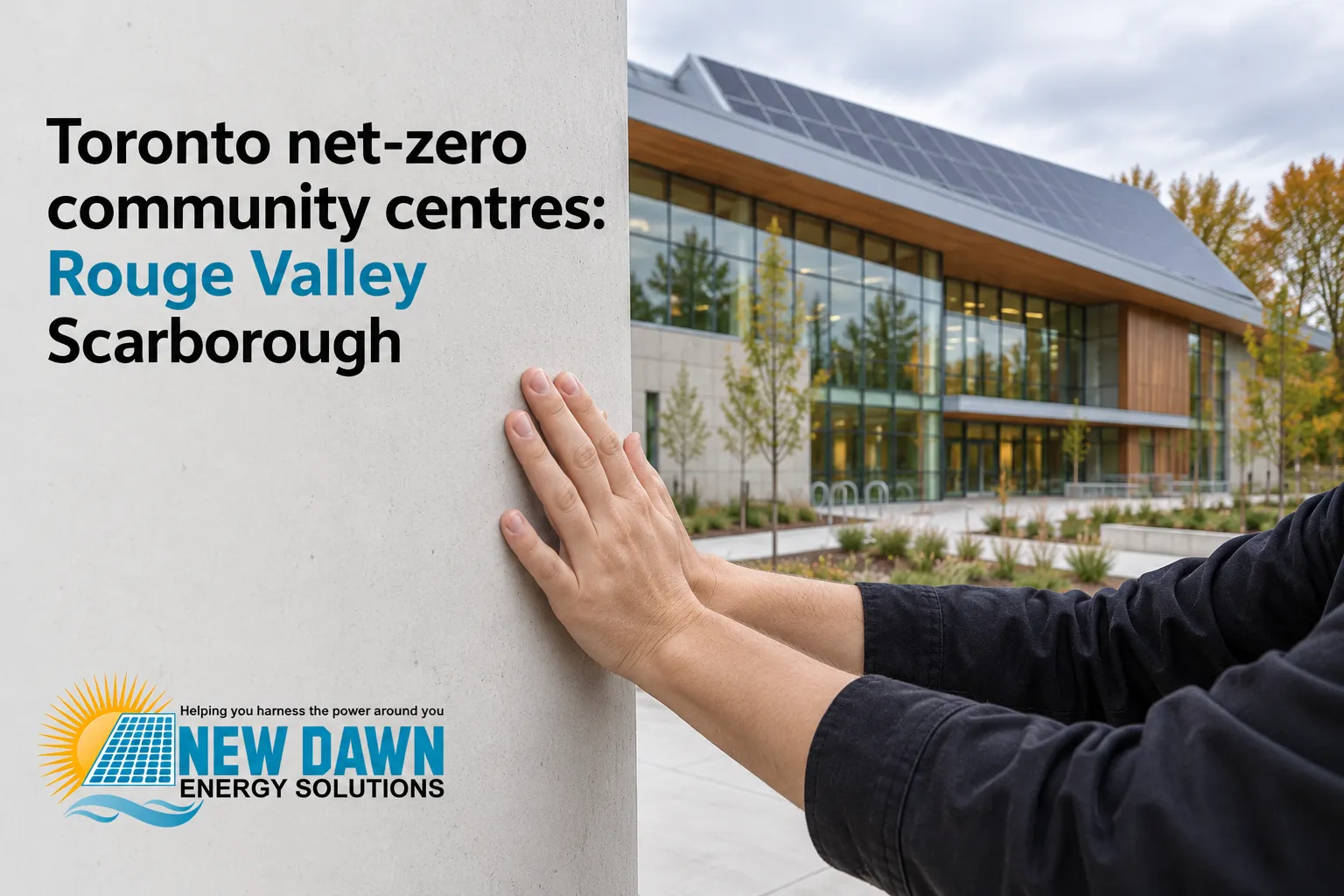
The centre covers 94,000 square feet in Joyce Trimmer Park, in Scarborough’s Morningside Heights neighbourhood. It serves northeast Scarborough, and we supplied its solar energy system.
- Public opening: doors opened to residents in October 2025.
- Official ceremony: the City held the official opening on November 20, 2025.
- Dual role: it works both as an aquatic centre and as a full net-zero community centre for northeast Scarborough.
New Dawn Energy Solutions team installed and commissioned the integrated solar canopy and rooftop PVT system behind the centre’s renewable generation. For a municipal client, that one site shows how one building can bring together recreation, aquatics and on-site clean power.
Recognition and public purpose
Rouge Valley was the first facility in Ontario to earn the Canada Green Building Council’s Zero Carbon Building Certification. The certification looks at the emissions tied to building materials as well as those from daily operations.
The City built the centre under its TransformTO Net Zero Strategy, which aims to cut local greenhouse-gas emissions. Extensive public consultation shaped the programming, so the building serves health, learning, recreation and community programs that reflect the neighbourhoods around it.
Aquatic and recreation facilities
The programme is broad. Under one roof, families find swimming, sport, child care and spaces for learning.
- Pools: a 25-metre swimming pool and a separate leisure pool.
- Gymnasium: a full-size gym with space for Toronto’s first indoor cricket practice pitch in a City facility.
- Child care centre: licensed capacity for 62 children.
- Program rooms: dance and fitness studios, a teaching kitchen and multipurpose rooms.
The indoor cricket pitch shows how closely the design follows the local community. For the energy systems, every one of these spaces adds lighting, ventilation and heating loads, which on-site generation has to help offset.
How do Rouge Valley’s solar and heating systems work?
The centre uses two solar arrays and an all-electric heating and cooling strategy. Together, they replace fossil fuel with on-site renewable energy wherever the site allows.
Rooftop photovoltaic-thermal generation
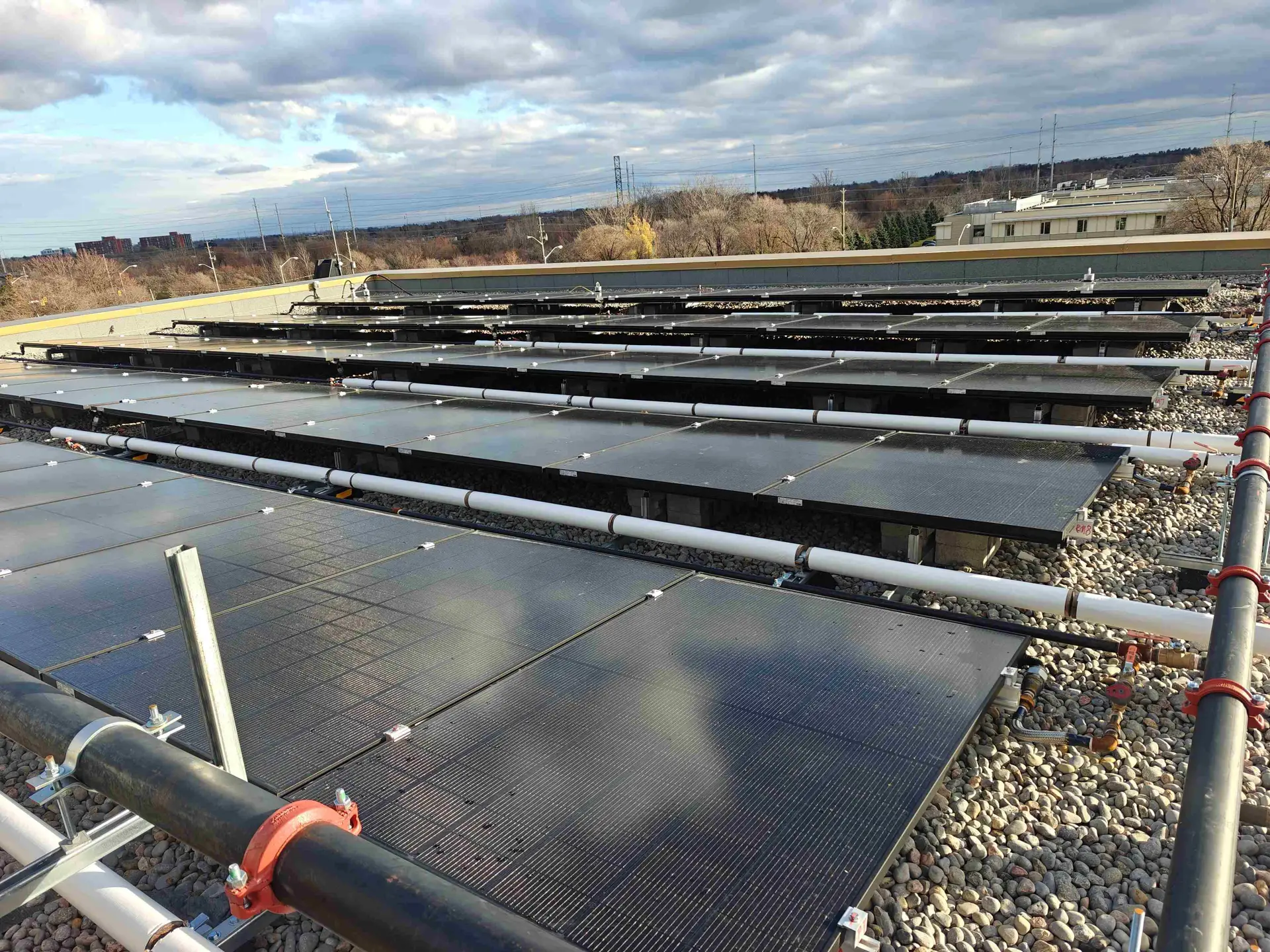
Photovoltaic-thermal (PVT) panels produce electricity and capture heat from the same module. On a pool building, which needs heat all year, that recovered energy has a ready use.
- Module count: we installed 472 DualSun hybrid PVT panels.
- Module rating: each panel is rated at 425 W.
- Electrical capacity: the rooftop array totals 200.6 kW DC.
- Scope: our work covered the rooftop installation.
The PVT panels’ thermal output feeds the building’s heating needs. The available sources do not give the share of annual heating it supplies. Solar panels are also integrated into the building’s walls.
Solar generation above parking
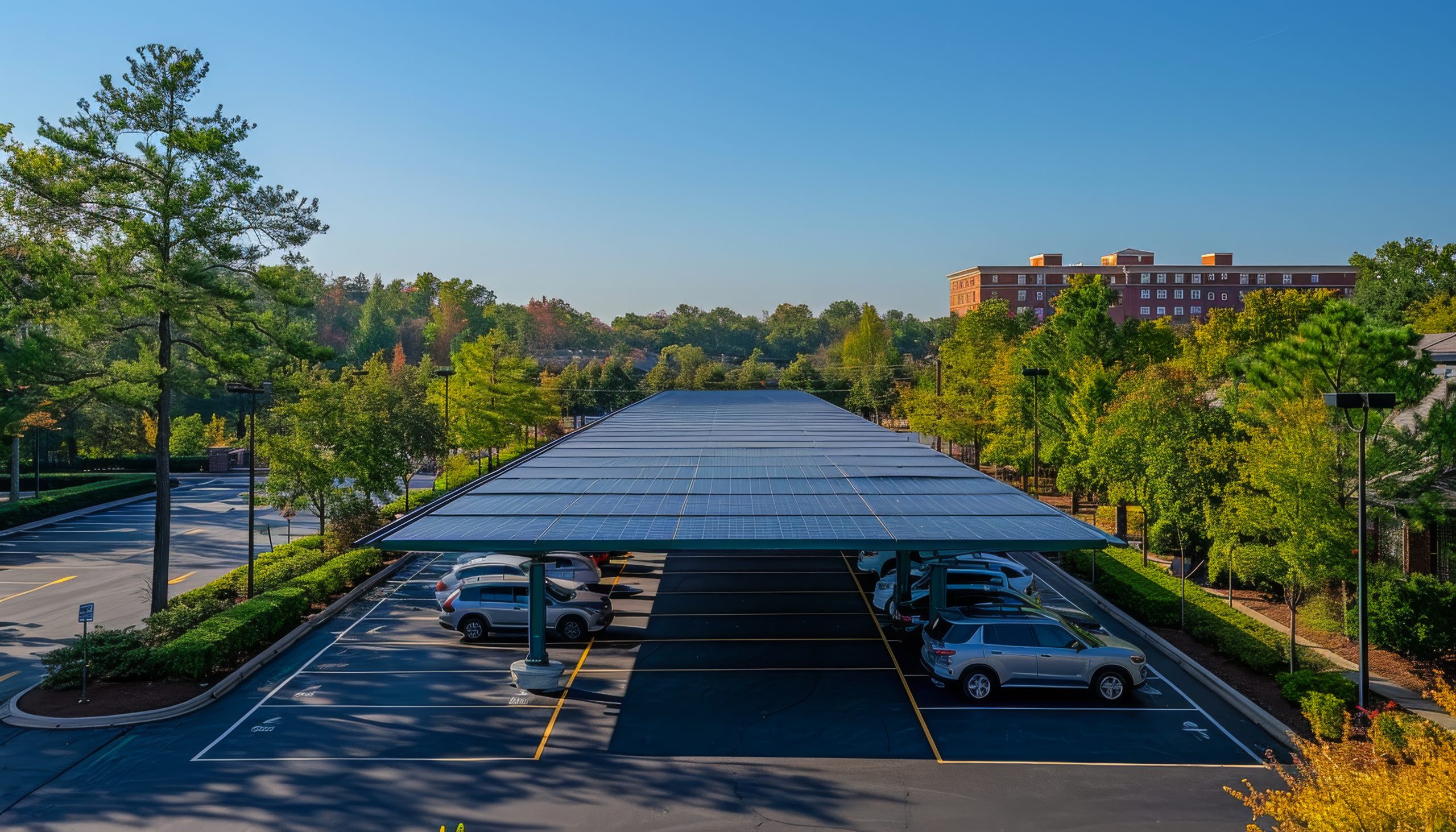
Roof area runs out quickly on a busy recreation building. A solar parking canopy turns the parking lot into a second generating surface.
- Capacity: the solar car port we installed provides 750 kW DC.
- Dual use: it generates power while giving visitors and staff shaded parking.
- Space gain: it adds production beyond what the roof alone can host.
The canopy carries most of the site’s solar capacity. For municipalities from Vaughan to Pickering with limited roof space, we deliver commercial solar installations, including parking structures, that use this same approach.
Heat pumps and electrical integration
Air-source heat pumps draw on outdoor air to help heat the centre in winter and cool it in summer. The solar arrays connect to the grid through a dedicated inverter fleet.
- Inverters: 15 grid-connected Solis string inverters, rated from 25 to 60 kW.
- Functions: they convert solar electricity, provide safety functions and allow real-time performance monitoring.
- Combined output: roof and canopy together reach 950 kW DC of installed capacity.
That combined capacity supports the City’s goals of lower greenhouse-gas emissions and lower long-term energy costs. Real-time monitoring also gives facility staff the data they need to spot underperformance early.
What does net zero mean in operation?
Net zero is an accounting claim, not a label. Before you judge any facility, find out which balance is being measured, and over what period.
Energy and carbon boundaries
A net zero energy goal balances a building’s energy consumption against qualifying generation over a defined period. It does not mean a building is self-sufficient every hour, so drawing from the grid at times is compatible with that goal.
Carbon claims use different boundaries. A zero-carbon certification is therefore a separate claim from a measured annual energy balance.
- Net-zero energy: total energy used versus qualifying generation.
- Operational emissions: greenhouse gases released while the building runs.
- Embodied carbon: emissions tied to the building’s materials.
- Outage resilience: the ability to keep essential services running during a grid failure.
The last item is often overlooked. A conventional grid-connected solar system does not guarantee backup power on its own, so an annual net-zero balance says nothing about resilience during an outage.
How operating performance is checked
A credible review compares measured consumption, solar generation and grid exports with the design model. It also adjusts for weather, occupancy and operating hours.
Hybrid arrays add one more step. At Rouge Valley, the PVT panels’ electrical output and useful thermal output need separate metering to show what each one contributes.
The City’s opening announcement does not report annual electricity use or renewable generation. Until it does, treat net-zero energy as the centre’s target, not as verified annual performance.
Toronto’s verification requirements
Toronto Green Standard Version 4 requires new City-owned facilities over 100 m² (about 1,076 sq. ft.) to be designed and built for net-zero emissions. A third party verifies them during construction. The standard also calls for whole-building energy modelling and commissioning through at least the first year after construction. The City says its June 2026 implementation change did not alter these requirements.
The Canada Green Building Council’s Zero Carbon Building, Design Standard v4, released in June 2024, assesses the final design once. It does not certify measured annual operation, so ask for post-occupancy data when you compare facilities.
Frequently Asked Questions
What other amenities does the Rouge Valley Community Recreation Centre offer?
The surrounding park has a skatepark, basketball court, playground, mini soccer field and splash pad. Inside, gender-neutral change rooms and washrooms are on every level. The pool can also be screened from public view for women-only swims.
When will the Western North York community centre be completed, and what will it include?
The City lists winter 2028 as the planned construction-completion period, subject to change. A June 2025 announcement expected the centre to open in late 2028. The facility will cover about 80,000 square feet and is designed to pursue net-zero energy. As of September 2026, the primary steel frame was complete, mechanical and electrical rough-ins were underway, and mass-timber installation was continuing over the aquatic hall.