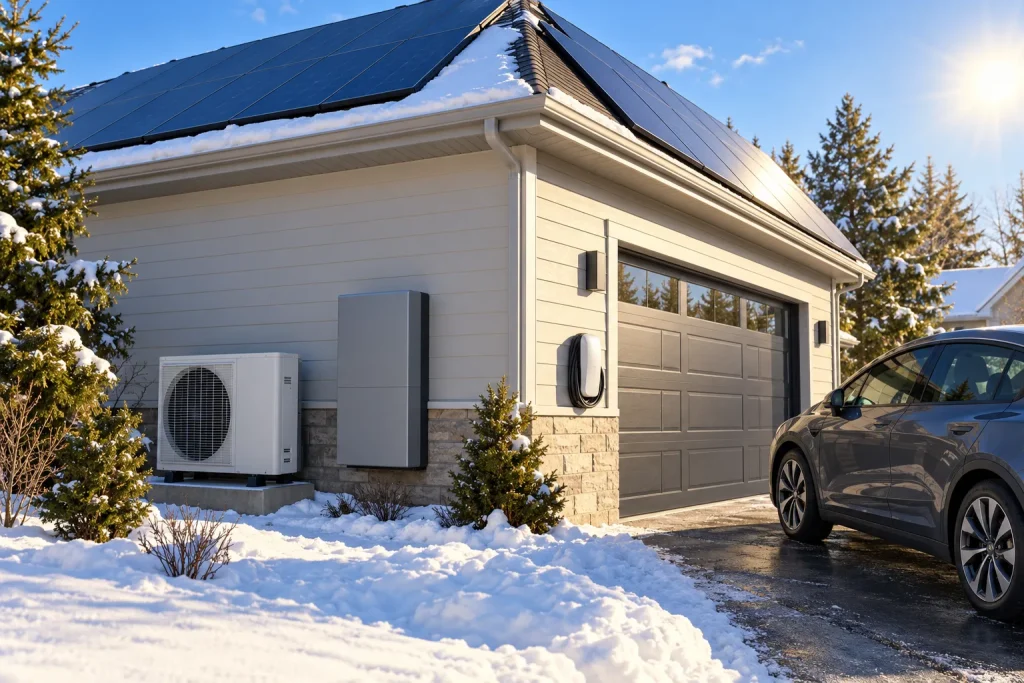
This article examines how Ontario electricity rate increases are reshaping household and business energy budgets—and how on-site solar energy generation can reduce exposure to rising hydro costs while delivering lasting financial returns. You will learn what is driving rates upward and how homeowners can respond today. For a deeper look at the real value of solar electricity, that resource complements what follows.
Understanding Ontario electricity prices
Ontario electricity prices have shifted dramatically in recent years. The Ontario Energy Board has approved increases that leave residential consumers and small businesses paying significantly more per kilowatt-hour than they did two years ago. Explore the solar energy benefits in Ontario to see how generation can work in your favour.

Time-of-Use rate periods
Under Ontario’s Time-of-Use pricing, three charging windows apply throughout the day. During winter 2025–2026, off-peak hours run from 7 p.m. to 7 a.m. on weekdays, as well as all day on weekends and statutory holidays. Review the techno-economic evaluation of Ontario electricity rate structures for solar systems for academic confirmation of these dynamics.
- Off-peak rate At 9.8¢/kWh, this window covers weekday evenings, nights, and all weekend and holiday hours.
- Mid-peak rate Priced at 15.7¢/kWh, mid-peak applies during weekday shoulder periods and represents a moderate charge for daytime activity.
- On-peak rate At 20.3¢/kWh, on-peak hours coincide with peak demand during weekday mornings and afternoons, making grid electricity most expensive.
Running laundry, dishwashers, and other high-draw appliances after 7 p.m. on weekdays can produce measurable energy savings. However, households using 1,200 kWh monthly still face an additional CAD 30–35 per month compared with prior rates at current electricity prices.
| Period | Hours (weekdays) | Rate (Winter 2025–2026) |
| Off-peak | 7 p.m. – 7 a.m. | 9.8¢/kWh |
| Mid-peak | Shoulder hours | 15.7¢/kWh |
| On-peak | Morning/afternoon | 20.3¢/kWh |
| Weekends/holidays | All day | 9.8¢/kWh |
Tiered and overnight options
Beyond Time-of-Use billing, Ontario offers two alternative structures. Tiered pricing charges 12.0¢/kWh for the first 1,000 kWh consumed in winter, then 14.2¢/kWh above that threshold.
- Tiered Tier 1 At 12.0¢/kWh for the first 1,000 kWh in winter, this rate suits moderate consumers with predictable monthly usage.
- Tiered Tier 2 Consumption beyond 1,000 kWh rises to 14.2¢/kWh, adding pressure for higher-use homes, particularly during cold Ontario winters.
- Ultra-Low Overnight rate At 3.9¢/kWh from 11 p.m. to 7 a.m., the ultra-low overnight rate is the cheapest available. Its on-peak charge of 39.1¢/kWh, however, requires disciplined load management.
- Plan switching Consumers receive one free plan change per 12-month period, allowing them to adjust their strategy as usage patterns or electricity rates for 2026 evolve.
The ultra-low overnight plan can suit households operating EV charging or battery storage systems overnight. For many others, tiered or Time-of-Use plans remain more practical. Energy consumption charges typically represent only 30–35% of a total bill, while fixed delivery charges account for 25–30% and do not shrink through conservation alone. That is why reducing consumption cannot fully protect residential consumers from rising electricity rates.
Why hydro bills keep rising
Ontario utilities generate electricity at roughly 4¢/kWh in centralized plants. Transmission, distribution, regulatory charges, and infrastructure maintenance add further costs, while monopoly utilities face little competitive pressure to reduce them. Ontario electricity demand is projected to grow 75% by 2050 as transportation and heating become more electrified, the population expands, and the economy grows. Meeting that demand will require costly grid upgrades, with expenses passed to ratepayers.
The Ontario Energy Board sets periodic adjustments, and current projections point to further annual increases of 3–5%. Effective November 2025, rates were already roughly 29–30% higher than in the prior period—the steepest increase since 2019. For Ontario households, solar generation paired with a battery can reduce grid purchases, manage peak demand, and strengthen grid resilience. A properly sized system can also improve the system payback period and support the wider clean energy transition without relying solely on net metering or future rate forecasts.
How solar limits Ontario hike exposure
Generating electricity on your roof changes your relationship with the grid. Instead of absorbing every rate adjustment, you produce power locally without an incremental per-kilowatt-hour cost once the system is installed. That shift makes solar power a durable financial strategy for Ontario homeowners and businesses facing persistent utility price pressure.

Offsetting costly daytime electricity
Each kilowatt-hour produced on-site replaces one that would otherwise come from the grid. The connection between Ontario electricity rate increases and the advantage of solar becomes clear during mid-peak and on-peak time-of-use rates, when electricity is most expensive. An 8 kW system in the Greater Toronto Area produces approximately 9,500–10,500 kWh annually, avoiding roughly CAD 1,400–1,600 in grid purchases at blended rates.
- Peak alignment Solar output is strongest during weekday daytime hours, matching on-peak and mid-peak demand windows—the highest-cost periods on many billing plans.
- Summer synchrony During summer, solar panels produce most strongly alongside air-conditioning load, so avoided purchases occur when residential electricity costs are highest.
- Transmission savings On-site generation avoids the transmission and distribution costs embedded in grid electricity, creating deeper savings per unit than headline rate figures suggest.
A well-designed residential solar system can reduce an Ontario home’s electricity bill by 60–90%. Fixed connection and delivery charges—typically CAD 30–50 monthly—remain regardless of solar output. The energy savings portion, however, becomes more valuable as the Ontario Energy Board approves further rate adjustments because every avoided kilowatt-hour is worth more over the system’s operating life. Explore the benefits of solar power for Ontario homeowners to assess the full household impact.
Net metering credits explained
When a solar PV system produces more electricity than a property uses, the surplus flows back to the grid. Ontario’s net metering program credits that export at the same rate the customer pays for consumption, including applicable time-of-use rates. Reviewing an updated Ontario time-of-use rate chart for 2026 alongside projected production helps confirm how credits will accumulate across seasons and billing cycles. Net metering applies to systems up to 500 kW, covering standard residential and small commercial installations.
- Credit mechanism Surplus generation exported to the grid earns credits at the applicable electricity price, offsetting future consumption charges on the same account.
- 12-month credit window Unused net metering credits expire after 12 months, so system sizing should target 90–100% of annual consumption to maximize credit use without material overproduction.
- 500 kW eligibility cap Ontario permits net metering for systems up to 500 kW, comfortably accommodating typical residential and small-to-medium commercial solar installations.
- Fixed charge persistence Even when solar offsets all energy charges, Ontario households still pay fixed delivery, connection, and regulatory fees of approximately CAD 30–50 per month.
Net metering effectively turns the grid into seasonal storage. Surplus energy produced during long spring and summer days can offset use during shorter winter days, smoothing annual billing. Rising electricity rates also mean each stored credit represents a higher avoided cost than when it was earned, increasing the long-term reduction.
Long-term bill protection
Solar systems operate for 25–30 years with minimal maintenance, usually requiring only occasional cleaning and periodic inspections. Once installed, every kilowatt-hour they produce avoids fuel and purchase costs. As grid electricity prices rise, the gap between free on-site production and utility-supplied power widens, strengthening the system payback period over its operating life.
- Compounding savings As Ontario commercial electricity rates and residential tariffs increase, the avoided-cost value of each on-site kilowatt-hour grows without requiring changes to the equipment.
- Demand growth pressure Ontario’s 75% projected electricity demand increase by 2050 will require infrastructure investment funded by ratepayers. On-site solar can insulate properties from part of that future allocation.
- Ontario Electricity Rebate limitations The Ontario Electricity Rebate increased from 13.1% to 23.5% as a pre-tax credit, reducing a typical 700 kWh bill by about CAD 36 monthly.
- Asset longevity With 20–25 year product warranties standard across the industry, a residential solar investment creates an energy-producing asset that can outlast typical financing terms by a decade or more.
Properties that generate their own electricity gain partial protection from grid volatility throughout the system’s life. For households, that means more predictable energy costs; for Ontario businesses, it supports stronger margins when rising power costs cannot be passed to customers indefinitely.
Choosing a solar strategy in Ontario
Every property and business has a different energy profile. Selecting the right solar configuration therefore requires a structured review of system size, incentives, electricity rate plans, and battery integration. Making those decisions early can shorten the system payback period and improve long-term energy savings for Ontario homes and commercial facilities.

Incentives and payback in CAD
Ontario and federal programs can reduce the upfront cost of a solar project. The Ontario Home Renovation Savings Program offers rebates of up to CAD 5,000 for eligible residential solar installations and up to CAD 5,000 for battery storage. The Canada Greener Homes Grant provides up to CAD 5,000 for energy-efficient renovations, including solar panels, along with interest-free financing of up to CAD 40,000. Homeowners should confirm current availability and eligibility before making a commitment.
For businesses, the Save on Energy Retrofit Program provides CAD 1,000 per kW-DC for micro-generation systems of 10 kW-DC or less, and CAD 770 per kW-AC for qualifying systems between 10 kW and 1,000 kW, up to a maximum of CAD 770,000. A commercial 300 kW array producing 350,000 kWh annually can avoid approximately CAD 77,000 in electricity purchases each year at a blended rate of 22¢/kWh. When incentives are combined with those avoided costs, the payback period for a larger commercial installation can fall substantially. Typical residential payback is 8–12 years, followed by 15–20 years of low-cost generation within the system’s warranted lifespan.
When batteries add value
Battery storage provides capabilities that a grid-tied solar-only system cannot. In Ontario, the clearest arbitrage opportunity is charging at the ultra-low overnight rate of 3.9¢/kWh, then discharging during on-peak periods at 20.3¢/kWh—or at the Ultra-Low Overnight plan’s on-peak charge of 39.1¢/kWh.
- Outage resilience Solar panels paired with battery storage can keep essential household or commercial loads operating during outages caused by ice storms, heat waves, or flooding. This protects continuity when the electricity grid is under stress.
- Peak demand reduction Commercial customers can use stored electricity for equipment start-up instead of drawing from the grid. Lower peak demand may reduce utility charges and, in some cases, a facility’s utility tier classification.
- Rate arbitrage Charging overnight at 3.9¢/kWh and discharging during peak periods captures a spread of up to 35.2¢/kWh against the Ultra-Low Overnight plan’s on-peak rate. The approach requires disciplined load scheduling.
- Rebate availability Rebate availability can further improve the economics when storage has a clear operational purpose.
For most residential consumers in Ontario, a net-metered solar PV system without battery storage currently delivers the strongest financial return. A battery is more compelling when outage protection matters, when a property uses the Ultra-Low Overnight rate with substantial controllable load, or when a business can materially reduce peak demand through battery dispatch. A qualified assessment will show whether storage strengthens the investment case for a specific energy profile.
Sizing for home or business
System sizing is the most consequential technical decision in a solar project. Oversizing can tie up capital in credits that expire unused, while undersizing leaves avoidable grid purchases in place. The appropriate capacity generally targets 90–100% of annual usage, determined from a full year of utility data.
- Roof orientation and shading South-facing roof planes with minimal obstruction from trees or neighbouring structures usually produce the most energy. East- and west-facing surfaces remain viable but generate less output per installed kilowatt.
- Annual consumption baseline Using 12 months of metered data captures seasonal demand and helps prevent excess production. Under net metering rules, unused credits can expire after 12 months.
- Planned electrification loads EV chargers, heat pumps, and other electric equipment increase future consumption. Including those expected requirements from the beginning can avoid an expensive system expansion later.
A professional turnkey installation should start with a complete site assessment. The review should cover roof structure, orientation, shading, load profile, planned electrification, and local distribution company interconnection requirements. Contact a qualified renewable energy contractor to determine the capacity that best fits the property’s usage patterns and expected payback.
Frequently Asked Questions
How much can solar panels actually reduce my monthly electricity bill in Ontario?
A properly sized residential solar system can reduce an Ontario home’s electricity bill by 60–90% on the energy-consumption portion. For an average household, that equals roughly CAD 100–150 in monthly savings, or CAD 1,200–1,800 annually. Fixed delivery, connection, and regulatory charges of approximately CAD 30–50 per month remain, regardless of solar production, because they are not consumption-based. An 8 kW system in the Greater Toronto Area typically generates 9,500–10,500 kWh per year, representing approximately CAD 1,400–1,600 in avoided grid purchases at blended rates. Each rate increase widens this gap further, year after year, at no additional cost.
Is the ultra-low overnight rate a better option than Time-of-Use pricing for Ontario homeowners with solar?
The ultra-low overnight rate of 3.9¢/kWh suits households that can shift most of their consumption—such as EV charging, battery charging, and high-draw appliances—to the 11 p.m. to 7 a.m. window. Its on-peak charge, however, is 39.1¢/kWh, the highest available rate. For homes unable to reschedule daytime loads, the annual bill can rise by several hundred dollars.
Ontario’s own rate comparisons show a solar-equipped home under standard Time-of-Use billing saves roughly CAD 217 per year compared with the ultra-low overnight plan. Homeowners with solar and no battery storage typically benefit more from standard Time-of-Use billing, where avoided on-peak consumption at 20.3¢/kWh delivers consistent savings through spring and summer.
What is the system payback period for residential solar in Ontario, and what incentives are currently available?
The typical system payback period for residential solar in Ontario is 8–12 years. After that point, the system can continue producing low-cost electricity for another 15–20 years within its warranted lifespan of 20–25 years. Current cost data from the Canadian Renewable Energy Association places that figure at approximately CAD 15,000 in avoided energy purchases.
The Ontario Home Renovation Savings Program offers rebates of up to CAD 5,000 for eligible solar installations and up to CAD 5,000 for battery storage. The Canada Greener Homes Grant can provide up to CAD 5,000 for qualifying energy-efficient renovations, while interest-free financing of up to CAD 40,000 may also be available.
For businesses, the Save on Energy Retrofit Program provides prescriptive incentives of CAD 1,000 per kW-DC for micro-generation systems up to 10 kW-DC, and CAD 770 per kW-AC for larger qualifying systems up to 1,000 kW. Stack the Ontario Home Renovation Savings Program rebate with the Save on Energy incentive, and you can cut the system payback period to under eight years.