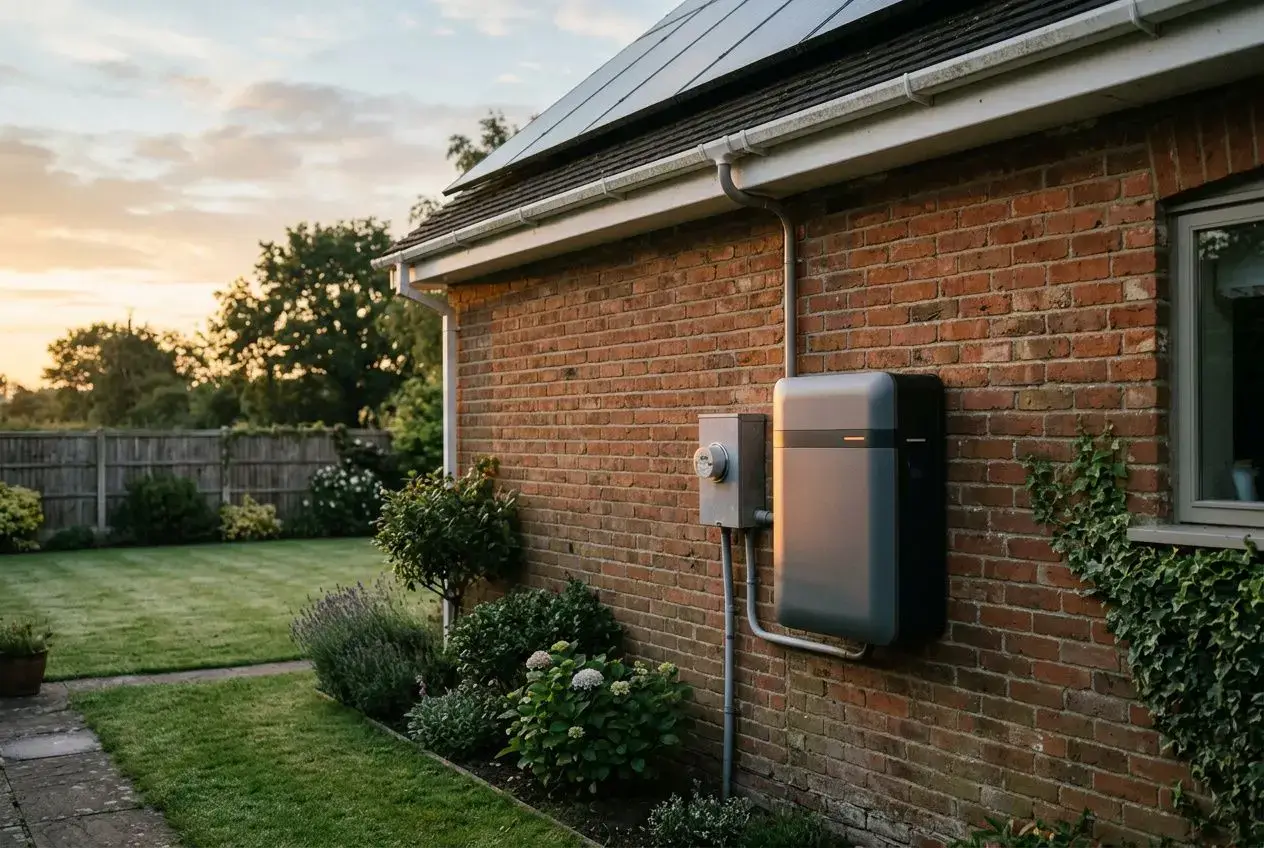
This guide explains how to evaluate a whole home solar battery backup setup for homes in Ontario, including component integration, sizing, costs, and Ontario regulations. You will also learn how these systems protect your household during grid outages while helping reduce electricity costs.
How a whole-home backup system works
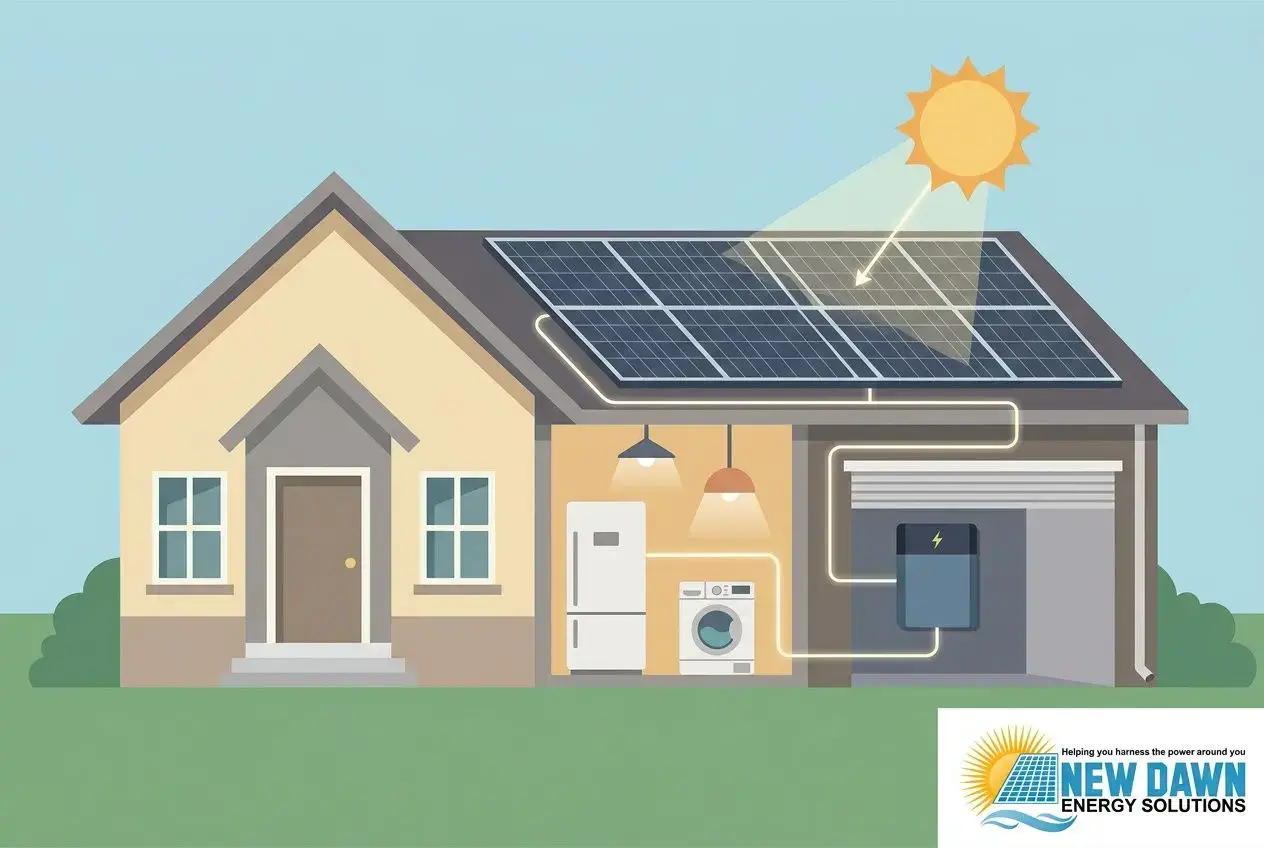
A solar-and-battery system combines several technologies into one energy platform. Solar panels generate electricity, batteries store it, inverters convert it into usable household power, and a backup interface keeps the home energized when the utility grid fails. Understanding each function helps you compare equipment and request accurate quotes from a contractor.
Solar, battery and inverter roles
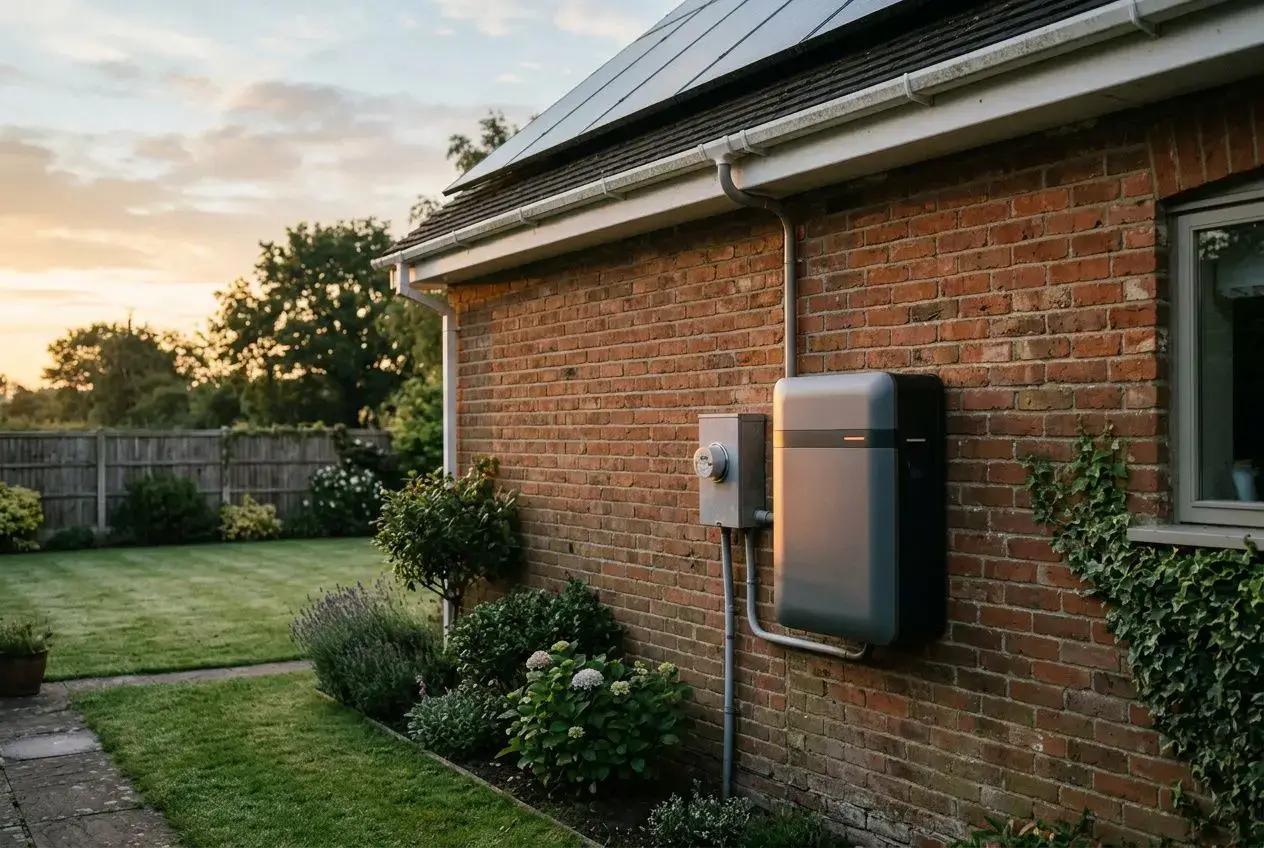
Installing a whole home solar battery backup system creates an integrated setup in which every component supports the others. Solar panels produce direct current (DC) electricity from sunlight, while batteries hold that energy for later use. An inverter converts stored DC power into the alternating current (AC) required by household appliances. According to the US Department of Energy, combining battery storage with solar power transforms a standard array into a more resilient energy source that can operate independently of the utility.
- Solar panels generate DC electricity whenever sunlight reaches the photovoltaic cells, providing the system’s generation foundation.
- Battery bank stores surplus DC electricity produced during peak daylight hours for use at night or during a utility outage.
- Inverter converts stored or newly generated DC power into 120 V or 240 V AC electricity for Canadian household circuits and appliances.
Explore the range of solar battery storage options in Ontario to see how these components integrate with Ontario’s net metering framework. All three must be correctly sized, certified, and wired by a licensed contractor to deliver dependable whole-home backup power.
Why the grid disconnect matters
A standard grid-tied solar array without battery storage shuts down automatically when utility power fails. This safety feature prevents live electricity from flowing back onto the grid and protects line workers. For homeowners, however, it also means that solar panels produce no power during a blackout, even on a bright day. A battery system with a dedicated backup interface addresses that limitation.
The specific backup interface in a solar battery system determines how quickly and safely your home isolates from the grid. The Growatt Interface, for example, disconnects the home from the utility during an outage and allows the solar-and-battery system to operate safely in island mode. Fast-acting transfer switches can move the home to stored energy in as little as 20 milliseconds, keeping internet equipment, security systems, and refrigerators running with no noticeable interruption.
- Grid isolation prevents live solar power from reaching downed utility lines, protecting electrical workers during an outage.
- Automatic transfer switches the home to battery power in milliseconds, eliminating manual intervention during a blackout.
- Island mode operation allows the combined solar-and-battery system to power selected loads or the entire home independently of the utility.
- Seamless reconnection restores grid-tied operation automatically once utility power returns, with no homeowner action required.
You can review a residential solar battery backup project in Ontario that shows how this grid-disconnect mechanism performs under real outage conditions shortly after commissioning.
Choosing a solar battery safely
Battery chemistry is an important consideration for residential storage. Lithium iron phosphate (LiFePO4) is widely preferred in Canadian installations because of its thermal stability, long cycle life, and reliable cold-weather performance. One benchmark LiFePO4 system operates reliably down to −20°C, covering every Canadian climate zone. Compare continuous power output with storage capacity: continuous wattage is the sustained battery power available, while peak output is a short surge rating that does not represent everyday capability. Dual-voltage systems supporting both 120 V and 240 V circuits provide broader appliance compatibility and greater flexibility for whole-home coverage.
Capacity is measured in kWh, while the inverter determines how much power the system can deliver at one time. A properly matched design balances stored energy, peak demand, and the loads you want protected. That balance supports a practical system payback period while improving energy savings, backup performance, and participation in the clean energy transition.
Size battery capacity and kWh for outages
Sizing battery storage is the most consequential design decision in a solar backup project. Undersized storage can leave critical appliances without power during an extended outage, while oversized equipment increases the upfront cost. The right approach begins with measuring household energy use and identifying the loads that must remain energized during a blackout—not with choosing a round figure from a product brochure.
Essential loads versus whole-home power
Canadian homes consume roughly 25–40 kWh of electricity per day on average, but that figure alone does not determine the battery size required. A well-designed kit for whole home solar battery backup includes storage modules and a critical-load panel that separates priority circuits—such as the refrigerator, lighting, sump pump, and internet—from non-essential equipment like electric dryers and hot tubs. This strategy reduces required storage capacity and total project cost while preserving meaningful protection during an outage.
- Essential-load tier covers lighting, refrigeration, internet, and a sump pump, typically requiring 10–15 kWh of battery capacity.
- Comfort-load tier adds HVAC, electric cooking, and EV charging. It needs substantially more storage and inverter output, often 30 kWh or more.
- Whole-home tier powers all household circuits simultaneously, which can require 30–90 kWh of storage and 10–21.6 kW of continuous AC output.
Modular designs let you begin with essential-load coverage and expand in fixed increments as your budget allows. One modular approach increases capacity in 5 kWh steps, with 15–20 kWh per cabinet and up to 40 kWh across two cabinets. Individual modules typically weigh under 60 lb, making transport, installation, servicing, and future replacement easier without changing the entire battery bank.
| Backup tier | Typical storage needed | Loads covered | Runtime without solar (approx.) |
| Essential only | 10–15 kWh | Fridge, lights, Wi-Fi, sump pump | 1.5–2.5 days |
| Comfort loads | 20–30 kWh | Above + HVAC cycles, some cooking | 12–24 hours |
| Whole-home | 30–90 kWh | All household circuits | Varies by demand |
They determine whether your investment provides meaningful outage protection or falls short when needed. Choose an installer who completes a detailed consumption audit before recommending storage capacity or an inverter rating.
How long batteries can run
Runtime depends on installed storage capacity, the power draw of active loads, and whether solar panels recharge the batteries during the outage. A 13.5 kWh battery powering essential circuits—refrigeration, lighting, internet, and a sump pump—typically lasts 1.5 to 2.5 days without solar input. Add air conditioning or electric cooking, and the same unit may be depleted in 4–6 hours. To assess the price of whole home solar battery backup, identify the runtime scenario included in that quote: essential-load coverage costs substantially less than whole-home protection for heavy appliances.
Depth of discharge also affects usable runtime. Most quality residential batteries specify the maximum depth of discharge, meaning the percentage of total capacity that can be safely drawn without accelerating degradation. A battery rated for 13.5 kWh of usable capacity with a high depth of discharge makes nearly all its rated energy available. A lower threshold provides less runtime than the nameplate figure suggests, so compare usable capacity rather than gross capacity.
Solar recharge during extended outages
Pairing solar panels with a battery enables daytime recharging, unlike a standalone battery bank. On a clear day, a properly sized array can replenish overnight battery consumption before midday, extending backup coverage from days into weeks when household demand remains within the system’s generation and storage limits. Winter conditions are different: shorter days and lower solar angles reduce energy production, making array sizing essential for year-round grid resilience.
Outage duration and weather determine whether the system can sustain the home indefinitely or whether conservation becomes necessary. Panel-level power optimizers, including those used in SolarEdge configurations, maximize production from individual modules and can improve recharge potential when some panels are shaded or exposed to weak light.
- Clear-day recharge can replenish a 13.5 kWh essential-load battery before the afternoon, extending coverage beyond the initial charge cycle.
- Overcast conditions reduce solar harvest substantially; partial cloud cover may deliver 20–50% of rated production depending on cloud density and season.
- Winter performance requires conservative assumptions because shorter days and low sun angles reduce daily kWh production across Ontario’s latitude.
- Demand management during a prolonged outage—by reducing non-essential consumption—stretches stored energy and helps the array keep pace with household needs.
A qualified installer can model seasonal solar production against measured consumption to determine whether your intended backup scope is achievable throughout the year. The result is a more accurate assessment of batteries, inverter capacity, storage capacity, and your whole home solar battery backup price.
SolarEdge home battery system examples
Installed solar battery projects in Erin and Uxbridge Ontario offer more practical reference points than specification sheets alone. Two completed residential systems—one with 30 kWh of storage and another with 40 kWh—show how component selection, array size, and backup-interface integration affect outage resilience and grid reliance in Canadian homes.
A 30 kWh Mississauga Ontario installation
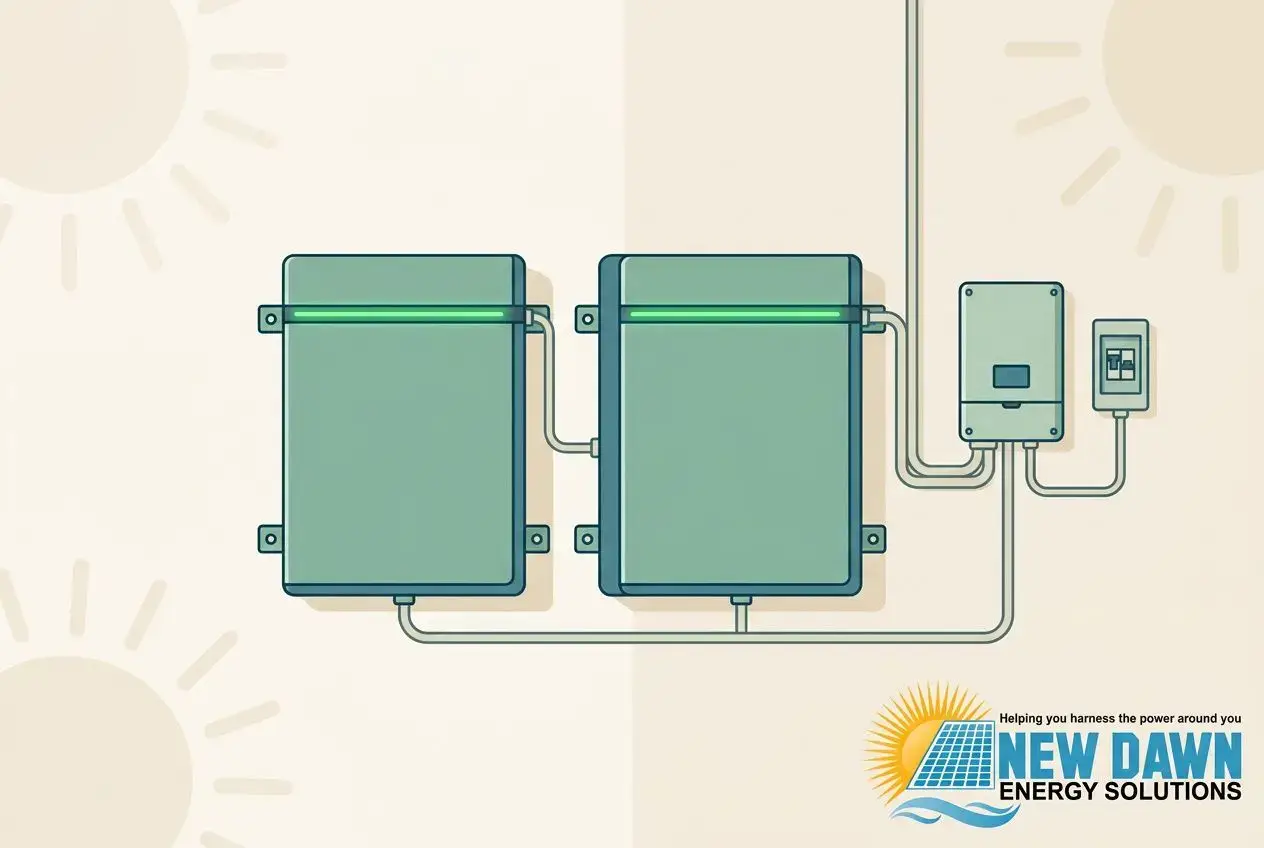
Among the strongest home battery backup systems available in Canada, fully integrated SolarEdge configurations combine panel-level optimization, scalable battery storage, and automatic backup control. One Ontario project uses 59 LONGi bifacial monocrystalline 550 W panels, delivering 32.45 kW DC of installed generation capacity. Three 10 kW SolarEdge inverters provide 30 kW AC of continuous output, while 59 SolarEdge Power Optimizers manage production at the module level and support efficient battery charging throughout the day.
Three SolarEdge Home Battery units, each rated at 10 kWh, provide approximately 30 kWh of total battery storage capacity within the inverter system. The SolarEdge Backup Interface disconnects the home from the grid automatically during an outage, allowing the array and batteries to operate in island mode and supply the entire residence. The system demonstrated its design within two months of commissioning by delivering critical backup power during a major grid outage.
- Array capacity: 59 LONGi 550 W bifacial panels, with 32.45 kW DC of total installed generation.
- Inverter output: three SolarEdge 10 kW grid-tied inverters, providing 30 kW AC of continuous output.
- Battery storage: three SolarEdge Home Batteries rated at 10 kWh each, for approximately 30 kWh in total.
Review the full details of this residential solar battery backup project in Ontario to see how each component was specified for the site’s load profile and backup requirements. At this scale, the design reflects detailed engineering rather than an off-the-shelf assembly.
Richmond Hill home backup results
A second Ontario case study is a completed whole home solar battery backup project in Richmond Hill. This AC coupled system equiped with Schneider XWpro Hybrid and SolarEdge Grid-tie inveretrs combines an 18.76 kW solar array with 40 kWh of battery storage, achieving near-zero grid reliance under normal conditions and seamless backup during a significant outage.
- Solar array: 18.76 kW of installed panel capacity for daily generation, battery charging, and household consumption.
- Battery storage: 40 kWh of total capacity, enabling longer outage coverage than a single-battery system.
- Grid reliance: reduced to near-zero under normal conditions, with utility draws occurring only during prolonged low-generation periods.
- Outage performance: seamless backup transition confirmed during a real grid interruption after commissioning. This system is capable of powering the whole home without any loadshedding during grid outage.
The two Ontario installations demonstrate how storage capacity and inverter output determine outage coverage. Backup duration, whole-home or partial coverage, and operation through an extended outage depend on storage capacity, inverter output, local solar irradiance, and household demand.
Monitoring and energy independence
SolarEdge panel-level monitoring, delivered through its online platform, provides real-time visibility into solar production, battery status, and overall system performance, along with remote alerts. This detailed information helps homeowners identify underperforming panels, check stored energy before a forecast storm, and confirm that the backup interface is operating correctly.
Pairing solar power with batteries shifts surplus daytime generation into evening use, increases self-consumption, and reduces reliance on utility electricity. During peak-rate periods, stored energy can replace grid purchases, improving energy savings beyond outage protection alone. Over time, lower grid consumption also reduces exposure to utility-rate increases.
For homeowners comparing a solar battery backup, the key measures include battery storage capacity in kWh, inverter output, expected outage duration, and the loads included in the home backup design.
Whole-home battery costs and savings in Ontario Canada
Understanding the cost of a solar-and-battery project means separating equipment, installation labour, and available incentives. System scope, household load priorities, and installer selection all influence the final price, while federal and provincial rebate programs can reduce the net investment.
Equipment and installation costs
Battery equipment generally costs CAD $1,000–$2,000 per kWh of storage capacity. Brand, power rating, site conditions, and required electrical upgrades can shift the final figure. A 10 kWh home battery therefore represents roughly CAD $10,000–$20,000 before installation. For a fully integrated project, the whole-home solar battery backup cost covers solar panels, batteries, inverters, a backup interface, and professional installation.
Professional installation of the battery portion of a Canadian whole-home system typically costs approximately CAD $3,000–$10,000, separate from equipment and any solar array installation. Federal and provincial rebate programs may reduce the net cost of batteries by approximately CAD $5,000–$10,000, depending on the province and current program availability. Eligibility rules and funding can change over time, so confirm current incentives with your installer or the administering authority before setting the project budget.
Rate arbitrage and payback
Ontario’s time-of-use pricing gives battery storage a practical role in reducing electricity bills. The unit can charge overnight when rates are low, then discharge during expensive on-peak hours. Ontario’s Ultra-Low Overnight rate spread is approximately 3.9¢/kWh overnight versus 39.1¢/kWh on-peak, one of the widest residential price differentials available.
A 13.5 kWh battery cycling daily under this structure may save roughly CAD $900–$1,250 per year, before assigning financial value to outage protection. Over 10 years, that usage could deliver approximately CAD $10,000–$13,000 in cumulative electricity savings from one device that also supports the home during a grid outage.
Typical system payback periods for Canadian homeowners are approximately 10–12 years for battery-only installations and 8–12 years for full solar-plus-battery projects, based on current rebates and prevailing electricity rates. As utility prices rise, those timelines may shorten. Rising electricity prices shorten those timelines further.
Battery versus generator value
A solar battery pays back in more than dollars. A battery system operates quietly, requires limited maintenance, and uses stored solar energy instead of gasoline, propane, or natural gas. That eliminates recurring fuel costs. Generators do not qualify for federal or provincial rebates or incentive programs in Canada, while batteries may receive CAD $5,000–$10,000 in available rebates.
- Operating costs: Batteries have negligible ongoing costs; generators require fuel, oil changes, and periodic servicing.
- Incentive eligibility: Battery storage may qualify for federal and provincial rebates; generators do not qualify for comparable Canadian programs.
- Environmental impact: Solar panels and a battery can produce and store clean, renewable electricity on-site; a generator creates emissions and noise during operation.
Modern battery units fit neatly in a garage or utility room. They create no operating noise or fumes and avoid the fuel-storage requirements associated with generators. Backup duration depends on how much of the home you want to keep powered.
Safe home battery backup installation in Ontario
Ontario’s 2024 Electrical Safety Code sets clear rules for residential batteries. It governs approved locations, electrical work, and the approvals required before a system can operate. Check the code requirements before selecting a location or hiring a contractor, as they affect allowed placement, system size, and room construction.
Approved installation locations
Homeowners researching options for a whole home solar battery backup, including discussions on Reddit and other community forums, often find conflicting information about battery placement. Sleeping areas are prohibited in every case.
- Attached or detached garage: permits up to 80 kWh of aggregate battery capacity under standard residential limits.
- Exterior wall: also permits up to 80 kWh in aggregate. The enclosure rating must suit outdoor exposure.
- Dedicated or utility room: limited to 20 kWh per individual energy-storage system and 40 kWh in total aggregate capacity.
A compliant dedicated or utility room needs a self-closing door, gypsum-board walls and ceiling with sealed joints, and a floor made from lumber sheathing or a stronger material such as concrete. Indoor rooms cost more because construction work must be included in the project quote. This detail should be confirmed with the contractor before signing.
ESA, utility and electrical requirements
Every Ontario home battery installation requires an Electrical Safety Authority (ESA) notification before work begins. For projects completed for hire, a Licensed Electrical Contractor must perform the electrical work. When solar panels are connected to the batteries, utility approval is also required for interconnection with the distribution grid.
A contractor offering a turnkey installation typically includes a single point of contact and a fixed system payback period estimate.
Safety certifications to verify
Before purchasing a battery system, ask the supplier for certificates showing compliance with UL 9540 and other applicable standards. Authorities having jurisdiction may also request UL 9540A thermal-runaway test data, especially when equipment is installed in or near habitable spaces.
Inverters and other power-conversion equipment must carry applicable Canadian-recognized certification, such as CSA C22.2 No. 107.1 and/or UL 1741. Battery packs and modules may also have UL 1973 certification as supporting evidence. Ask the installer to confirm the standards that apply to every major component, including the batteries, inverter, and complete system. Proper certification strengthens safety, supports grid resilience, and helps ensure the home battery backup operates as intended during an outage.
Frequently asked questions
How much does a whole home solar battery backup system cost in Canada?
Battery equipment generally costs CAD $1,000–$2,000 per kWh of storage capacity. A 30 kWh system therefore represents about CAD $30,000–$60,000 for equipment alone, before installation. Professional installation usually adds CAD $3,000–$10,000 for the battery portion, with further costs for the solar panels and backup interface when included.
Federal and provincial rebate programs can lower the net price by approximately CAD $5,000–$10,000, depending on your province and eligibility. A complete solar-plus-battery project typically has a 10–15-year payback period at current electricity rates, while battery-only installations generally reach payback in 8–12 years. In Ontario, rate arbitrage using the Ultra-Low Overnight pricing spread can reduce bills by CAD $900–$1,250 per year, strengthening the financial case over time. Request a detailed quote that separates equipment, installation, and incentives before comparing proposals.
What is the best home battery backup system available in Canada for whole-home coverage?
The best battery for your home depends on household loads, outage priorities, electrical service capacity, and budget. No single product suits every property. Commonly deployed options include the Tesla Powerwall, the Panasonic EverVolt home battery, and SolarEdge Home batteries for properties using SolarEdge inverter infrastructure.
SolarEdge systems provide panel-level optimization, a dedicated Backup Interface for automatic grid isolation, and real-time monitoring through one platform. Prioritize LiFePO4 chemistry for safety and service life, then compare the home battery power output in continuous watts rather than peak output alone. Confirm that the equipment has UL 9540 certification. A qualified Ontario contractor can assess your consumption profile. They can design the battery storage capacity around your needs instead of defaulting to the largest product.
How long will a solar battery run a house during a power outage?
Runtime depends on battery storage capacity, active household demand, and whether solar panels recharge the battery during the outage. A solar battery backup system with 13.5 kWh of storage serving essential circuits—such as a refrigerator, lighting, internet equipment, and a sump pump—typically provides 1.5 to 2.5 days of coverage without solar input.
Adding major loads, including air conditioning or electric cooking equipment, can reduce runtime to roughly 4–6 hours on the same battery. On a clear day, solar panels can replenish a discharged battery serving essential loads before midday and extend coverage indefinitely, provided demand remains within the system’s generation capacity.
Depth of discharge also affects practical runtime. A higher discharge setting makes more of the rated battery storage capacity available, although operating conditions still influence battery degradation. Designing for winter conditions, shorter days, overcast weather, and higher heating loads helps a whole home solar battery backup system provide dependable protection throughout the year.
For homeowners comparing options, the Tesla Powerwall, EverVolt home battery, and SolarEdge Home systems should be evaluated by usable kWh, inverter performance, backup configuration, and grid-isolation capability—not brand recognition alone. Use those criteria to shortlist systems that match your actual consumption, then request quotes that break down equipment, installation, and incentives.