Solar power can run household devices and heat water, buildings and pools. It can also charge electric vehicles, back up a home during outages and supply farms or remote communities. Each use calls for its own equipment, covers a realistic share of demand and comes with specific incentives and approvals in Ontario.
What can solar power do in an Ontario home?
A rooftop array can supply electricity for your daily routine. Solar energy can also produce heat, charge a car or be stored for later. How much of that you get depends on the size of the system, how it is designed and when your household uses power. The first step is understanding how sunlight becomes usable current.

Electricity for everyday devices
Each solar cell relies on the photovoltaic effect to convert sunlight into direct-current (DC) electricity. A solar inverter then turns that DC output into alternating current (AC), the type your home circuits use. With a properly sized array, solar can power almost anything plugged into a house:
- Constant loads: refrigerators, freezers, routers, computers and televisions, along with lighting throughout the house.
- Appliances that run on a schedule: cooking equipment, washing machines and dishwashers, as long as the design accounts for their demand.
- High-demand equipment: electric water heaters, stoves, clothes dryers and central air conditioners, which can exceed what a small system produces.
The real limit is capacity, not the type of device. Listing your large appliances before you request a quote helps size the system to the loads you actually want to cover.
Grid supply and electricity bills
In a grid-tied solar installation, your panels serve household loads while they produce, the grid fills any shortfall, and any approved surplus is exported. With this arrangement, the lights stay on at night and on overcast days without a battery.
Under Ontario net metering, eligible customers receive bill credits for eligible surplus electricity. The Ontario Energy Board says unused credits can carry forward for up to 12 months before they expire. These credits offset eligible consumption charges only. When you generate electricity, what you import and the fixed charges on your bill still affect the final amount, so solar lowers your energy bills but does not necessarily eliminate them.
Matching production to household demand
Your solar savings grow when appliances run during productive daylight hours, because those loads use on-site power directly. Annual production does not tell you whether your system can cover winter demand or peak loads. A residential solar power system has to be compared with seasonal and daily demand, not just a yearly total.
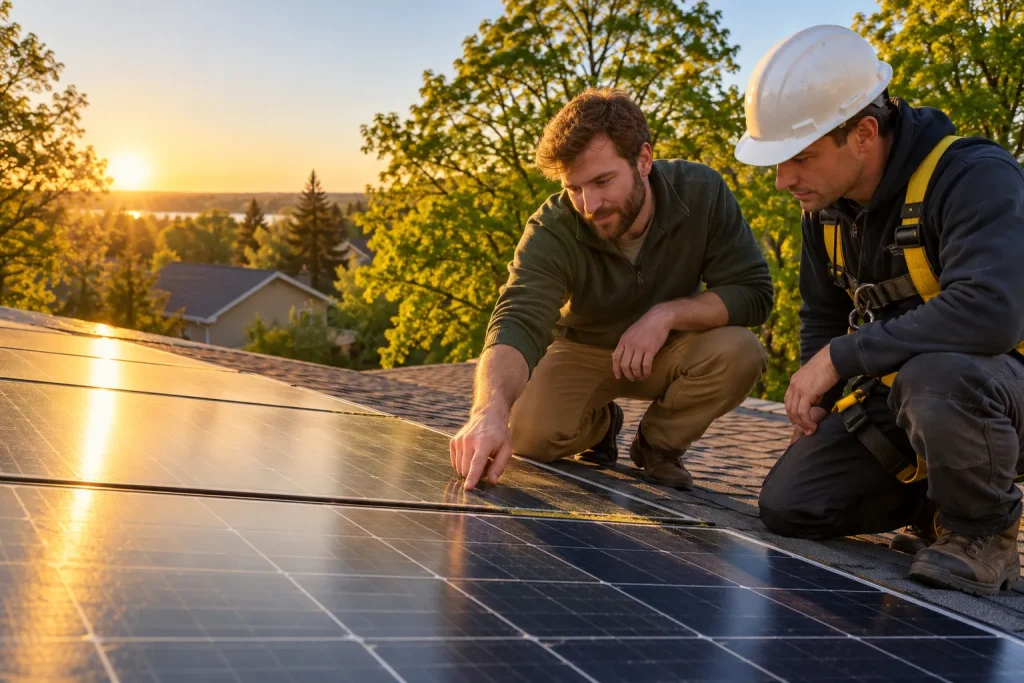
Roof condition, structural capacity, orientation, tilt, shading and electrical-service capacity all determine whether a home is a good candidate. As part of our residential solar system assessments, New Dawn Energy Solutions reviews roof size, angle and sun exposure. Natural Resources Canada’s PV mapping tool estimates monthly and annual output using a 0.75 performance ratio. Lifetime-average production for most systems should fall within about 10% of the modelled value, but each roof still needs its own assessment.
Can solar energy heat or cool a home?
Yes, in three different ways. Solar-thermal collectors capture heat directly. Photovoltaic panels supply electricity to heating and cooling equipment. Passive design uses the building itself to manage incoming sunlight. Each approach uses different equipment, so knowing which one fits your goal makes it easier to plan.
Hot water and pool heating
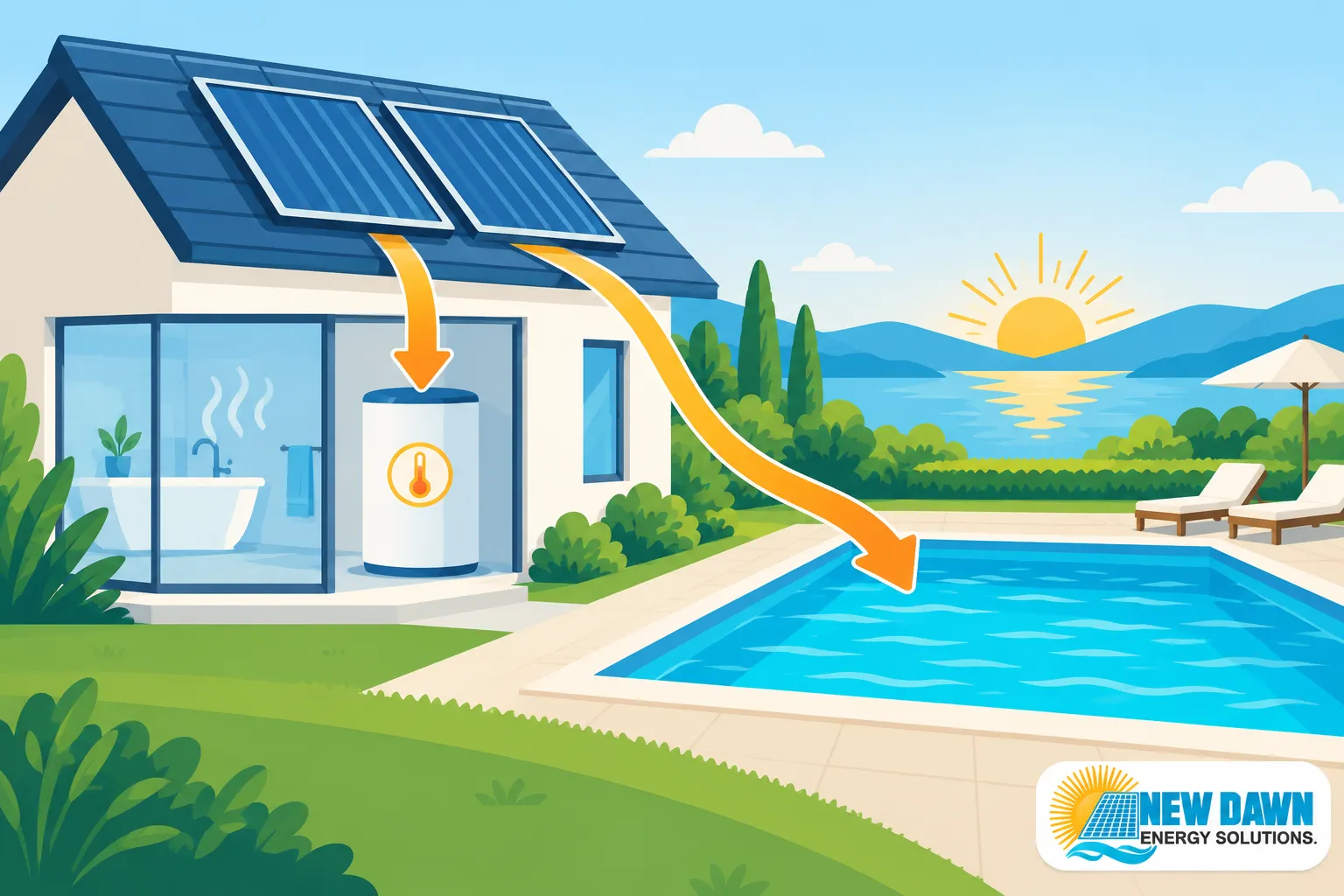
Solar-thermal collectors capture sunlight as heat rather than electricity. They can supply domestic hot water for showers, sinks and laundry, or heat a swimming pool. A typical solar water heating system includes these components:
- Collectors: absorb solar heat on the roof or another sunny surface.
- Circulation equipment and heat exchanger: in a closed loop, these move heat from the collectors to preheat domestic water.
- Storage tank: holds heated water until the household needs it.
Ontario conditions require freeze protection, summer-overheating control and careful integration with existing plumbing. A conventional water heater remains necessary for periods without enough sun, so plan for solar heating as a preheat stage rather than a full replacement.
Space heating, ventilation and cooling
Solar-air collectors can preheat ventilation or make-up air, so solar ventilation reduces the energy needed to warm incoming air. Solar-thermal heat can also feed radiant-floor or forced-air systems to help heat homes.
Photovoltaic panels work indirectly. They supply electricity to heat pumps, electric water heaters, air conditioners and ventilation equipment, but the panels do not produce heat themselves. Under suitable conditions, a heat pump delivers more heat energy than the electrical energy it consumes. It is still electrical equipment rather than a solar collector, so pairing it with a PV array is a practical combination.
Passive solar design
Passive solar design manages sunlight and heat through building orientation, windows, shading and thermal mass, without a PV array.
South-facing glazing can provide heat gains in winter. Overhangs and shading can limit overheating in summer, when the sun is higher in the sky.
The building also needs proper insulation, airtightness, ventilation and heating or cooling equipment. Passive design works best as part of a renovation or new-build plan that covers the whole building.
Can solar panels charge an electric vehicle?
Yes. EV charging is a practical use for solar panels at homes and businesses. Most of the energy comes from a roof or carport array that feeds a charger, not from panels on the car itself. When charging happens matters as much as the size of the array.
Charging from a home array
Rooftop solar power can supply an EV charger when the vehicle is plugged in during productive solar hours, and the charger controls how much power goes to the battery. Smart charging extends this approach by shifting vehicle demand toward hours with available generation. Overnight charging generally draws from the grid or from a battery designed for that purpose.
Charging at workplaces and parking areas
Solar charging is not limited to single homes. It can serve workplaces, apartment parking areas, commercial sites and fleet depots.
A solar parking canopy does three jobs on one site. It generates electricity, shelters vehicles and supports chargers underneath.
Each project depends on the electrical service, the charger rating, the inverter output and any other loads running at the same time. Review these four constraints early to avoid upgrading the service later.
What about panels on the vehicle?
Panels mounted on a vehicle can add some energy, but the limited body area makes them unsuitable as the only power source for an ordinary Canadian passenger car. Specialised lightweight solar cars that run entirely on their own panels do exist.
For everyday driving, charging a conventional EV from building or carport panels is the practical choice. New Dawn Energy Solutions has installed a residential rooftop array together with a Level II car charger for this purpose.
How can solar power work beyond daylight?
Storage and off-grid design let solar energy cover evenings, outages and places with no utility connection. Each option needs different equipment, and portable gear has clear limits. Ontario also offers incentives for home storage, with conditions you should check before you buy.
Stored power for evenings and outages
Solar batteries store electricity but do not generate it. They shift surplus daytime production to the evening. Capacity in kWh measures how much energy the battery holds, while its kW rating limits how many loads can run at once. A standard grid-tied system generally shuts down during an outage, so backup needs suitable inverter operation and isolation or transfer equipment.
Backup can cover selected circuits rather than the whole building. The battery is sized based on running and starting power, the operating time you need and the usable stored energy. Our battery energy storage systems start with that load and backup assessment, as we did for a Richmond Hill home designed to ride through grid outages.
Off-grid and portable uses
An off-grid solar power system runs without a utility connection. Energy independence requires designing for nights, long stretches of poor weather and winter demand, not just average annual production. Systems differ in what they can power:
- Off-grid systems: supply cabins and remote sites entirely from panels and storage.
- Hybrid systems: combine generation and battery storage with a grid connection or a generator, and their outage capability depends on the specific design.
- Standalone units: solar street lighting, park lights and remote sensors that run on their own panel and battery.
- Portable solar panels: charge compatible phones, laptops, radios and solar lights during travel or outages.
Battery capacity and continuous output limit portable equipment. A power station is useful for camping, but it does not replace a properly sized home backup system.
Ontario incentives for home storage
Ontario’s Home Renovation Savings Program launched on 28 January 2025. Eligible rooftop solar receives $1,000 CAD per kW, up to $5,000 CAD. The rebate is also capped at 50% of eligible total costs.
Batteries receive $300 CAD per kWh, up to $5,000 CAD and 50% of eligible total costs. The stated combined maximum for solar and battery is $10,000 CAD, subject to eligibility.
Under the October 2025 residential requirements, projects need pre-installation approval and must be completed within 12 months. Participants receiving the solar-and-battery incentive cannot sign a net-metering agreement with their local distributor, so compare both options before you apply.
How do organizations use solar power?
Businesses, farms, public institutions and remote communities use solar for the same reasons as homeowners: lower operating costs and more reliable supply. Their loads, connection rules and schedules differ, and these factors shape every design.
Businesses and commercial buildings
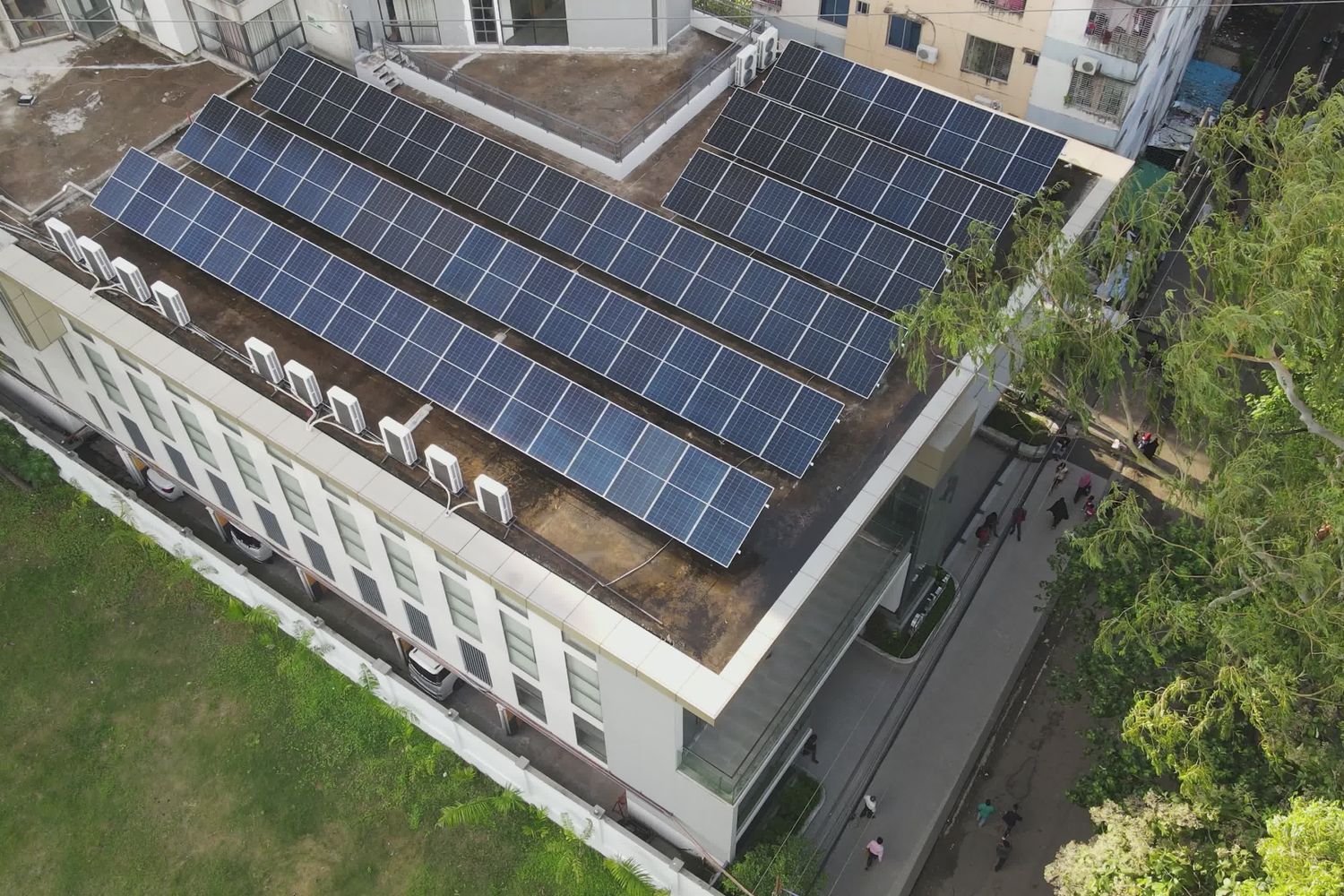
Commercial photovoltaic systems supply electricity to offices, warehouses, workshops, factories and shops. Sites with high daytime loads may use more of their generation directly.
Orientation matters on flat roofs. In December 2020, we completed a 100 kW flat-roof commercial solar installation in Toronto. Its east–west array was designed to capture energy throughout the day. Common commercial applications include:
- Daytime operations: lighting, equipment and HVAC that run during business hours.
- Energy storage: shifts solar output to later in the day.
- Peak management: storage can reduce applicable peak-demand charges.
- Fleet and staff charging: solar-supplied EV chargers on site.
Battery value depends on the tariff. Demand charges and the site’s load profile determine whether storage pays off.
Farms and public facilities
Agricultural and institutional sites have very different load patterns. On-site solar can serve:
- Water systems: irrigation and water pumps.
- Barns: equipment, ventilation, refrigeration and electric fencing.
- Greenhouses: supplementary lighting.
- Public buildings: schools, hospitals, community centres and municipal facilities, subject to their load profiles and connection requirements.
Planning starts with interval demand data, operating hours, roof loading, remaining roof life, connection capacity and applicable demand charges. Gather these data before you request a design.
Remote facilities and communities
Where a utility connection is unavailable or costly, remote microgrids combine solar with batteries, generators, wind or hydroelectricity. Solar reduces diesel use when it is producing, while storage, controls and dispatchable generation maintain supply when output falls.
This renewable energy model already works in Ontario. The Canada Energy Regulator’s 2023 snapshot describes a 300 kW Fort Severn First Nation installation completed in 2021. It is expected to cut diesel demand by about 20%, or 400,000 litres a year.
Frequently Asked Questions
Can solar panels produce electricity during a Canadian winter?
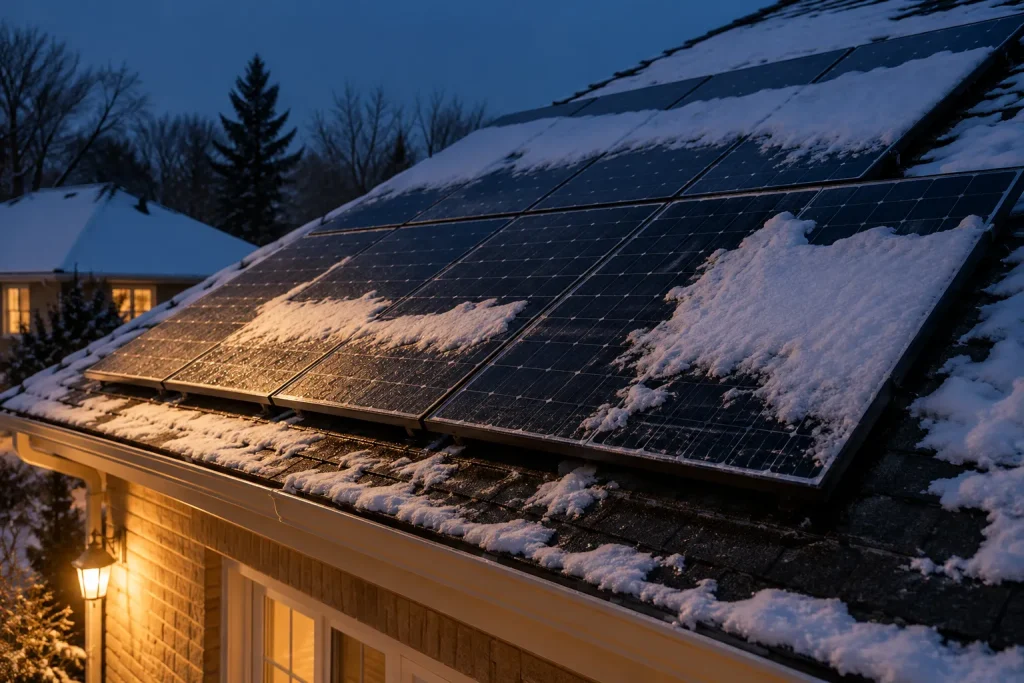
Yes. Panels generate electricity in cold weather, and cells generally work more efficiently at lower temperatures than in extreme heat. Shorter days, low sun angles, snow cover, cloud and shading reduce total winter production, so cold alone does not determine a site’s output.
Is the federal Canada Greener Homes Grant still available for solar projects?
No. The grant is closed, and its final document-upload date was 31 December 2025. The related loan stopped accepting new applications on 1 October 2025.
What approvals does a rooftop solar system need before it can be connected in Ontario?
You need connection approval from your local distributor, which is separate from any incentive pre-approval. Hydro One sends projects of 12 kW or less to a micro-generation form and larger projects to a connection-impact assessment. In Toronto, rooftop collectors over 5 m² (about 54 sq. ft.) and solar hot-water systems require a building permit. The Electrical Safety Authority raised its plan-review threshold to 12 kW on 6 July 2026, but systems still require electrical inspection.