The biggest barrier with industrial solar panels in the GTA, Ontario, is not the same for every building. A roof, a grid connection or a poor fit with your load can stop a project before payback is even calculated. Roof, grid, load, cost and equipment barriers each need screening on your own property before you commit capital.
What is the biggest industrial solar barrier in the GTA?
The real barrier is whether the project works for your specific building. A warehouse in Vaughan and a plant in Brampton can face completely different obstacles, even with similar roof areas. Screening the site first tells you which constraint dominates, and that order of checks shapes every decision after it.
Why the answer depends on the building
An array can produce substantial electricity and still deliver weak returns when on-site use is low, exports are restricted, grid upgrades are expensive, reinforcement is needed or capacity exceeds the facility’s load. Five practical categories deserve screening, and the dominant one is site-specific:
- Roof and grid constraints: structural capacity, membrane condition and feeder or switchgear limits can each block an installation outright.
- Generation-to-load fit: output that arrives when the facility is idle weakens energy savings.
- Project economics and equipment faults: costs, incentives and component failures decide whether the system payback period holds over decades.
Does generation match electricity use?
Start with at least 12 months of bills and interval data. Together, they establish annual consumption, hourly and seasonal demand, maximum demand, daytime and overnight use, and applicable rates before anyone sizes an array.
Timing drives value. A Markham factory running daylight shifts can consume much of its solar output directly, while a mainly overnight operation is a weaker match. Production also shifts with season, cloud, snow, shade, orientation and module temperature.
Model the array against facility demand rather than filling the roof automatically. Battery storage may address timing or demand-management gaps, but cost effective energy storage solutions still need their own assessment of costs and benefits.
Do panel choice and faults change the answer?
Faults can erode returns quietly. Common culprits include dirt or shading, module damage and hotspots (overheated cell areas), moisture or corrosion, potential-induced degradation, and inverter or wiring failures. Monitoring helps separate these problems from normal weather variation.
Industrial PV systems commonly last 20–30 years, and panels may keep generating beyond 30 years, according to the City of Toronto. Inverters can need major work sooner, while panel output warranties commonly run 25 years. N-type monocrystalline TOPCon suits general industrial use; bifacial, heterojunction and back-contact modules may fit particular roofs if added output justifies cost, loading and mounting.
How can grid approvals block an industrial project?
A sound roof means little if the electrical service or local feeder cannot accept the array. Distributors control what connects to their lines, so their review sets a firm gate on cost and schedule.
What can the electrical system accommodate?
Connection design begins with the building’s own equipment. Review these items before choosing a point of connection:
- Service and documentation: service voltage and phase, plus current single-line diagrams.
- Equipment capacity: transformer, switchgear, breaker and metering ratings, along with protection settings.
- Interval load: the facility’s demand profile, which shows how much generation the site can absorb.
A technically workable array may still need transformer, switchgear, protection, controls, metering or service upgrades, and utility-side or transmitter-side work can change cost and schedule. Zero-export designs still face distributor review. Toronto Hydro’s restricted-feeder lookup flags locations with no additional short-circuit capacity, yet its result is neither approval nor a capacity reservation.
Which approvals govern connection?
The Ontario Energy Board’s connection procedure runs in four stages: preliminary consultation, connection impact assessment, connection cost agreement, then build and energization. Its process changes took effect May 1, 2026, so verify older timelines against current rules.
Toronto Hydro’s June 2026 guidance requires a connection impact assessment above 12 kW. Your property’s own distributor, whether in Richmond Hill or Oakville, determines the thresholds and forms that apply.
Hydro One lists 15 days for a complete preliminary request. For its defined small projects, the connection impact assessment takes 60 days without reinforcement and 75 days when a host distributor or transmitter assessment is needed. With reinforcement, it takes 90 days, counted from a substantially complete application.
What else can delay energization?
Municipal permits run in parallel. Toronto requires a building permit for roof- or wall-mounted solar PV larger than 5 m² (about 54 sq. ft.), with framing, mounting and design documents. Mississauga requires a solar-panel building permit, and Markham requires one for commercial roof-mounted PV. Electrical Safety Authority notification generally precedes electrical work, and a Toronto building permit alone does not authorize grid connection.
Toronto Hydro also requires an ESA notice and, above 12 kW, a commissioning report certified by an independent professional engineer. Incomplete drawings, failed technical assessments, inadequate protection, unpaid connection costs and design changes can all stall approval. Toronto’s three-business-day Express Services target and Mississauga’s 7–10-business-day permit prescreening cover reviews, not construction or utility connection.
Which roof problems can stop an industrial array?
A roof’s remaining service life may not match the life of the solar plan. Checking condition, structure and usable area early prevents costly removal and reinstallation later.
Is the roof ready for solar?
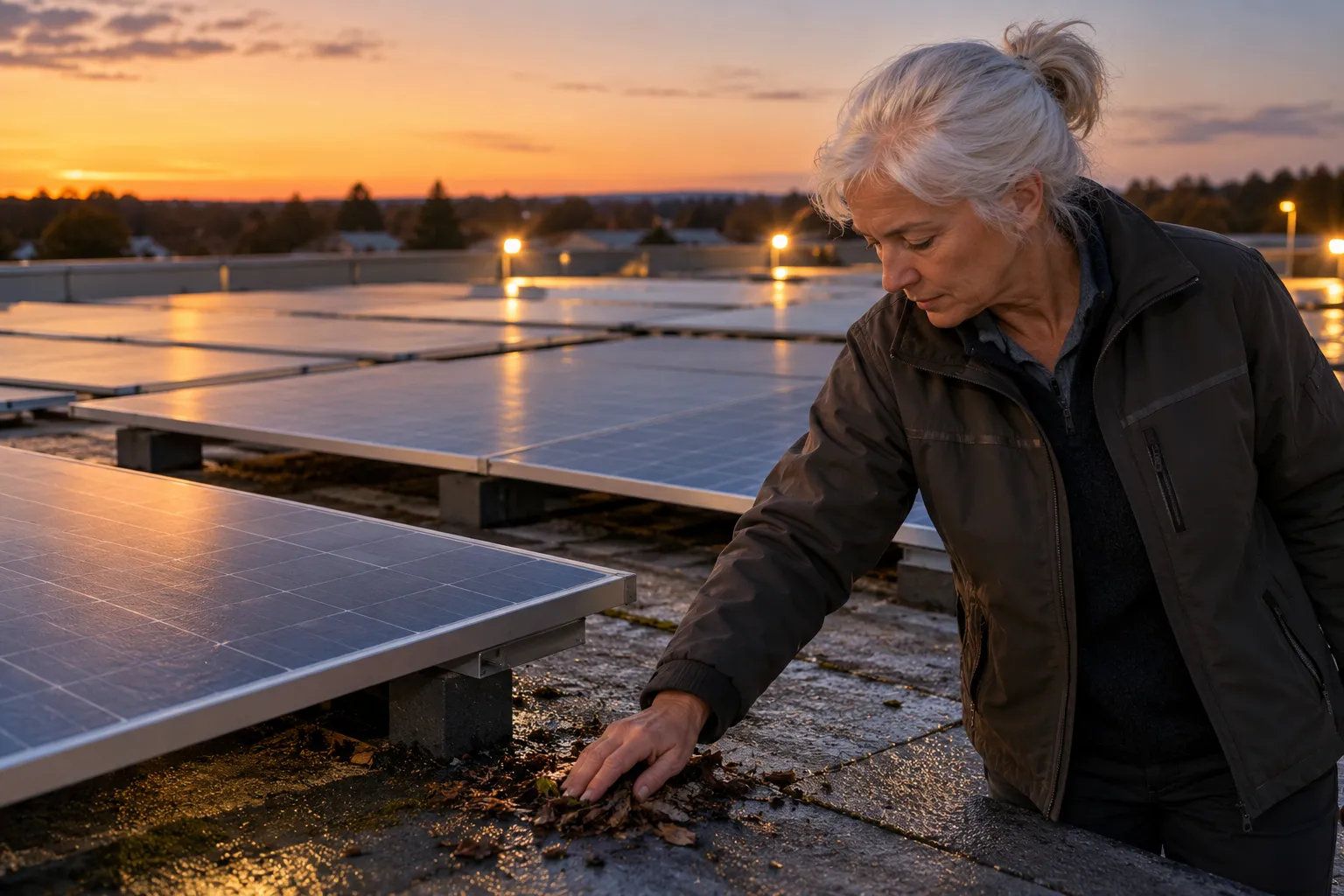
Assess remaining service life, membrane and leak history, warranties, drainage, structural drawings, rooftop equipment and maintenance access. The City of Toronto advises against installing on a roof more than 10 years old, depending on its condition, rather than setting a universal age limit.
A roof replacement due soon should be coordinated with the installation. Replacing it later can require temporary panel removal and reinstallation, so project documents should assign roof access, waterproofing and removal responsibilities.
Weight is the next check. The City of Toronto gives about 2–4 lb per square foot as a typical installation load, and ballasted flat-roof mounting can add more. Structural review also covers concentrated loads, wind uplift, snow drifting, rain and drainage under applicable Ontario Building Code provisions.
How much roof area is usable?
Mounting choice affects both load and waterproofing. Ballasted racking avoids some penetrations but adds dead load, while fastened racking reduces ballast and introduces waterproofing details, according to the Canadian Roofing Contractors’ Association.
HVAC units, vents, skylights, shade, spacing and access routes make usable panel area smaller than gross roof area. Natural Resources Canada’s photovoltaic-potential data, in kWh/kWp, helps screen location and orientation, though it reflects lifetime-average potential rather than a guaranteed yield for your roof.
What do Toronto flat-roof projects show?
Roof geometry and demand shape design. On one Newdawn-es flat-roof project, a commercial flat roof in Toronto carried an east-west panel layout that spreads production across the day instead of concentrating it at noon.
At 60 Mobile Drive, we used Longi bifacial panels, SolarEdge inverters with monitoring and safety features, and non-penetrating racking that preserves roof integrity. The solar installation at 60 Mobile Drive was custom-engineered for Ontario’s grid and climate conditions.
What will solar cost and when will it pay back?
Once roof and grid look feasible, economics decide the project. Installed price, incentives, tax treatment and the way savings are valued together determine whether the clean energy transition pays off for your facility.
What goes into the installed price?
A 2026 Canadian commercial guide estimates Ontario installed cost before incentives at CAD 2.15–3.00/W; these are guide estimates, not GTA contractor quotes. The price of solar panels in Toronto also depends on line items, so ask for a quote separating modules, inverters, racking, engineering, roof work, electrical work, permits, commissioning and interconnection. Toronto’s 2026 permit fee is CAD 425.30 per structure for a system over 5 m².
| System size | Indicative pre-incentive cost (CAD) |
| 25 kW | 47,500–70,000 |
| 50 kW | 95,000–140,000 |
| 100 kW | 190,000–280,000 |
| 250 kW | 475,000–700,000 |
| 500 kW | 950,000–1,400,000 |
Toronto Hydro’s June 2026 initial application payments are CAD 500 plus HST up to 12 kW. Above 12 kW through 30 kW, the payment is CAD 1,500 plus HST, before site-specific connection costs. Ontario taxable supplies generally carry 13% HST, which a registrant may recover as eligible input tax credits to the extent the purchase serves commercial activity, according to the CRA.
Which incentives and financing apply?
In Ontario, the IESO’s 2026 incentive for eligible behind-the-meter rooftop systems fell from CAD 860 to CAD 770/kW AC on June 30, 2026. The IESO also lists CAD 1,000/kW DC for eligible systems up to 10 kW DC. Systems above 1 MW AC are capped at 1 MW AC and 50% of eligible costs, so the applicable worksheet governs calculations.
- IESO timing rules: apply before any binding commitment and finish project steps within 24 months of pre-approval; pre-approval is not distributor connection approval, and an incentive-backed system cannot enter net metering for its lifetime, under the IESO’s Retrofit FAQ.
- Federal Clean Technology Investment Tax Credit: refundable at 30% for eligible property available for use from March 28, 2023, through December 31, 2033, with the labour election, or 20% without it. For 2034 the rates are 15% and 5%, and the credit ends after 2034, according to the CRA.
- Enhanced capital cost allowance: eligible solar equipment can qualify for a 55% first-year rate in 2026, subject to eligibility; government assistance can reduce the federal credit’s cost base, so review depreciation and possible credit recapture.
Financing can close the gap. Toronto’s Energy Retrofit Loan covers up to 100% of qualifying costs for up to 30 years. It requires a third-party feasibility study, two years of audited financial statements and a broader plan targeting at least a 60% greenhouse-gas reduction by 2040.
How is realistic payback estimated?
Value each benefit against what it actually replaces. Self-consumed generation offsets only the bill components it avoids, and demand-charge savings count only when production reliably lowers the billed peak. Ontario net metering pays bill credits, not cash, for eligible exports, and unused credits carry forward for up to 12 months. IESO Class A customers should test output against Ontario’s five peak-demand hours. In leased or multi-tenant buildings, settle roof ownership, account control and who receives savings first.
An owner-purchase model should include quoted capital cost, solar-driven roof and electrical work, operating costs, financing, incentives, tax treatment, degradation, inverter work and residual value; after-tax net present value and cumulative cash flow say more than simple payback. No single GTA payback period holds; our commercial solar installation service offers a no-obligation energy assessment and a custom proposal with site-specific cost and savings estimates. Newdawn-es handles design, permits, installation, financing and guidance on grants, rebates, loans and tax credits; book that assessment before signing any purchase order.
Frequently Asked Questions
Does switching off the main disconnect make a rooftop solar array safe for firefighters?
No. Ontario firefighter guidance warns that opening the main switch and PV disconnect does not de-energize modules exposed to light or the DC wiring upstream. Clear labels, shutdown procedures and responder access therefore matter, and a CSA Group standards list covers module safety, inverters, connectors, DC arc-fault protection and rapid shutdown.
Can wall-mounted solar panels still qualify for the IESO Retrofit incentive?
No longer under the prescriptive solar incentive. The IESO removed wall-mounted PV and updated its worksheet on May 29, 2026, so eligibility now centres on building rooftops.
Who can claim the federal Clean Technology Investment Tax Credit when a tenant or third party owns the system?
Eligibility belongs to the qualifying claimant and property, such as a taxable Canadian corporation or qualifying real estate investment trust, not automatically to the landlord. The CRA also describes possible recapture for qualifying events involving property acquired in the current or preceding 10 calendar years.