To get solar rebates in Ontario, you need to know which program you qualify for, file it in the correct order and prove that the work was finished as approved. At New Dawn Energy Solutions, we take homeowners and businesses through every stage: rebate amounts, eligibility, approvals, the final claim and the choice between a rebate and net metering.
Which solar rebates can Ontario homeowners receive?
Ontario’s provincial homeowner incentive is the Home Renovation Savings Program, which pays for new solar and paired batteries. Municipal financing can help in some cities. Most federal homeowner programs have closed. Before you budget, check which of these you can still use.
How much does the provincial rebate pay?
The Home Renovation Savings rebate program pays $1,000 CAD per kW DC of new rooftop solar capacity. The solar portion is capped at $5,000 CAD and at 50% of eligible solar costs. Enbridge Gas and Save on Energy run the program with support from the Ontario government.
Battery storage paired with new solar earns $300 CAD per kWh, up to a separate $5,000 CAD cap. A project with solar panels and a battery can therefore reach $10,000 CAD in total. Each part must still pass its own capacity calculation and cost limit, so you will not automatically receive the maximum.
| Example project | Solar rebate | Battery rebate | Combined |
| 5 kW DC solar + 10 kWh battery | $5,000 CAD | $3,000 CAD | $8,000 CAD |
| Maximum per measure | $5,000 CAD (and 50% of eligible costs) | $5,000 CAD (and 50% of eligible costs) | $10,000 CAD |
Which costs affect the rebate?
The 50% cap applies only to eligible costs. These include equipment directly tied to the project, labour, connection work, permits and approvals. HST, financing, insurance, later maintenance, spare equipment and tools are excluded.
A typical Ontario installation is subject to 13% HST. That tax raises your upfront payment but does not increase the eligible-cost base. The cost of solar also depends on roof condition and usable area, electrical or structural work, system capacity, storage, site access and the distributor’s connection requirements. Ontario has no single province-wide permit or inspection fee.
Which other homeowner programs are available?
In some cities, municipal financing can be combined with provincial Ontario solar incentives. Toronto’s Home Energy Loan Program lends eligible owners up to $125,000 CAD. Ottawa’s Better Homes Loan Program offers up to $125,000 CAD or 10% of the property’s assessed value. Both are loans that you repay, not rebates, and availability depends on where you live.
The federal Canada Greener Homes Grant is closed to new applicants, and its final document deadline was December 31, 2025. Its former solar grants of up to $5,000 CAD are not an extra Ontario rebate today. The Canada Greener Homes Loan closed to new applications on October 1, 2025. Its interest-free financing of $5,000–$40,000 CAD over 10 years now applies only to applicants who were already approved. There is also no general federal personal income-tax credit for panels used only in your own home, so current residential solar grants in Ontario come from provincial rebates and municipal loans.
Who qualifies for the residential solar rebate?
Eligibility depends on three things: who applies, what kind of property it is and what equipment goes on it. If any one of these fails, the claim fails, so check all three before you request quotes.
Which homeowners and properties qualify?
The property owner must apply. You can apply for a home that tenants occupy, but a tenant cannot apply on your behalf.
- Detached and semi-detached houses are eligible.
- Row houses and townhomes are eligible.
- Mobile homes can qualify if they sit on permanent foundations.
- Occupied new-build homes can qualify if the application is filed before installation.
An electrically heated home needs a residential meter connected through an Ontario local distribution company to the IESO-controlled grid. Off-grid homes and Cornwall Electric accounts are excluded from the streams that depend on the electricity grid. Enbridge Gas customers may still qualify for the streams that apply to them.
Which panels and batteries qualify?
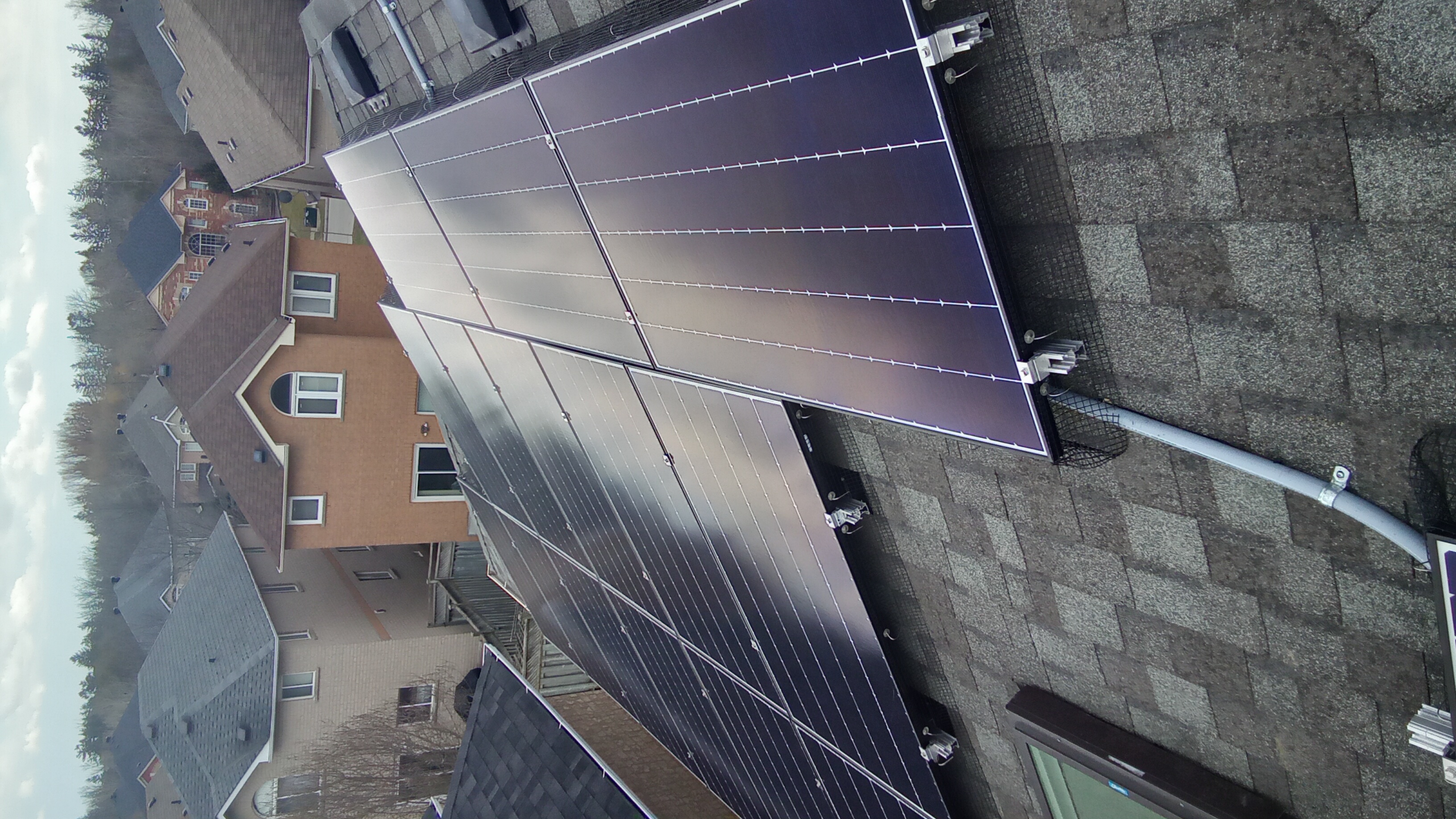
The panels must be mounted on the roof of the home or on a qualifying permanent outbuilding connected to the home’s meter, such as a permanent detached garage. Ground-mounted arrays and panels on portable structures do not qualify.
The rebate covers only first-time installations. If you already have a solar energy system or a battery, replacing or expanding it does not qualify under this residential stream.
A battery must be paired with the new panels and mainly store their output. A standalone battery does not qualify, even if the house is otherwise eligible.
What installation requirements apply?
All equipment must be new, bought in Canada and owned by you. Rented, third-party-owned and lease-to-own equipment is not eligible. The October 2025 Solar and Storage Program Stream Requirements also require a licensed electrical contractor to design and install the system, so a self-installed solar panel installation cannot qualify.
You do not need a home energy assessment for this rebate. At New Dawn Energy Solutions, we assess your household loads and the proposed design before we prepare an installation proposal. This means the sizing is checked before the application begins.
How do you apply and receive payment?
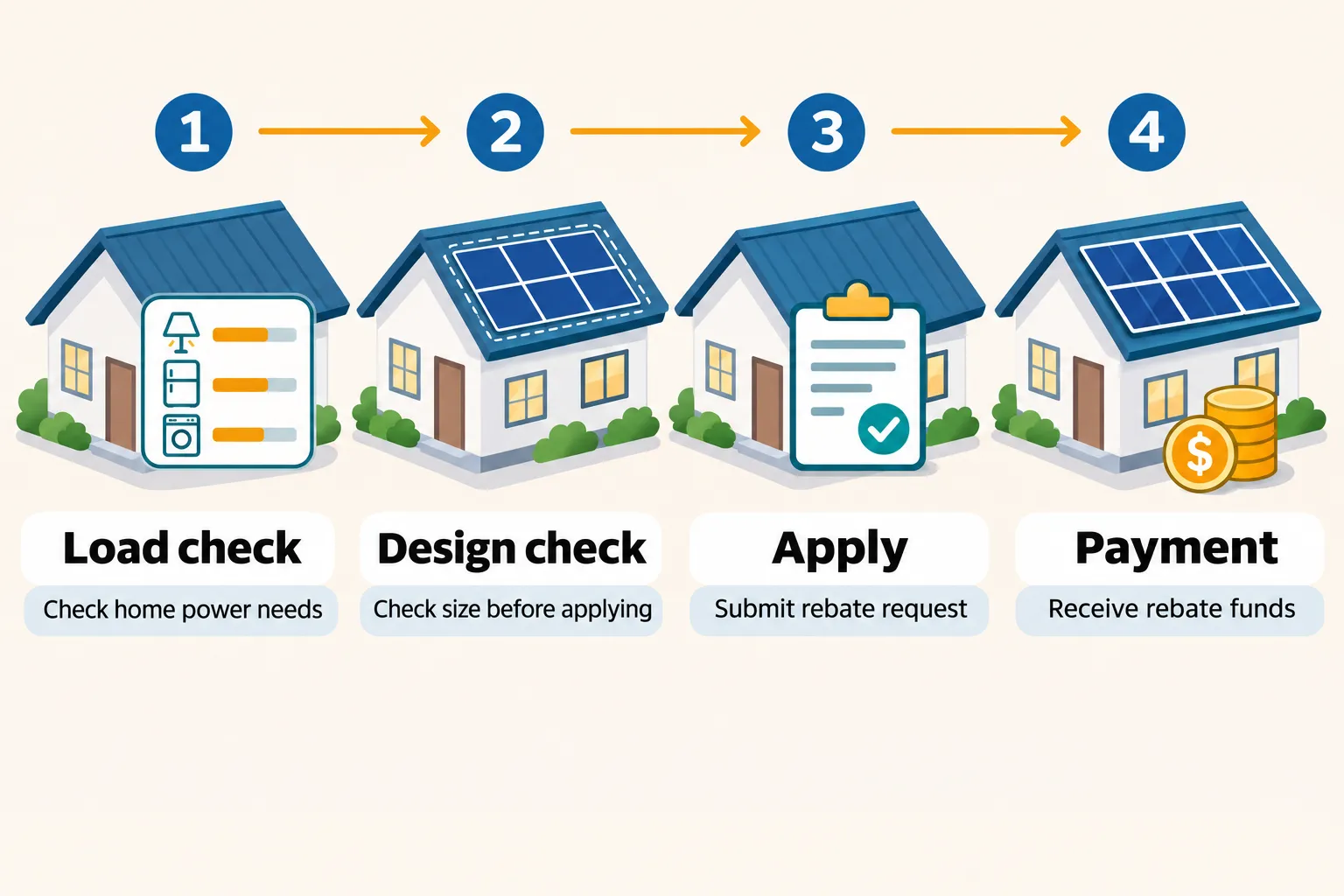
The order of the steps matters. The rebate depends on two approved applications, one before installation and one after, with connection and safety approvals in between. If you buy equipment too early, you can lose the rebate.
Prepare the pre-installation application
Start by checking roof suitability, your household’s electricity use, the proposed system size and whether your local utility can connect the system. We begin every project with a residential solar assessment and a custom design.
- Timing: the contractor files before any equipment is purchased or installed.
- Content: the applicant, the property, the distributor, the proposed kW DC and kWh capacities, the reasons for that sizing, the costs and any other funding.
- Attachments: a signed participant agreement and, where required, a system sketch or single-line diagram.
The detailed proposal and cost estimate must be dated within 60 days of the submission. If your quote is older than that, ask your installer to reissue it before the file goes in.
Secure approvals before installation
Wait for both approvals before you buy or install anything. Program approval does not give you permission to connect.
- Program pre-approval: written confirmation that the project fits the rebate rules.
- Distributor approval: separate consent from your local distributor to connect the system.
- Permits: the municipal permits and Electrical Safety Authority approvals that apply to your site.
Next, the licensed contractor installs the rooftop solar panels according to the approved design. New Dawn Energy Solutions handles permits and installation through our residential solar installation service. Under the October 2025 requirements, the work must be finished within 12 months of pre-approval.
Submit the final claim and await a decision
The contractor has 30 days after installation to submit the post-installation file. It includes an itemized final invoice, equipment details, photographs, the distributor’s generation connection agreement and an Electrical Safety Authority certificate of acceptance or an equivalent inspection report.
You and the contractor then receive a written decision. Pre-approval does not guarantee payment, and a refused final claim pays nothing.
The October 2025 requirements do not set a fixed time between final approval and payment. Keep the proposal, agreement, approvals, inspection and connection records, invoice, photographs and other-funding disclosures together so the review goes smoothly.
Should you choose the rebate or net metering?
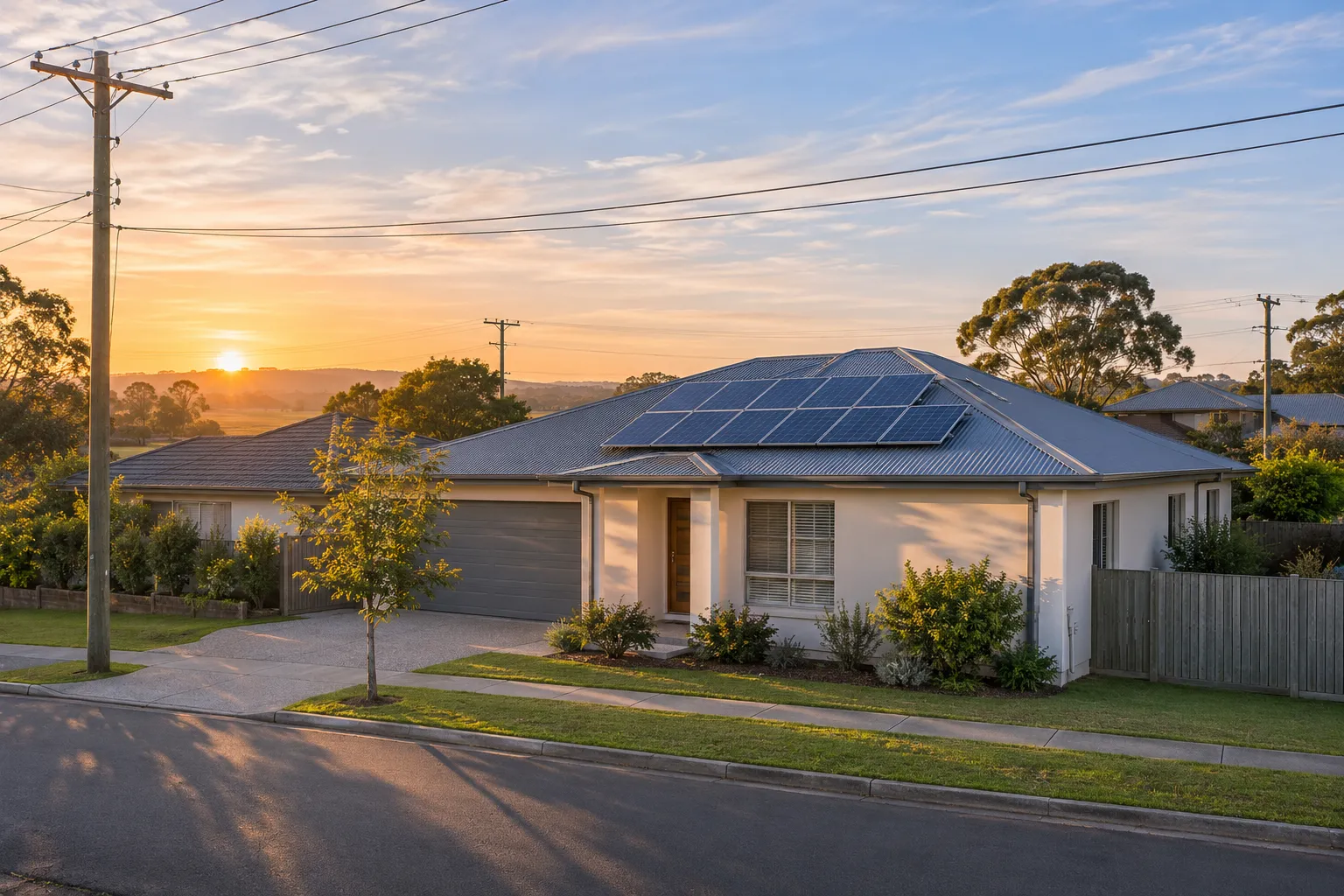
The rebate and net metering cannot be combined. One pays you upfront for solar power you use on site. The other gives you credits for electricity you send to the grid. Choose one before your proposal is finalized.
Why are the two routes exclusive?
The rebate supports electricity used in your home, so a rebated system cannot have a net-metering agreement or any other export-compensation agreement. The October 2025 participant agreement prohibits such an agreement at any time and requires you to repay the rebate if you sign one.
Panels installed outside the program can use net metering if they meet its rules. That route gives up the residential rebate.
How do net-metering credits work?
Under net metering, the renewable energy you export earns a credit on your bill, not cash. The credits offset electricity-consumption charges only, not every line on your energy bills. Unused credits expire after 12 months.
The Home Renovation Savings help page describes 5–10 kW as a typical size for a system that offsets on-site use, not a required size. Whichever route you choose, your local utility must assess the proposed connection.
How should you compare savings?
The rebate lowers what you pay for the system, but it does not guarantee annual savings. Compare the two routes using your daytime and seasonal demand, expected generation, how much you use directly and how much you would export. Roof direction, age, shading, structure and area affect output, and winter weather and snow reduce it. Standard grid-connected panels usually shut down during an outage.
Energy storage can shift daytime production to later in the day. With properly configured equipment, it can also keep power on during outages, which gives you more energy independence. Include the battery’s purchase, installation and eventual replacement costs in your comparison. Our solar and battery storage solutions start with an assessment of your electrical load and backup needs.
How do other applicants access solar incentives?
Commercial, industrial and institutional sites follow a separate route with different rates, deadlines and payment steps. If you own or manage a business property in Markham, Oakville or Burlington, the Retrofit program is the one to look at.
Which business projects qualify?
Save on Energy’s Retrofit program serves eligible commercial, industrial and institutional facilities, including hotels and multi-residential buildings. A tenant can apply with the property owner’s authorization.
- Microgeneration: $1,000 CAD per kW DC for systems up to 10 kW DC.
- Small and medium generation: $770 CAD per kW AC above 10 kW AC and up to 1 MW AC, with the incentive capped at 1 MW AC.
- Cost cap: the incentive cannot exceed 50% of eligible costs.
- Mounting: rooftop and parking-canopy arrays may qualify, but ground-mounted systems do not.
The incentive is for solar power used on site, not for net-metered systems. Unlike the residential stream, Retrofit can accept an array added to a site that already has solar.
How does a Retrofit applicant get paid?
First, confirm the allowable capacity and connection with your distributor. Then submit the solar photovoltaic worksheet through the Retrofit Portal before you sign a contract or order equipment. You need program pre-approval and a separate connection approval. Save on Energy says most pre-approvals take about 2–3 weeks. After installation, you submit your actual costs and evidence, then send an invoice once the project is approved. The cheque normally arrives 8–12 weeks after the invoice is accepted. Projects pre-approved after 2024 must finish within 24 months.
What targeted or tax pathways remain?
Save on Energy plans a Retrofit change for November 30, 2026. The microgeneration threshold rises to 12 kW DC, and the small and medium category will start above 12 kW AC. Incentive rates stay the same, and applications submitted or pre-approved before that date keep their original terms.
The IESO’s 2026 Indigenous Energy Support Program funded project development for renewable energy and storage for eligible First Nation and Métis communities and organizations. Intake closed on October 2, 2026.
Federal business tax measures are separate from residential rebates. Qualifying businesses may consider the Clean Technology Investment Tax Credit for new solar and fixed-location storage. The Clean Electricity Investment Tax Credit is a separate 15% refundable credit for qualifying entities. The same amount cannot be claimed under both credits.
Frequently Asked Questions
Which Ontario solar rebate programs are still open in 2026?
The Home Renovation Savings Program is open. It pays $1,000 CAD per kW DC, up to $5,000 CAD and 50% of eligible costs. The Home Efficiency Rebate Plus closed on February 5, 2024, and the Home Efficiency Rebate ended on January 27, 2025. microFIT closed on December 1, 2017. Durham Region’s deep-retrofit rebate of up to $5,000 CAD, including Whitby’s matching rebate, is fully subscribed.
How much do permits and electrical inspections cost for a home solar installation?
From April 1, 2026, the Electrical Safety Authority charges $336 CAD for contractor-installed systems rated below 10 kW. Toronto requires a building permit for arrays larger than 5 m² (about 54 sq. ft.), at $214.79 CAD for small residential buildings. If the required notification is filed more than 48 hours after work starts, there are charges of $354 CAD for the first two hours and $177 CAD for each extra hour.
Why might a solar rebate claim be refused?
A claim can be refused if work starts before written pre-approval or if the equipment is ineligible or non-compliant. Missing documents are another cause. A system not designed to offset electricity used on site can also be rejected.