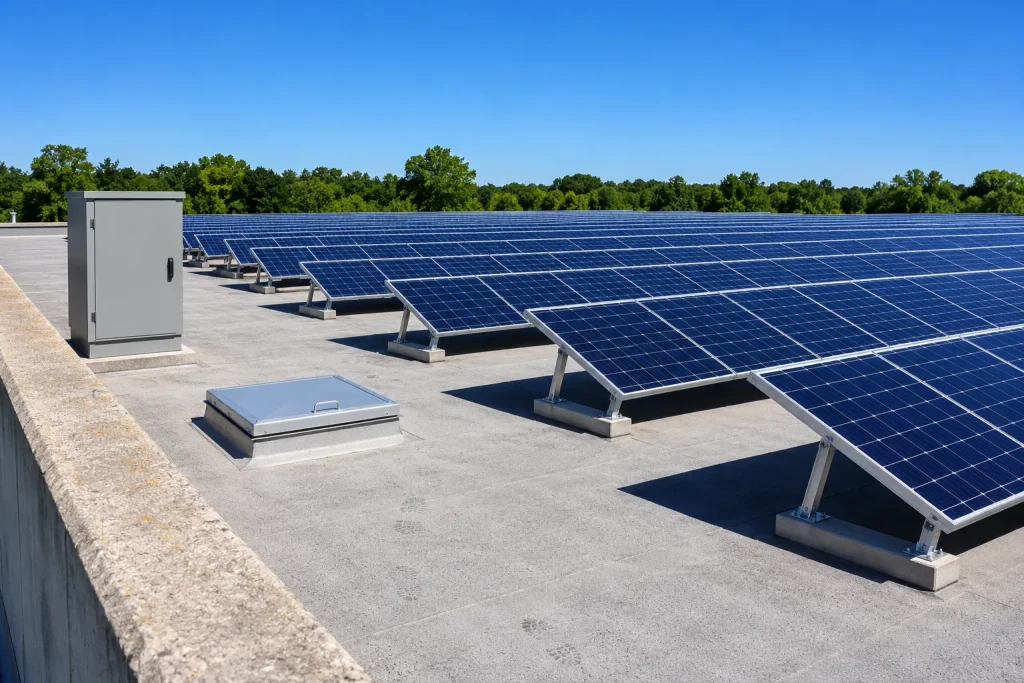
Commercial solar panel costs in Ontario depend on system size, roof conditions, utility connection work and the incentives your business can claim. Ontario planning ranges in CAD run from 10 kW to 1 MW systems. Fees added on top of the installed price, the programmes that lower your net cost, and financing and payback figures all belong in the comparison before you commit.
Commercial solar panel costs in Ontario by system size
Price per watt is a useful starting point. A planning benchmark lets you test a budget against your roof and your electricity load before you request a quote. The final price for any commercial solar installation still depends on your site’s structure, wiring and connection conditions.
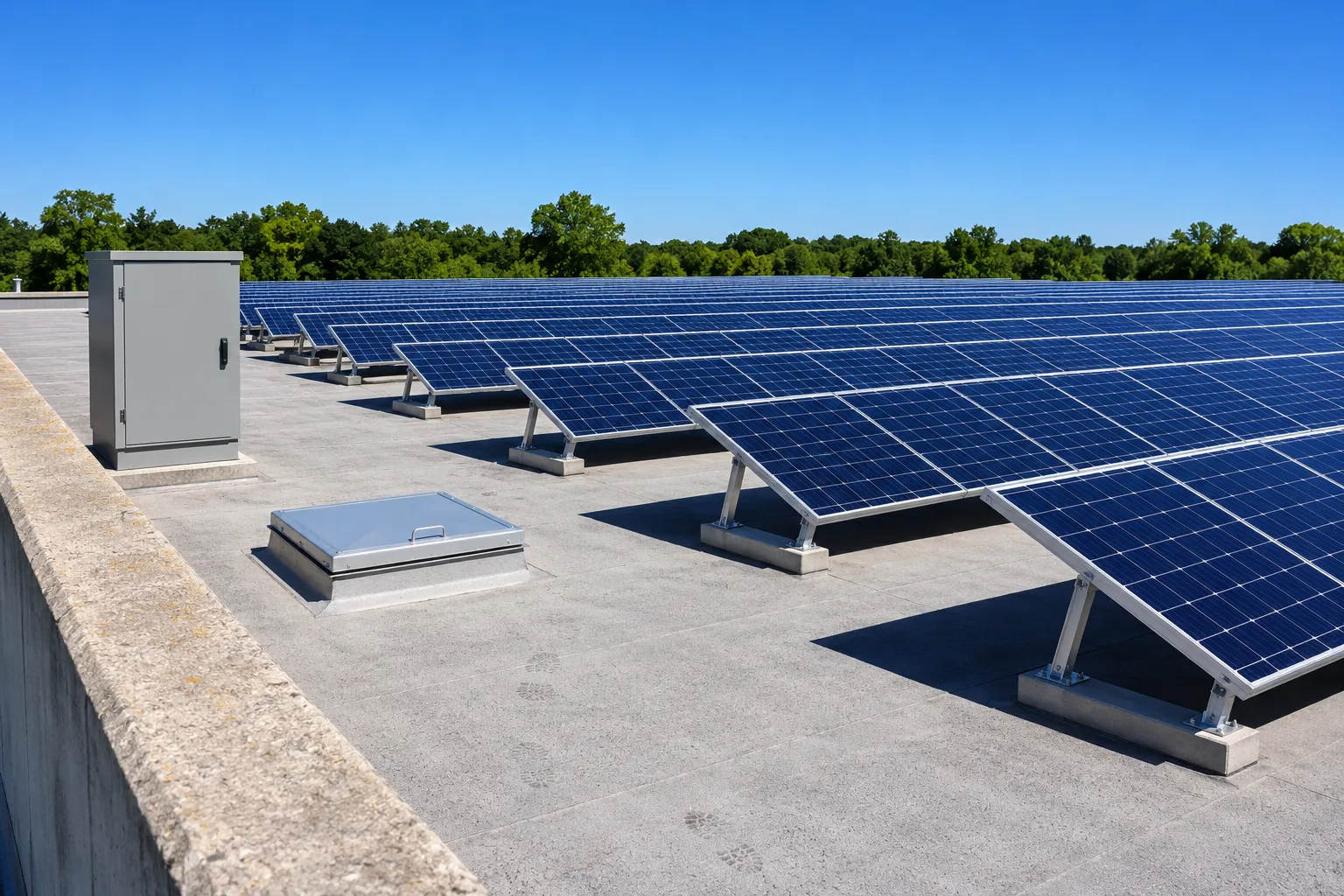
Installed prices by capacity
One published Ontario benchmark puts the average cost per watt at $2.15–$3.00 CAD installed. Use it for planning only, because it is not a verified quotation. The three published benchmarks below cover different markets:
- Ontario commercial benchmark: $2.15–$3.00 CAD per watt installed, the basis for the size estimates in the table.
- Canadian commercial benchmark: $1.90–$2.80 CAD per watt, a separate national guide estimate.
- Residential guide figure: $2.42–$3.05 CAD per watt, which comes from a residential solar guide and is not a commercial price.
- Panel-only prices: the price of an individual panel covers hardware only, not a working installation.
Applying the Ontario benchmark to each system size gives the following before-tax planning ranges:
| System size | Before-tax planning estimate (CAD) |
| 10 kW | $21,500–$30,000 |
| 25 kW | $53,750–$75,000 |
| 50 kW | $107,500–$150,000 |
| 100 kW | $215,000–$300,000 |
| 200 kW | $430,000–$600,000 |
| 250 kW | $537,500–$750,000 |
| 500 kW | $1,075,000–$1,500,000 |
| 1 MW | $2,150,000–$3,000,000 |
A larger commercial solar system costs more in total, but the cost per watt can fall as capacity grows. Labour costs, engineering and inverters do not necessarily rise in step with the number of panels. Fixed project work is spread over more generating capacity.
Roof area and electricity demand
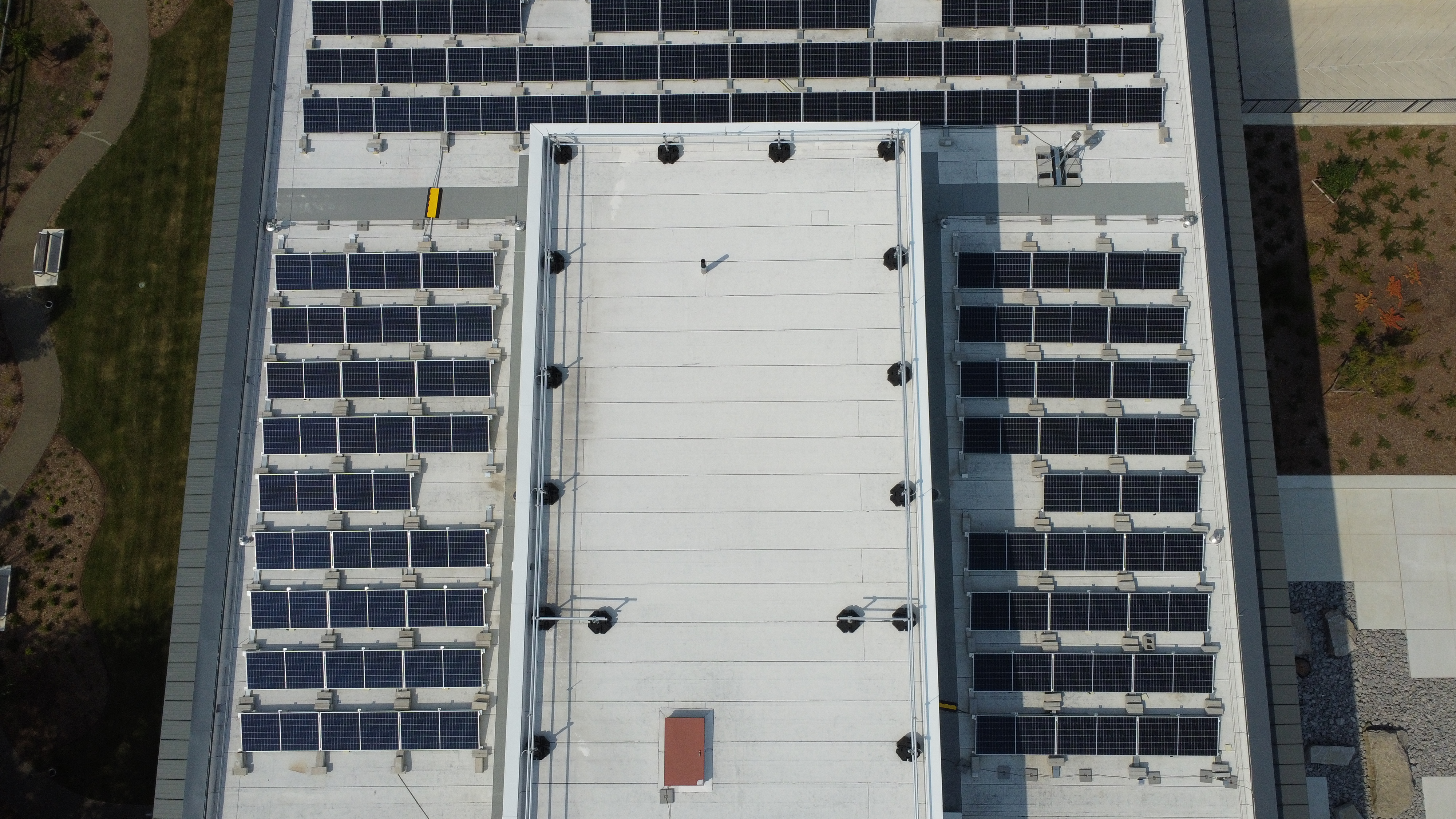
A preliminary guideline for rooftop solar is 15–20 W per square foot of usable roof. At that density, 25 kW needs about 1,250–1,667 sq. ft. and 50 kW needs about 2,500–3,333 sq. ft. A 100 kW array needs roughly 5,000–6,667 sq. ft. For 250 kW, plan on 12,500–16,667 sq. ft. A 500 kW system calls for approximately 25,000–33,333 sq. ft.
Usable area is almost always smaller than gross area. Shading, HVAC units, fire access, setbacks and structural capacity all take space away from the array. A roof assessment also checks the membrane, drainage, remaining service life, and snow and wind loads. Natural Resources Canada notes that ballast on a flat roof adds dead load and can change how snow drifts build up.
Size the solar photovoltaic system to your daytime and seasonal demand and to your utility’s connection limits. Your proposal should state module capacity in kW DC and inverter output in kW AC. Two arrays of the same size can offset very different amounts of purchased power, depending on when each building uses electricity.
What changes an installed quote?
Solar panel installation costs can include modules, inverters, racking, cabling, protection, labour, engineering, permits, interconnection and commissioning. Site conditions decide how far a quote moves above the benchmark:
- Structural work: roof reinforcement adds engineering and construction to the project.
- Electrical and site logistics: unusual electrical upgrades, lifting, staging and planned shutdowns increase labour.
- Delivery: shipping to sites that suppliers reach less easily adds transport cost.
Ask solar installers to list equipment, labour, engineering, permitting, utility studies, structural work, monitoring and exclusions separately, rather than rely on a standard percentage breakdown. At New Dawn Energy Solutions, we assess your energy needs, prepare a tailored design and proposal, and handle permits and installation. Equipment choice matters too. Our 142 kW grid-tied commercial solar panel installation on a Toronto office roof used bifacial panels, inverters with built-in monitoring and non-penetrating racking. The project lowered the owner’s annual electricity costs, although no dollar figure has been published.
Charges beyond the installed price
The installed price does not include every cost. Utility studies, connection work, permits and sales tax are added to the budget for a commercial solar installation. Some of these charges are fixed fees. Others depend on what the utility finds when it studies your connection.
Utility studies and connection work
Each local distribution company sets its own connection charges and study fees. These published figures show the range:
- Hydro One micro-generation: its May 2026 guidance lists a standard connection charge of $800 CAD, subject to site conditions.
- Hydro One common items: where they apply to projects of 250 kW or less, their indicative total is $16,250–$36,000 CAD. This is not a universal surcharge.
- Hydro One estimates above 12 kW: the initial estimate is Class C, accurate to about ±50%, and you pay the actual cost. A qualifying small net-metered project can also pay a $3,329.86 CAD connection-impact assessment fee before HST. That fee covers the study, not the connection work.
- Hydro Ottawa assessments: $1,000 CAD plus HST for its small-generator category and $4,750 CAD plus HST for its medium category. Above 12 kW AC, a preliminary report normally arrives within 15 days, and the completed assessment within 60 days.
A utility study can call for new metering, protection, transformer or feeder work, and those upgrades can make a project uneconomic. Connection approval is also separate from incentive pre-approval. At 500 kW or more, Hydro Ottawa may apply a non-exporting standby charge.
Building and electrical permits
Ontario’s 2024 Building Code treats a building-mounted solar collector of 5 m² or more as a designated structure. In Toronto, commercial rooftop solar panels of that size normally need a building permit and a later inspection. The fee is $425.30 CAD per structure under the City’s schedule effective 1 January 2026. Almost all electrical work also needs a notification filed before work begins. The Electrical Safety Authority’s fee guide, effective 1 April 2026, charges $336 CAD up to 10 kW for licensed-contractor photovoltaic work. Systems above 10 kW through 250 kW pay $917 CAD, and 251–500 kW systems pay $2,292 CAD, plus any equipment charges. Where plan review is required, the authority charges $350 CAD for the first two hours or part thereof. Each additional hour or part costs $175 CAD. The authority decides which installations need inspection and may authorize connection without one.
HST paid and recovered
Ontario’s 13% HST applies to taxable purchases of solar equipment and installation work. Solar components are not automatically exempt from sales tax, so your cash budget should include it.
An eligible GST/HST registrant can generally recover the tax through input tax credits, to the extent the installation is used in commercial activities. Model the HST you pay upfront and the tax you finally bear as two separate figures.
Incentives that reduce the net project cost
Provincial incentives, federal tax measures and depreciation rules can reduce the net cost of a project well below its installed price. Each has its own eligibility rules and timing. How you combine them changes the result.
Save on Energy Retrofit eligibility
Ontario’s Save on Energy Retrofit incentive supports solar panels for business on rooftops and parking canopies that supply on-site load (behind the meter). Ground-mounted arrays do not qualify. Commercial, industrial and institutional participants can apply, including a tenant who has the building owner’s consent. Under the earlier thresholds, microgeneration up to 10 kW DC earns $1,000 CAD/kW DC. For applications from 30 November 2026, that category extends to 12 kW DC, and the small-to-medium category starts above 12 kW AC.
Save on Energy cut its small-to-medium rate from $860 to $770 CAD/kW AC on 30 June 2026. The rate covers qualifying capacity up to 1 MW AC and is capped at 50% of eligible project costs. Above 1 MW AC, incentive capacity is capped at 1,000 kW AC. The programme’s own examples calculate to $38,500 CAD for 50 kW AC and $77,000 CAD for 100 kW AC. An eligible 80 kW AC array works out to $61,600 CAD on a preliminary basis. Each amount remains subject to approval and the cost cap. Submit your application and solar worksheet before you sign any binding commitment, because building before pre-approval puts eligibility at risk. You must also finish within the 24-month period after pre-approval.
Federal tax credits and depreciation
The refundable federal Clean Technology Investment Tax Credit covers qualifying new solar property available for use from 28 March 2023 through 31 December 2033. The rate is 30% when prevailing-wage and apprenticeship requirements are met, and 20% otherwise. During 2034, those rates fall to 15% and 5%. The credit ends after that year.
Taxable Canadian corporations and qualifying real-estate investment trusts can claim this solar tax credit. Government assistance reduces the eligible base. In an illustration, $220,000 CAD of eligible property less a $61,600 CAD Retrofit incentive leaves $158,400 CAD. The 30% credit is therefore $47,520 CAD rather than $66,000 CAD, subject to tax review. You claim it on your corporate return with T2 Schedules 75 and 31.
The credit can be recaptured if the property is sold, exported or converted to other use within the CRA’s 10-calendar-year window. Capital cost allowance is a depreciation deduction, not a cash rebate. The CRA lists Class 43.1 clean-energy property at 30% declining balance. Class 43.2 at 50% requires acquisition before 2025, so do not assume it for a new purchase. We guide businesses through these grants and tax measures as part of our commercial solar installation service for Ontario businesses.
Net metering as a separate route
Save on Energy states that a funded load-displacement system cannot enter a net-metering or other export-compensation agreement for its entire life. You therefore cannot count Retrofit solar incentives and export credits together in one solar investment calculation.
Under an approved net-metering arrangement, Ontario credits offset electricity-consumption charges, not every line on your bill. Unused credits expire after 12 months. Compare both routes for your load profile before choosing one.
Financing and payback for commercial solar
Once you know your net cost, the next questions are how to pay for the system and how quickly savings recover the investment. The ownership structure you choose affects your cash flow, which party claims the incentives, and the payback period itself.

Ownership and financing choices
A cash purchase requires the most capital upfront, but it avoids interest and gives you direct ownership of the equipment. Other structures move the cost over time:
- Loan or equipment financing: you own the system and repay the debt, so compare interest, terms and early-repayment penalties.
- Lease: the comparison should state who owns and maintains the system during the agreement and after it ends.
- Power-purchase agreement: a provider owns the array and sells you its output. The Ontario Energy Board cautions that this does not necessarily save money.
For every option, check contracted payments, escalation, roof obligations, exit terms and which party claims the tax credit. In Toronto, the Energy Retrofit Loan programme can finance up to 100% of qualifying renewable energy project costs for eligible commercial, retail and industrial buildings. Terms run up to 30 years. It is a financing option, not a grant.
How electricity savings affect payback
Each kWh of solar output is worth what it displaces at the moment you use it. An hourly, location-specific production model is therefore more reliable than multiplying annual output by one blended rate. Solar reduces usage-based energy costs, but it does not necessarily remove fixed, delivery or demand charges. Ontario’s Global Adjustment is generally based on consumption for Class B customers. For Class A customers, it depends on demand during the province’s five highest peak hours.
A solar battery can store unused production for later use or provide backup power, but it adds equipment and lifecycle costs. A grid-tied array without suitable backup equipment does not automatically supply your building during an outage.
Are solar panels in Canada worth it?
For a business investing in a commercial solar system, simple payback divides net project cost by annual savings. In one illustration, a $250,000 CAD installation that saves an assumed $30,000 CAD per year pays back in 8.33 years before incentives. Those savings are an assumption, not an Ontario average.
To find solar panels worth the investment for your building in Canada, look beyond simple payback. A site-specific comparison should include financing, operating and roof costs, the timing of tax benefits, and any useful export credits. It should also show net present value and how the result changes if generation or electricity rates shift. Our guide to solar savings for commercial properties covers payback and financing choices in more depth.
Lifespan supports the case. Commercial modules commonly operate for about 25–30 years or longer, and most carry 25-year performance warranties. A well-maintained system can run for 40 years or more. A warranty term is not the same as useful life, however, and inverter replacement, maintenance and insurance all affect lifetime returns. Request a no-obligation assessment so these figures are modelled on your own load.
Frequently Asked Questions
What steps are involved in connecting a commercial solar system to the Toronto Hydro grid?
The Toronto Hydro sequence starts with an application or connection-impact assessment, followed by an agreement and payment. Construction comes next. You then need an Electrical Safety Authority certificate, a utility inspection and any required meter installation.
When should a business seek approval for a net-metered solar project in Ontario?
Seek distributor connection approval before you buy equipment or sign a contract, because local technical constraints can prevent connection. The project also needs an appropriate net-metering agreement. Ontario clarified third-party leasing, financing and power-purchase arrangements for net metering effective 1 July 2022.
Which documents are required to apply for the Save on Energy Retrofit solar incentive?
You need a Retrofit application and the required solar worksheet, version 3.3, effective 4 August 2026. Submit both before any binding project commitment. Construction can start before pre-approval, but doing so puts incentive eligibility at risk.