
The advantages of industrial solar battery storage come from three sources: lower demand-related charges, protected critical operations and more value from on-site solar. This guide covers how each benefit works in Ontario and what it depends on. It also covers the costs, incentives, connection rules and design choices to check before you commit capital.
How solar battery storage benefits industrial facilities
A battery does not generate power. It moves electricity through time. For an industrial solar site, the benefits of energy storage depend on when your facility produces electricity and when it uses it. The gap between those two curves is where storage earns its return.

Using solar electricity after production ends
Midday output of solar often exceeds what a plant draws at that moment. Pairing solar power and battery storage lets you keep that excess and supply it during later high-demand operating hours, including after sunset. Storing solar energy this way extends the working day of every panel.
- Grid charging: a battery can also charge from the grid, and your tariff and supply arrangement decide how that lowers costs.
- Automated scheduling: an energy management system tracks production and consumption, then times the charging and discharging around load patterns.
- Later shifts: evening or night operations can draw on stored output instead of purchased power.
- Reduced reliance: more self-supplied electricity moves a facility toward greater energy independence.
Those scheduling decisions are where solar energy storage turns into savings. At New Dawn Energy Solutions, we size controls and capacity together through our battery energy storage system service, so that dispatch follows your real load profile.
Comparing storage with solar exports
Surplus solar is not wasted without a battery. Eligible Ontario businesses can export excess renewable energy under net metering. Ontario Energy Board guidance says those credits can carry forward for up to 12 months. However, they cannot offset every charge on the bill.
- Regulatory fit: Ontario’s Net Metering Regulation, O. Reg. 541/05, recognizes electricity that passes through storage before on-site use or export.
- Credit limits: charges that credits cannot offset strengthen the case for using the electricity on site.
- Later value: the electricity a stored kilowatt-hour displaces later sets its worth.
- Baseline: direct use or export is the benchmark storage has to beat.
The test is incremental. Storing solar output only adds value when later on-site use compares favourably with the export credit. You should run that comparison before anything else.
Making more of an industrial solar installation
Some connections cap exports. In that case, a battery can absorb solar production that would otherwise be curtailed, provided it has spare capacity and its approved operating mode allows charging.
- Export-limited sites: storage captures constrained output.
- Well-matched sites: where solar output already tracks load and export credits are acceptable, solar alone may deliver better value.
- Sustainability goals: greater on-site solar use supports corporate clean energy targets.
- Emissions outcome: this depends on the electricity displaced and how the battery operates.
Solar energy storage strengthens a clean energy transition plan when the battery’s operating strategy is designed around emissions as well as cost. Pick the outcome that matters most to you, then set dispatch rules that serve it.
Reducing industrial electricity costs
For many commercial and industrial facilities, demand charges are a major source of savings, alongside energy volumes. Industrial battery storage targets the moments that set those charges. The value of doing so depends on your distributor, your rate class and how your bill measures demand.
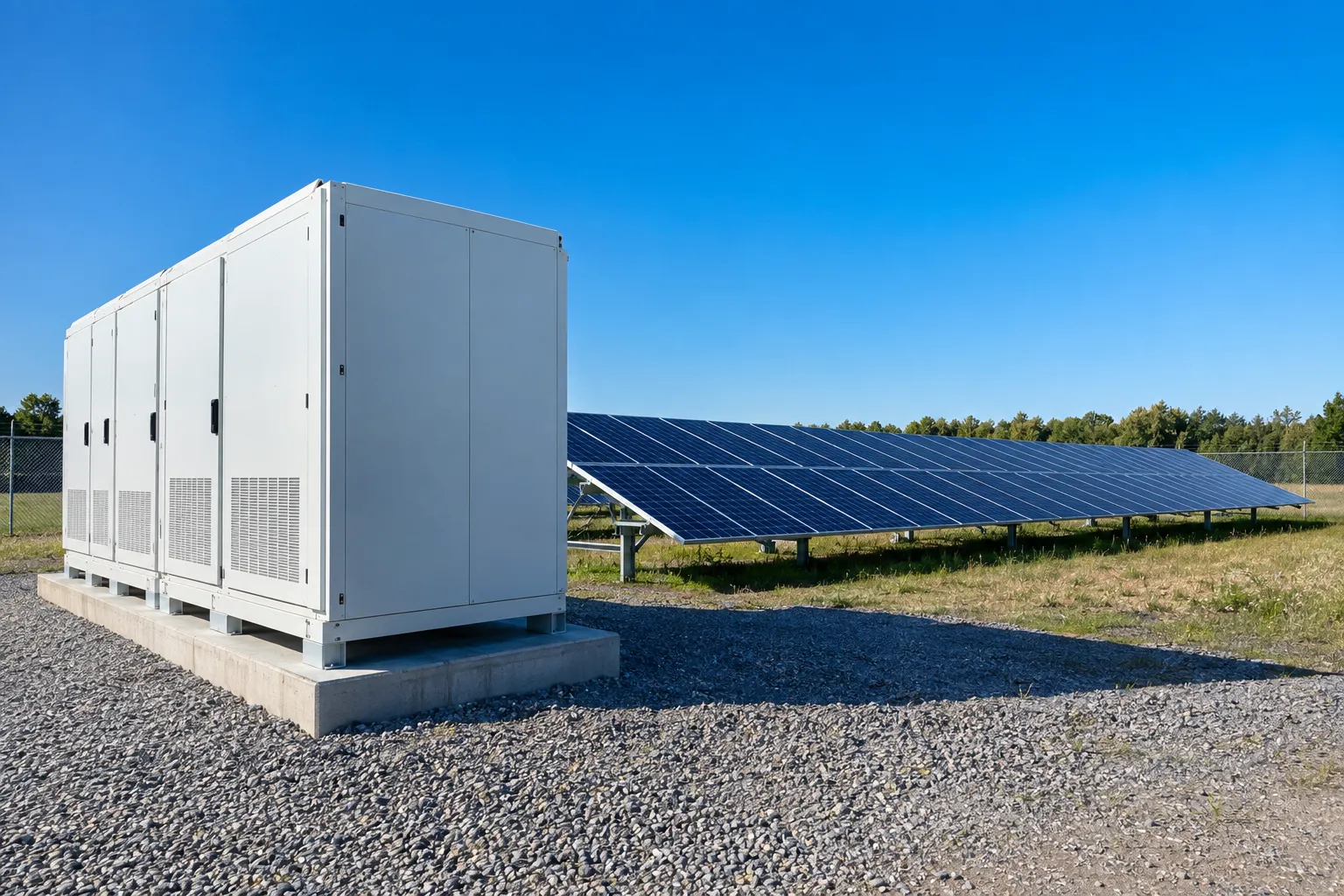
Shaving billed demand peaks
A battery discharges when facility demand would otherwise spike, which trims the grid import your bill records. Successful peak shaving relies on two separate ratings. Discharge power in kW sets how much demand the battery can offset at any moment. Usable energy in kWh sets how long it can keep that offset going.
- Urban rates: Hydro One’s demand-billed General Service customers at 50 kW and above pay CAD $10.5386/kW for distribution from January 1, 2026.
- Urban transmission: connection is CAD $3.0559/kW and network is CAD $4.0895/kW, and these are delivery components rather than the full bill.
- Non-urban rates: the matching components are CAD $20.0233/kW and CAD $2.4073/kW. A third component is CAD $3.1662/kW.
At those urban rates, cutting every applicable billed-demand measure by 100 kW avoids approximately CAD $1,768 per month in gross charges. A battery without enough charge, power, availability or well-timed controls can miss the peak, which leaves the intended billed-demand reduction unrealized.
| Hydro One component (from January 1, 2026) | Urban (CAD/kW) | Non-urban (CAD/kW) |
| Distribution | $10.5386 | $20.0233 |
| Transmission connection | $3.0559 | $2.4073 |
| Transmission network | $4.0895 | $3.1662 |
Managing Class A system-peak exposure
Class A customers face a different peak. The IESO calculates a Peak Demand Factor from a facility’s grid withdrawal during Ontario’s five highest-demand hours in each May 1–April 30 base period. That factor then sets the facility’s share of Global Adjustment for the following period.
- Above 5 MW: average monthly maximum hourly demand qualifies automatically for the Industrial Conservation Initiative, with a June 15 opt-out deadline.
- Above 1 MW and up to 5 MW: facilities can opt in by June 15.
- Above 500 kW and up to 1 MW: specified manufacturing and industrial sectors are eligible, according to the IESO.
The savings are delayed. The May 1, 2025–April 30, 2026 base period corresponds to the July 1, 2026–June 30, 2027 adjustment period. Lowering your monthly maximum does not necessarily lower your contribution during the five system peaks. Model battery dispatch for those specific hours.
Assessing additional industrial value
Ontario already has documented projects. Beyond peak management, a battery can shift energy costs by charging off-peak and discharging when electricity is worth more. This energy arbitrage depends on your actual tariff and supply arrangement.
- Stratford manufacturer: a 4 MW/8 MWh battery manages Global Adjustment.
- Multi-site industrial case: four systems total 5 MW/10 MWh.
- Projected result: that case study projects 20–30% annual bill savings for its own installation only.
- Market participation: the IESO’s May 2026 storage guide identifies potential Day-Ahead Market, real-time, operating-reserve and Capacity Auction access.
Grid services are a separate opportunity from behind-the-meter savings. Facilities generally need more than 1 MW of both injection and withdrawal capacity. Registration, connection, commissioning and telemetry are also required.
Each of these value streams can lower energy bills and electricity costs by reducing reliance on peak-hour power, a theme developed in our overview of solar battery storage in Ontario. Keeping energy costs predictable starts with knowing which charges your battery can actually affect.
Protecting critical operations during outages
Grid resilience matters most when a production line stops. A commercial and industrial battery can keep selected operations running through outages, but only when it is engineered for that role. Being connected to the grid does not, on its own, provide backup.
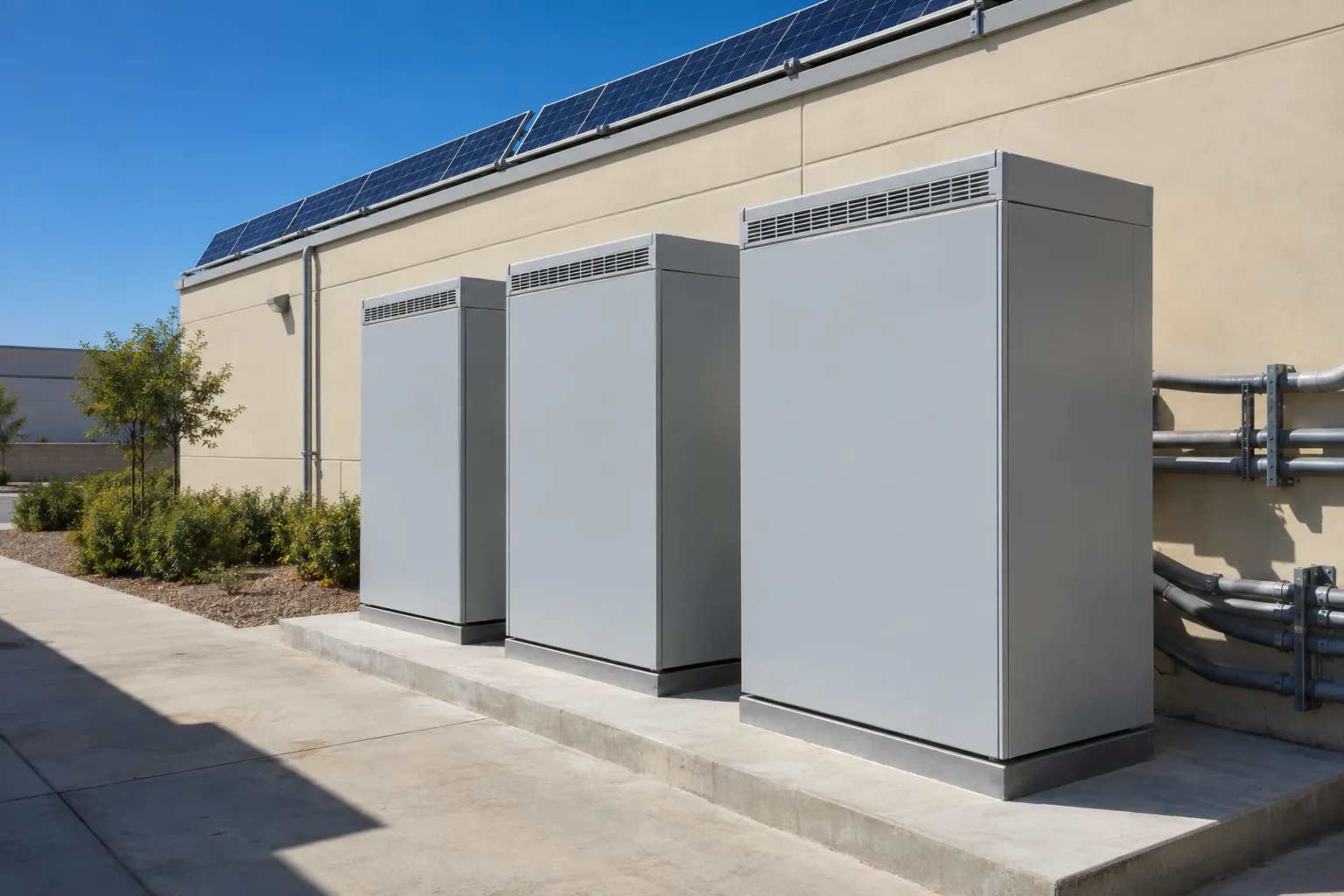
Designing backup around critical loads
A conventional grid-connected solar installation shuts down during a blackout so it does not energize utility lines. Battery backup changes that only when the design includes grid-loss detection, utility isolation, suitable inverter operation, protection, critical-load prioritization and safe reconnection.
- First-order sizing: supplying 500 kW of critical load for four hours requires 2,000 kWh.
- Real requirement: usable energy, reserved charge, inverter power, degradation and auxiliary consumption all raise that figure.
- Industrial loads: motor starting, simultaneous equipment, generator integration and process restarts also shape the design.
Start with a list of loads and the duration each one needs. That list turns a battery energy storage system into a continuity plan.
Valuing continuity against competing uses
Backup value varies by operation. For cold storage, continuous manufacturing and other outage-sensitive processes, it depends on which loads stay available and what interrupted production would cost.
- Shared battery: charge reserved for an outage cannot be used for peak shaving.
- Solar shifting: the same reserve reduces how much production can be moved to later hours.
- Fuel-free operation: a solar battery runs without gasoline, propane or natural gas.
- Duration: backup time depends on stored energy, consumption and any usable daytime solar.
Every reserved kilowatt-hour has an opportunity cost. Your controls must allocate charge between bill management and reliable power, and that allocation should reflect what downtime costs you.
At New Dawn Energy Solutions, we assess your site’s electrical load and backup-power needs before design. We then tailor the system to your operations and budget. Bring us your critical-load list so we can start with the right priorities.
Determining whether storage is worth the investment
The benefits of battery energy only count once they are set against real costs. A sound model tests installed price, losses, lifespan and incentive value before it estimates the system payback period.
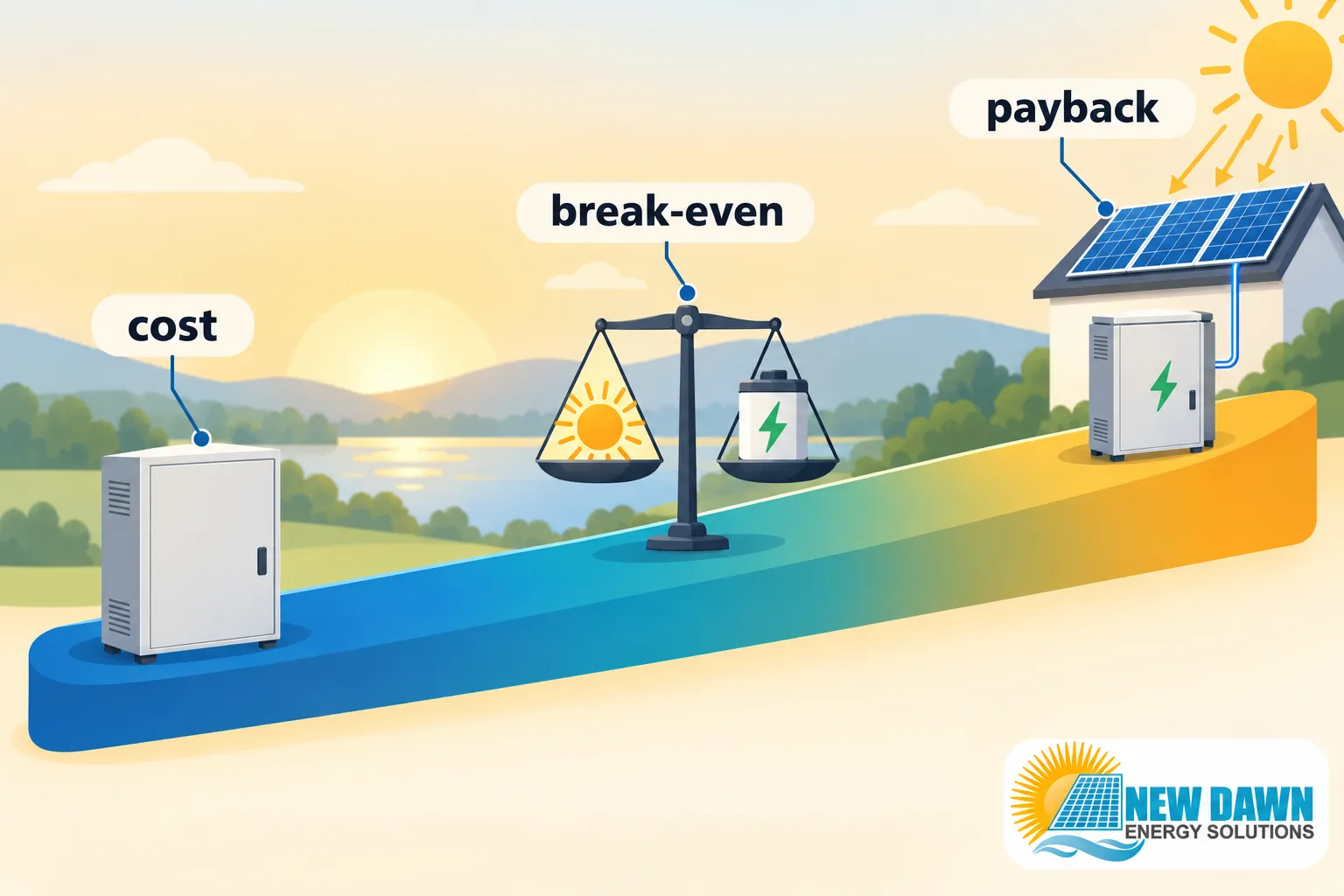
Testing costs against usable performance
A Canadian 2026 market estimate places installed commercial energy storage at approximately CAD $800–$1,400/kWh. The figure varies with project size, discharge duration and integration, and it is not an Ontario quotation.
- Round-trip losses: a 2024 U.S. National Renewable Energy Laboratory utility-scale lithium-ion model assumes 85% efficiency, which is not a site guarantee.
- Lithium iron phosphate: Natural Resources Canada benchmarks approximately 6,000–8,000 cycles before end of life.
- Nickel manganese cobalt: the same benchmarks give 2000–5,000 cycles.
Installed-system warranties and degradation depend on the equipment you select and its operating conditions. Cell benchmarks are a starting point, not a contract term.
Accounting for financing and tax treatment
Tax measures change the net cost of commercial solar battery storage. The refundable federal Clean Technology Investment Tax Credit can reach 30% for qualifying property available for use from March 28, 2023 through December 31, 2033. It can reach 15% in 2034. Choosing not to meet the labour requirements cuts either rate by 10 percentage points.
- Class 43.1: qualifying equipment may use a 30% declining-balance capital cost allowance, with 55% enhanced first-year treatment for property available for use in 2026 or 2027, according to the Canada Revenue Agency.
- Ontario HST: 13% applies, but eligible GST/HST-registered businesses may recover input tax credits.
- Ownership models: direct ownership brings control and operating responsibility, and loans spread that expenditure over time.
Third-party ownership and energy-savings performance contracts change who finances the equipment and who keeps the returns. Compare each structure’s after-tax position, alongside every available tax credit and incentive, before you choose among energy storage solutions.
Designing an industrial system that delivers its benefits
Every benefit above depends on design. Industrial facilities that size, connect and commission their storage correctly are better placed to capture the value they modelled. Shortcuts at any of these stages erode it.
Matching capacity to facility demand
Sizing starts with interval data, operating schedules, the applicable tariff, solar output and planned loads such as electrification or EV charging. Save on Energy’s Energy Performance Program asks applicants for 12 months of hourly interval-meter data and a recent utility bill.
- Power and energy: specify discharge power and usable energy separately.
- Capacity over time: compare beginning-of-life capacity with warranted end-of-life capacity.
- Contract terms: include efficiency, operating conditions and replacement provisions.
New Dawn Energy Solutions provides Ontario commercial clients with consultation, tailored design, turnkey installation and commissioning for solar and battery storage installation in Ontario. After startup, monitoring of production, battery status, consumption and grid power confirms performance.
Confirming the Ontario connection
The Ontario Energy Board’s Distributed Energy Resources Connection Procedures, Version 3, took effect May 1, 2026. They cover exporting, export-limited and non-exporting storage.
- Four stages: preliminary consultation, connection impact assessment, connection cost agreement, then build and energization.
- Small resources: up to 500 kW below 15 kV, or up to 1 MW at 15 kV or above.
- Assessment timelines: 60 calendar days without reinforcement, 75 days with an upstream assessment and 90 days with reinforcement or expansion.
Distributors have 15 calendar days to answer a preliminary consultation request. Their report does not reserve capacity, and connection costs stay site-specific. Confirm feasibility before you commit to equipment.
Addressing safety and commissioning
Ontario’s 29th Electrical Safety Code edition took effect May 1, 2025, and the Electrical Safety Authority lists Bulletin 64-7 for installing and approving an energy storage system. Siting must also satisfy the Fire Code, O. Reg. 213/07, whose cited consolidation applies from January 1, 2026, and address thermal runaway, stranded energy, gases and re-ignition. Technical references discuss ANSI/CAN/UL 9540 and 9540A. Distributor commissioning can then check grid-loss detection and prevention of unintended grid energization against the approved design for each energy storage system.
Frequently Asked Questions
Is it worth adding battery storage to a commercial solar installation?
It depends on your site. Storage can pay off when stored solar is worth more on site than net-metering credits, when exports are limited, or when demand-charge reduction, Class A peak management and backup add value. A facility whose solar output already matches its load may do better with solar alone. A complete model includes financing, maintenance, insurance and possible replacements.
How long does the Ontario connection assessment take for a larger industrial battery?
For small resources, it takes 60 calendar days without reinforcement, 75 days with an upstream assessment and 90 days with distribution reinforcement. Applicants for small or mid-sized projects generally have six months to sign the connection cost agreement. Specified large-project transmission cases get nine or 17 months. No single Ontario-wide construction or commissioning duration applies.
What maintenance does an industrial solar battery system require?
Very little, compared with fuel-based generators. Typical tasks include performance monitoring, firmware updates, connection and safety checks, and reviews of energy-use and savings reports.