A solar panel savings calculator can turn your electricity bills and roof details into an estimate of cost, savings and payback in CAD. Its accuracy rests on each input and on a realistic installed cost. Current Ontario incentives and local rates then set the value of every kilowatt-hour your panels produce.
How does a solar calculator estimate savings and payback?
A calculator works through three steps: your usage, your site’s production and the dollar value of that output. Each step depends on the one before it. If you enter a weak usage figure, every later result is weaker too.
Enter your electricity use and roof details
Most tools start with your address and average monthly bill. A full year of bills gives a more reliable annual kWh figure, and averaging 6–12 months of bills avoids seasonal skew. Some utilities also share actual consumption data through Green Button, which removes the guesswork.
Residential systems typically range from 5 to 12 kW ac. Roof area, orientation, pitch and shading from trees decide how much of that capacity can produce well. Include planned loads in your inputs too. An EV driven 25,000 km a year and charged almost entirely at home could add about 4,500 kWh a year, and a heat pump can also raise demand.
Estimate production for your location
Output depends on local irradiance, meaning the solar energy that reaches your roof. The photovoltaic potential maps of Natural Resources Canada give monthly and annual kWh per kW for grid-connected systems without batteries, on a grid of about 2 km. According to the agency, most systems fall within roughly 10% of these lifetime averages.
As an illustration, a site yielding 1,100 kWh per kW per year gives an 8-kW array about 8,800 kWh in its first year. That figure applies to one site, not to the whole country. Natural Resources Canada’s monthly values do not account for snowfall or weather. The agency also expects panel degradation of about 0.5% per year over a life of 25 years or more.
Calculate annual savings and payback
Annual savings equal the value of the solar electricity you use or export, minus your yearly solar-specific costs. That value depends on your utility’s rules and the rate period in which each kWh is produced.
Simple payback divides the net installed cost after incentives by the first-year savings. A solar payback period calculator cannot give a reliable result without a real installed-cost quote and a sound estimate of bill savings.
A useful tool shows system size, first-year production, installed cost and payback period. A fuller 25-year assessment also includes financing interest, replacement costs, degradation and discounted future savings. Treat these results as a starting point for our site review, custom design and quote.
What does a residential solar system cost?
Cost is the figure that drives every payback estimate. A solar panel cost calculator can only be as accurate as the price you give it. Price storage separately from the panels.
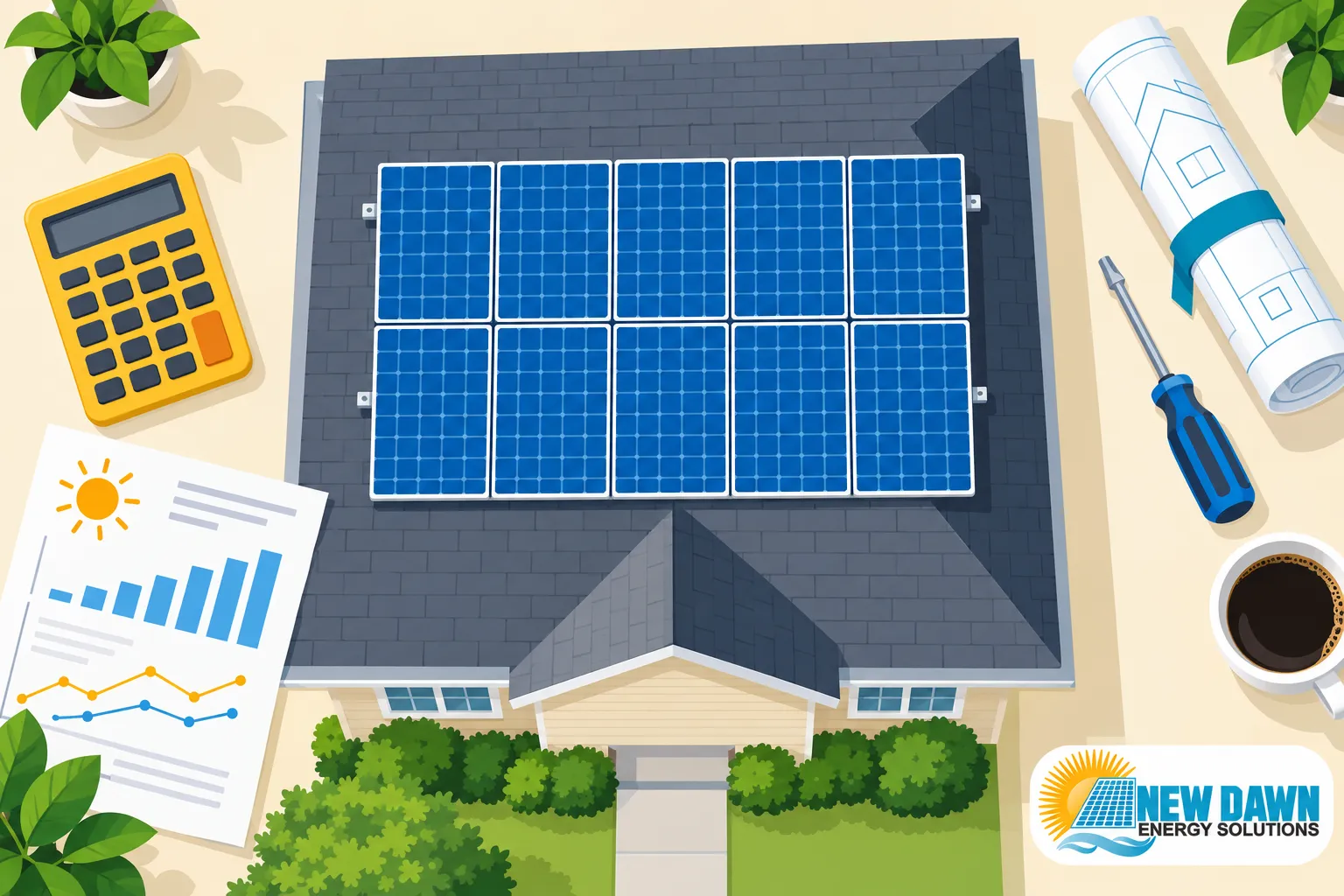
Set the installed-cost estimate
Canadian residential solar is commonly priced at $2.50 to $3.50 per watt installed. Roof conditions and equipment choices move a project within that range, so enter the price from your quote rather than an average. The installed price covers the following items.
- Equipment and shipping: panels, inverters, racking and their delivery to your home.
- Contractor labour: the crew’s time to install the array and wire it in.
- Permits and inspection: municipal requirements and Electrical Safety Authority inspection.
- Utility connection: whatever your distributor requires to connect the system to the grid.
We assess your energy needs, roof size, angle and sun exposure before preparing a custom design and cost estimate for our residential solar systems for Ontario homes. If you finance the project, add the loan terms to your total-cost calculation.
Allow for costs after installation
String inverters usually carry 10- to 15-year warranties. Budget for at least one inverter replacement over the system’s life.
Panels have no moving parts and are built to last 25 years or more. Ownership still includes occasional cleaning and routine system checks.
Utility access or connection charges and financing interest also count as solar-specific costs. A tool that leaves them out can understate the true system cost.
Price battery storage separately
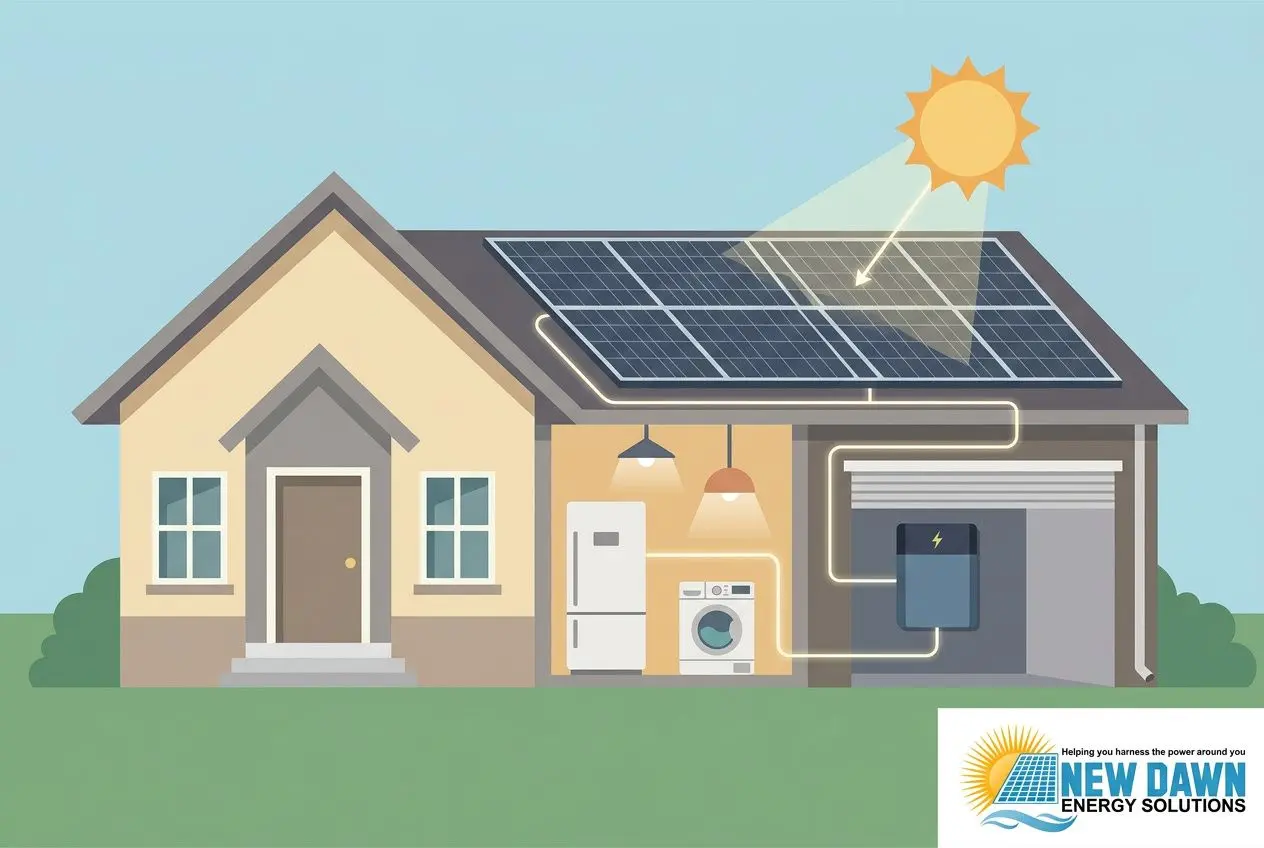
A standard grid-connected system shuts down during a blackout. A properly designed solar-and-battery system can instead keep essential loads running. Storage also holds daytime production for use at night or during higher-priced periods. As our guide to solar battery storage in Ontario explains, available backup depends on capacity, household use and daylight production.
Battery economics need their own cost and savings estimate. Multiplying capacity in kWh by a retail rate does not work. Our residential designs assess storage alongside grid-tied solar and EV charging.
Which Ontario solar incentives are still available?
Incentives reduce net cost, and net cost is what sets payback. Before a calculator subtracts any program, check that it is open and that you are eligible.
Apply the current solar and battery rebates
Ontario launched the Home Renovation Savings Program on January 28, 2025. It covers rooftop solar and battery storage through two rebates.
- Solar rebate: $1,000 per kW of rooftop solar, up to $5,000.
- Battery rebate: $300 per kWh of storage, up to $5,000. Reaching that ceiling requires about 16.67 kWh.
- Cost cap: each rebate is also limited to 50% of its eligible cost.
Because of the 50% cap, the amount you receive can be lower than the advertised maximum. Enter the rebate your quote actually supports.
Check the program’s system rules
A system that receives the solar incentive must serve household loads and cannot use net metering. Your projected savings therefore cannot include export credits. An eligible battery must be paired with a new rooftop solar system and mainly store its generation. The program does not fund standalone batteries.
The program recommends completing planned upgrades, such as a heat pump or EV charger, before you size the array. Adding them later can leave the system undersized.
Exclude business-only incentives
The federal Clean Technology Investment Tax Credit applies to qualifying taxable corporations and certain trusts, not to individual homeowners. Qualifying claimants receive 30% when labour requirements are met. That credit belongs to commercial solar installation for Toronto businesses, so leave it out of any home solar calculation.
How do Ontario rates change bill savings?
The same array can save very different amounts depending on your rate plan. Electricity rates set the value of each kWh, so a solar savings calculator needs the plan that appears on your own bill.
Use the applicable electricity prices
The Ontario Energy Board sets three residential plans, with commodity prices effective November 1, 2025.
- Time-of-use: three prices that change with the hour of the day.
- Ultra-low overnight: a very cheap overnight price and a high on-peak price.
- Tiered: two prices based on monthly consumption.
- Tier 1 threshold: 600 kWh per month in summer and 1,000 kWh per month in winter.
Match the plan and period to your bill before you enter a rate.
| Rate plan | Period | Price (¢/kWh) |
| Time-of-use | Off-peak | 9.8 |
| Time-of-use | Mid-peak | 15.7 |
| Time-of-use | On-peak | 20.3 |
| Ultra-low overnight | Overnight | 3.9 |
| Ultra-low overnight | Weekend off-peak | 9.8 |
| Ultra-low overnight | Mid-peak | 15.7 |
| Ultra-low overnight | On-peak | 39.1 |
| Tiered | Tier 1 | 12.0 |
| Tiered | Tier 2 | 14.2 |
Value the electricity solar produces
Applied to 8,800 kWh a year, 9.8¢ gives about $862 and 12.0¢ about $1,056. At 14.2¢ the result is $1,250, and 15.7¢ gives $1,382. At 20.3¢ it reaches $1,786. These are arithmetic comparisons, not forecasts. Under ultra-low overnight pricing, on-peak and overnight prices differ by 35.2¢, so a solar electricity bill savings calculator must separate noon production from night purchases. Board prices also cover the commodity only, and the Ontario Electricity Rebate was 23.5% from November 1, 2025, so an all-in rate misstates your monthly savings.
Account for net-metering credits
Under Ontario net metering, your generation serves the home first and eligible excess goes to the grid for a bill credit. Credits offset electricity charges and some variable delivery and regulatory charges. They cannot offset fixed monthly service or smart-meter entity charges. Unused credits carry forward for up to 12 months before dropping to $0, so compare projected exports with later eligible charges.
Regulation O. Reg. 541/05 requires distributors to credit eligible exports. Amendments effective July 1, 2022 also allow third-party ownership. Base your estimate on your rate plan, and keep net metering separate from the rebate program’s load-displacement rules.
Frequently Asked Questions
Is home solar worth it in Canada in 2026?
It depends on your site. No payback period or dollar saving applies Canada-wide, because location, utility, roof, usage, financing and programs all matter, and the Canadian Renewable Energy Association links payback to local prices. The City of Toronto’s SolarTO material cites 9–11 years without incentives, assuming $0.156/kWh over 25 years. After payback, the electricity is essentially free for the rest of the panels’ life.
Do solar panels still produce savings in a Canadian winter with snow?
Yes. Panels keep generating in winter and cloudy weather at reduced output, and cold temperatures can improve their efficiency. Solar can also produce effectively in heavy-snow regions. Tilt matters here: Toronto sits near 44° latitude, and lower tilt angles can increase snow-retention losses.
How many installer quotes should you compare before relying on a savings estimate?
Compare 3 from certified installers, and check local incentives, roof suitability and financing at the same time. Local installers often offer lower prices than national chains. A calculator only gives you a starting point, and a professional site review, system design and accurate quote should guide your final decision.