This article walks Canadian businesses through the commercial solar installation process, from the first assessment to grid connection. It covers system design, permitting, costs in CAD, and available incentives, giving you a clear basis for moving forward.
Assessing a commercial solar installation site
Before design work starts, the project team reviews your property, energy consumption, and available space to identify a suitable solution for your operating needs and budget.

Can a business use commercial solar panels?
Virtually any business—whether it has sufficient roof area, a parking structure, or unused land—can benefit from commercial solar panels. The feasibility review examines property documentation and confirms that installing panels on the premises is legally permitted before design or procurement begins.
- Grid-tied systems Connect directly to the utility grid, enabling businesses to offset consumption and receive net metering credits on their electricity bills.
- Solar plus battery storage Pair on-site energy production with battery backup to strengthen grid resilience and use stored electricity during off-peak periods or outages.
- Solar parking canopies with EV charging Turn underused parking areas into dual-purpose assets that generate clean power while supporting electric vehicle infrastructure.
- Building-integrated solar Incorporate photovoltaic technology into the building’s architecture, producing commercial solar energy as part of the structure.
Ground-mounted commercial systems require geological and topographical surveys to guide foundation design. Shading analyses also confirm seasonal sunlight exposure and help optimize projected energy production. Reviewing commercial solar installation insights can help you compare deployment formats before committing to a final design.
Roof requirements for a solar system
Your rooftop’s structural integrity is essential. A qualified engineer evaluates whether the roof requirements for solar panels on your building are satisfied by reviewing mechanical loads and confirming that the surface can safely support modules, mounting hardware, and installation equipment.
- Load-bearing capacity The roof must support panel weight, racking systems, and the snow or ice loads typical of Ontario winters.
- Surface condition Roofing materials and membrane condition are checked to ensure mounting will not compromise weatherproofing or warranty coverage.
- Orientation and pitch South-facing surfaces with a suitable slope maximize annual solar irradiance and improve system yield across the seasons.
Rooftop suitability determines whether the project can use the existing surface or needs another option, such as a carport or a ground-mounted array on adjacent land. This ordering also shortens the time needed for permitting and procurement.
Energy and grid feasibility review
Understanding how the commercial solar PV system will connect to the grid is essential before detailed design begins. The assessment covers available electrical infrastructure, the main panel location, inverter placement, cable routes, and access points, all of which affect project complexity and cost.
- Electricity consumption analysis Historical utility bills and demand data are reviewed to size the system accurately and estimate energy savings across its operating life.
- Grid connection method The team determines whether interconnection will be handled internally or through the local utility, clarifying timelines and regulatory requirements early.
- Incentive eligibility check Federal and provincial programs are identified at this stage so the proposal reflects accurate net costs from the outset.
- Alternative deployment options When rooftop space is limited, parking areas, carports, or unused land may provide productive locations for a commercial solar panel array.
Reviewing the commercial solar installation process in Ontario shows why a rigorous feasibility review helps reduce delays during permitting and construction. Establishing the energy baseline, grid connection route, and site constraints early makes the proposal more accurate and keeps the project aligned with your financial targets and clean energy transition goals.
Designing the system and project cost
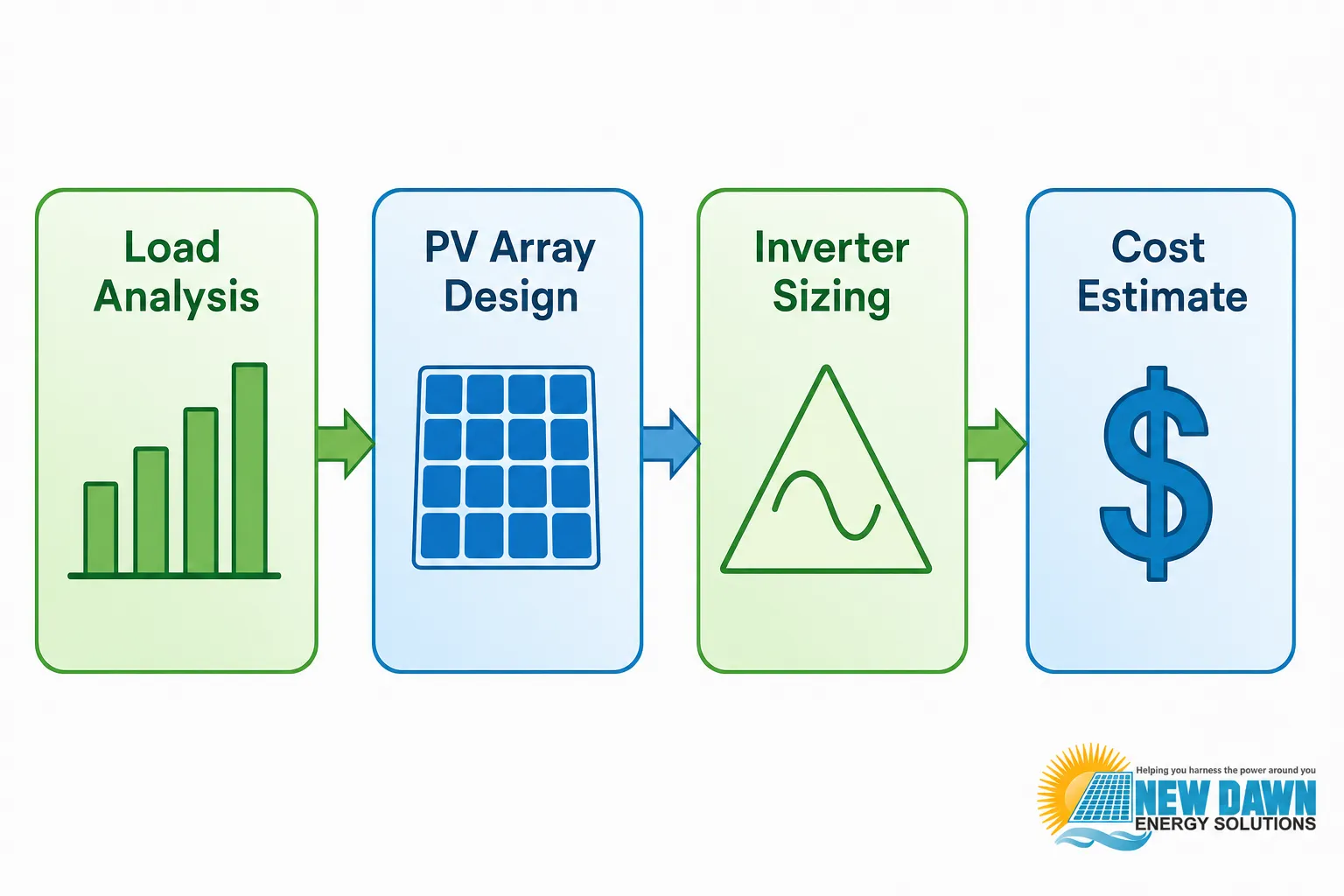
Once site-assessment data is collected, the design and commercial solar panel installation proposal stage turns those findings into a detailed, costed plan. This process establishes the panel count, layout, component selection, projected energy savings, and complete financial picture, including applicable Canadian incentives.
How many commercial solar panels are needed?
There is no fixed formula for determining how many solar panels a commercial building needs. The answer depends on electricity consumption, usable installation area, shading, the target offset percentage, and the wattage of the selected modules. A data-driven design addresses these variables for your specific site.
- Consumption baseline Twelve months of utility data establish average and peak demand. This information forms the basis of the commercial solar system sizing calculation.
- Available area and shading The panel layout is optimized for confirmed usable space while accounting for obstructions, setbacks, and seasonal shading patterns identified during the assessment.
- Module and inverter selection Panel wattage, efficiency ratings, and inverters are selected to match the design objectives, mounting area, and existing electrical infrastructure.
A detailed proposal sets out the full project scope, including panel layout, projected energy production, estimated annual electricity savings, total cost in CAD, and the advantages or limitations of each option. That transparency lets your team evaluate the investment using site-specific information rather than industry averages.
Energy savings and battery storage
Installing a commercial solar system produces clean electricity on-site, reducing grid electricity expenses and improving long-term price stability as Ontario power costs rise. A commercial solar installation typically advances at approximately 65 kW per week, helping businesses estimate project duration according to system size. Battery storage can capture excess daytime generation for use at night or during periods of elevated grid costs, reducing reliance on utility electricity outside production hours. It also supports peak-demand management and outage resilience, which matters to operations where continuity is critical. Time-of-use optimization can add financial value beyond solar generation, strengthening the overall system payback period.
Commercial solar installation cost and incentives
Installing commercial solar in Canada requires upfront capital, but federal and provincial programs can materially improve the financial case for eligible businesses.
- Federal Clean Technology Investment Tax Credit Eligible businesses can access a 30% refundable tax credit on qualifying solar PV and battery storage investments, including design, equipment, and installation labour costs.
- Accelerated depreciation A 100% first-year depreciation claim on eligible solar systems reduces taxable income in the year the system is commissioned and becomes operational.
- Rooftop solar incentive Ontario businesses may qualify for up to $770 per kW for rooftop solar installations, subject to program eligibility and applicable terms confirmed during the proposal stage.
Ontario businesses may also qualify for the Save on Energy Retrofit Program, which supports behind-the-meter solar PV that displaces grid electricity and reduces demand charges. Combined with energy savings and applicable micro-generation credits for electricity exported to the grid, these programs can bring the system payback period to roughly five to nine years, depending on system size, consumption profile, and confirmed incentive values.
| Incentive program | Type | Value / rate | Eligible scope |
| Federal Clean Technology Investment Tax Credit | Refundable tax credit | 30% of eligible project cost | Solar PV, battery storage, related equipment |
| Accelerated CCA depreciation | Tax depreciation | 100% first-year write-off | Eligible commercial solar systems |
| Save on Energy Retrofit Program Rooftop solar incentive (Ontario) | Provincial incentive | Up to $770/kW | Behind-the-meter Rooftop commercial solar installations |
For businesses installing commercial solar, a turnkey installation should connect the system design, equipment selection, permitting, and commissioning into one coordinated plan. Ask for a fixed-cost turnkey quote to eliminate mid-project surprises.
Completing the solar installation and grid connection
Once the design is approved and incentives are confirmed, the project moves into permitting, construction, and grid interconnection. The installation team manages each phase on your behalf, limiting disruption to business operations while maintaining compliance with Ontario requirements throughout the process.
Permits and commercial solar project planning
Permitting is structured and manageable with an experienced contractor. To understand how much time it takes to install solar panels overall, you must include the approval period before physical construction begins. Requirements vary by municipality and utility, so early submissions help protect the planned timelines. The contractor prepares applications, coordinates with local authorities, and manages utility interconnection paperwork, reducing the regulatory workload for your operations team.
- Building and electrical permits Applications go to the relevant municipal authorities and confirm that the commercial solar system installation meets building codes, electrical standards, and applicable safety requirements.
- Pre-installation planning meeting Before construction is scheduled, the team confirms site access, material storage, work hours, scaffolding locations, health and safety procedures, and constraints specific to your business.
- Construction Phase Plan sign-off A formal Construction Phase Plan is prepared after the meeting. Physical work begins only after both parties approve it, protecting your operations and the installation crew.
Scheduling is coordinated with your operations team so scaffolding and primary installation work cause as little disruption as possible. Careful planning at this point reduces on-site delays and keeps the project within the agreed timelines in the proposal.
How much time does solar installation take?
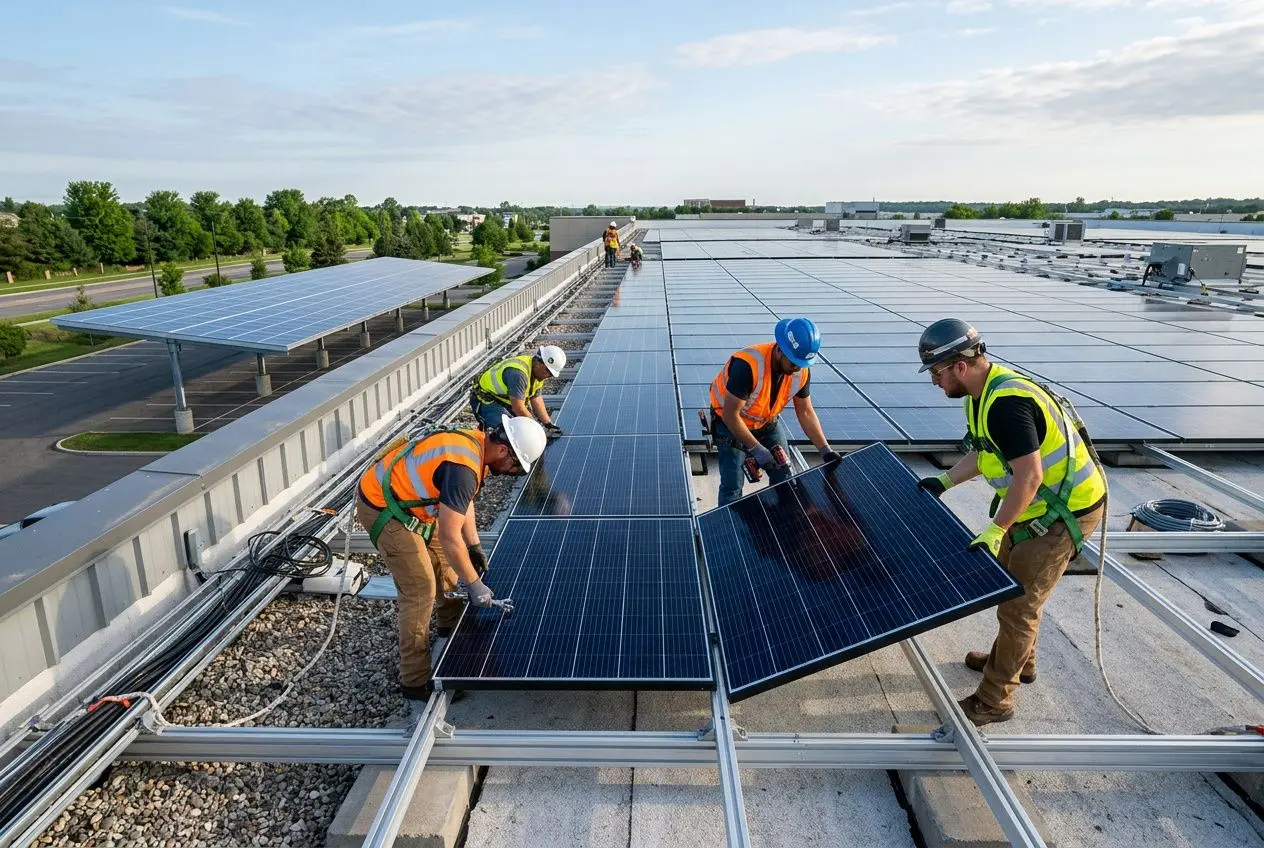
Commercial solar installation timelines depend on system size, site conditions, and permitting. On a typical commercial rooftop, mechanical work advances at approximately 65 kW per week. Electrical duration depends on the number of inverters, cable-run distances, and other site-specific factors.
- Mounting and racking Scaffolding is erected, mounting frames and cable trays are fixed to the prepared surface, and DC cabling is installed before the solar panels are placed according to the approved design.
- Panel placement Modules are secured to the racking with hardware tightened to specification. MC4 connectors link the panels to the DC cable runs reliably and without compatibility problems.
- Electrical integration Inverters are installed near the main electrical panel in a cool, sheltered location. They convert DC solar output into AC electricity for use throughout the commercial facility.
- Generation metering A consumer unit connects to the inverter output, while a generation meter records energy production in real time from system commissioning onward.
PV circuits remain energized even when the main breaker is off, so strict electrical safety controls apply to all wiring work. Professional project management protects the facility and the crew while ensuring the commercial solar system installation follows the approved design.
Testing, connection and system handover
After construction, the system undergoes detailed electrical testing. Inverter performance, panel output, connection integrity, and expected energy production are verified before local building inspectors—and, where required, utility representatives—complete their review. After a successful inspection, utility interconnection proceeds and a bi-directional meter may be installed to record generated and consumed electricity under net metering arrangements. Once regulatory approval is complete, monitoring software is activated for real-time performance tracking.
The handover includes system documentation, warranty details, and operating guidance, giving your team the information needed to manage the commercial solar power asset from the first day. Routine maintenance, including panel cleaning, mounting-system inspections, and electrical connection checks, supports long-term energy savings and helps protect the investment throughout its operating life.
Frequently asked questions
What steps make up the commercial solar installation process?
The commercial solar installation process includes six stages: a no-obligation consultation that reviews your energy use and site; a custom system design with a detailed CAD proposal and incentive analysis; permitting and utility coordination handled by the installation team; physical construction, including mounting, panel placement, and electrical integration; final inspection and grid interconnection; and post-installation monitoring with ongoing maintenance support. Each phase informs the next. A turnkey contractor manages the paperwork and coordination, helping prevent disruption to your operations and keeping the commercial solar installation on schedule.
How many solar panels does a commercial building need?
The required number of solar panels depends on the building and its operating profile. Contractors assess twelve months of electricity consumption data, usable rooftop or ground-mount space, seasonal shading, the target grid-offset percentage, and the wattage of the selected modules. A 500 kW facility will need a very different panel count from a 100 kW facility. A custom design resolves these variables and documents the proposed quantity, expected energy savings, and system performance for the commercial solar system.
What government incentives are available for installing commercial solar in Canada?
Canadian businesses can combine several financial programs to improve the economics of installing commercial solar. The Federal Clean Technology Investment Tax Credit provides a 30% refundable tax credit for eligible solar PV and battery storage projects. Businesses can also claim 100% first-year depreciation on qualifying systems, reducing taxable income immediately. In Ontario, the rooftop solar incentive can reach up to $860 per kW, while the Save on Energy Retrofit Program supports behind-the-meter solar PV that reduces grid demand. Confirm eligibility during the proposal stage so the net cost and system payback period are accurate before installing a commercial solar system.