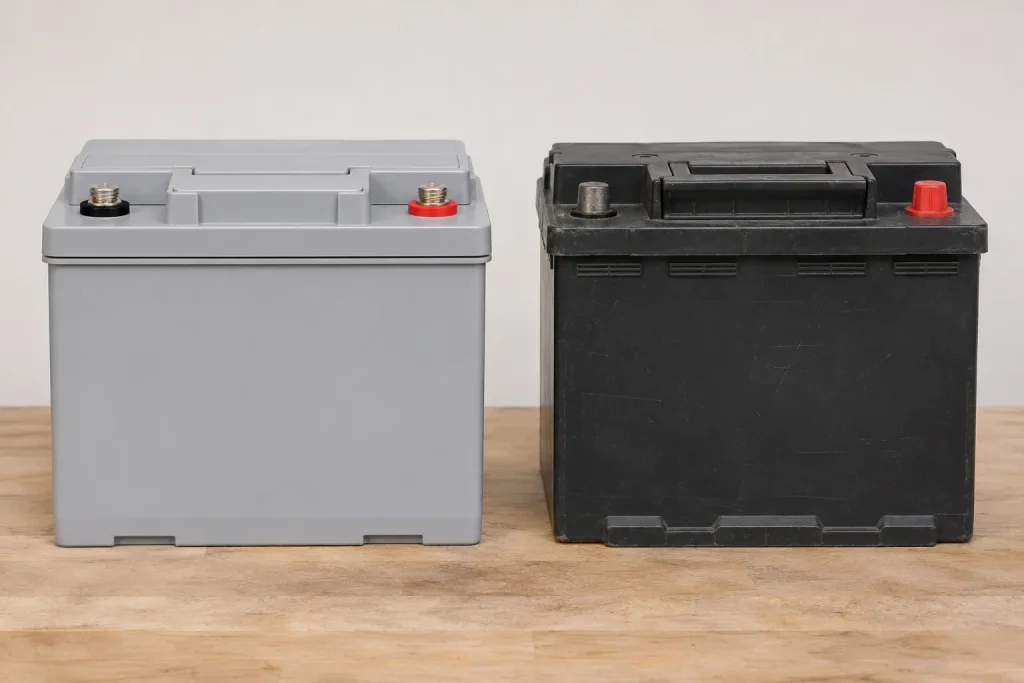
Solar panels work by turning daylight into electricity your home can use, through a short chain of equipment. In this guide, we follow that chain from the silicon cells to the inverter and your electrical panel. We also explain how Canadian weather affects output, and how grid connection and an optional battery change your bills and outage protection in Ontario.
How do solar panels turn sunlight into electricity?
The process has no turbine, no engine and no fuel. Photovoltaic panels convert sunlight into electricity directly, through what is known as the photovoltaic effect. Once you understand the three stages inside a panel, from absorbing light to releasing current to combining output, every other part of a residential solar system is easier to follow.
Sunlight reaches the solar cells
Light arrives as tiny packets of energy called photons. Most photovoltaic cells are made of silicon, a semiconductor, which means a material whose conductivity can be precisely controlled.
When a silicon cell absorbs a photon with enough energy, the photon frees electrons inside the material. Each freed electron leaves behind a “hole,” a gap that behaves like a positive charge. These mobile electron–hole pairs are the raw material of solar energy, and the cell’s next job is to put them to work.
The cells produce direct current
A free charge needs a direction. Each cell has two differently treated layers that meet at a p-n junction, a boundary with a built-in electric field. That field pushes electrons one way and holes the other, so the charges stop wandering and start flowing.
Thin conductive metal contacts on the cell collect this flow, and wiring carries it out of the panel. Solar panels generate direct current, or DC, which flows in one direction only. Your household loads run on a different form of electricity, which is why the next section focuses on the inverter.
Cells and panels combine their output
One cell produces very little power on its own. Manufacturers connect many solar cells together and seal them behind protective glass, inside a frame that gives the panel its structure. At New Dawn Energy Solutions, we design each system around your roof and your household’s electricity needs, so this panel count is never chosen at random.
The way panels are connected sets the system’s electrical character. Wired in series, panels add their voltages while the current stays roughly that of one panel. Wired in parallel, they increase the current instead. Connected panels form strings and arrays sized for the home, which is exactly what we plan in our residential solar systems for Ontario homes.
How does an inverter make solar electricity usable?
DC from the roof cannot run your kitchen as it is. The inverter is the component that turns panel output into usable electricity, and it also manages how much power the array delivers. Choosing the right inverter layout matters as much as choosing the panels themselves.
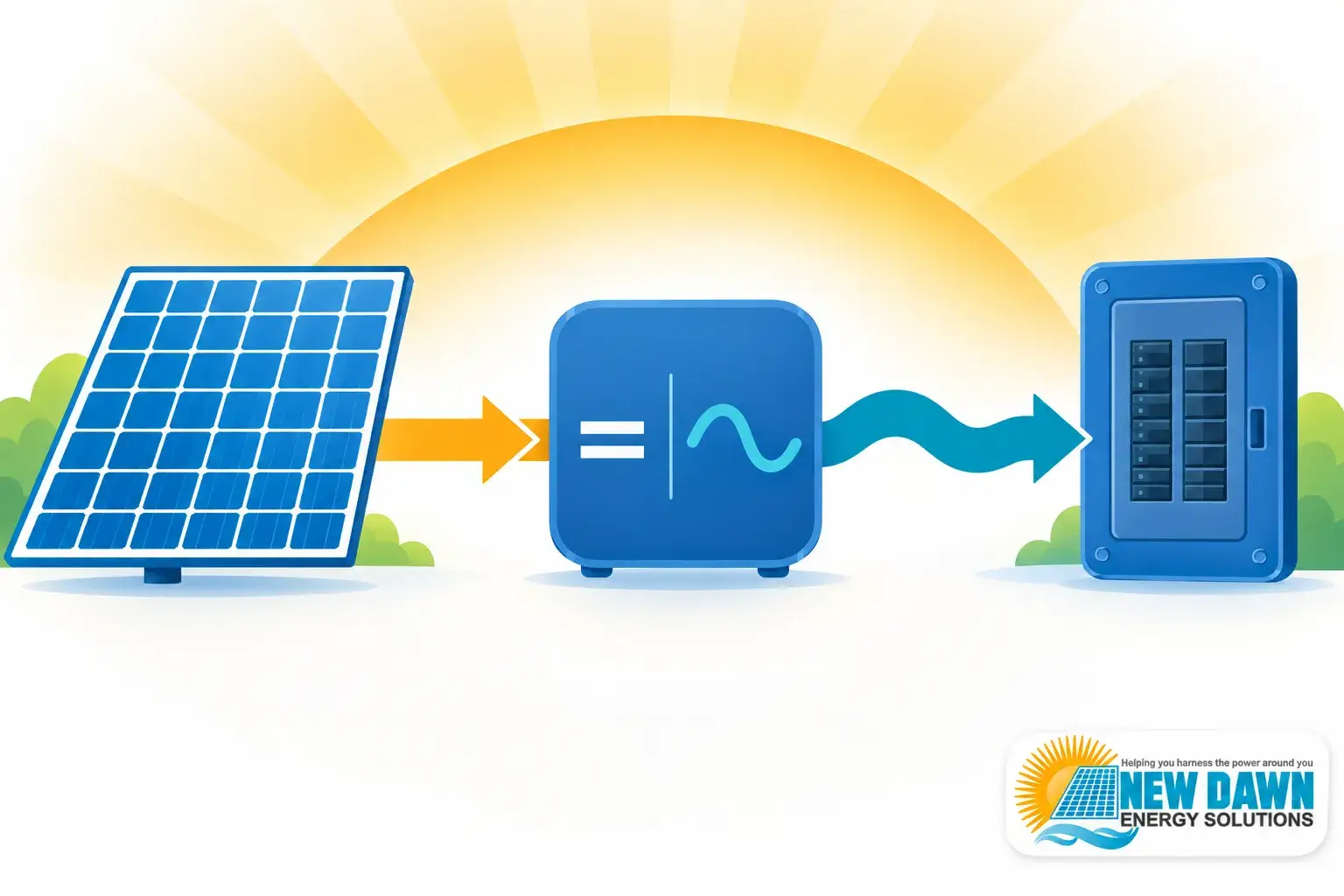
The inverter converts and controls power
An inverter converts the panels’ DC into alternating current, or AC, the form your appliances and the utility grid both use. Conversion is only part of its role.
The inverter also performs several control tasks continuously while the sun is up:
- Maximum-power-point tracking (MPPT): adjusts the array’s electrical operating point to extract the most power from the available sunlight and temperature.
- Grid synchronization: matches its AC output to the voltage and frequency of the electrical system it connects to.
Synchronization is what allows solar output and grid power to flow together through the same household wiring without conflict.
AC electricity reaches household loads
After conversion, AC power travels to your home’s electrical panel, which distributes it to the circuits in use. Natural Resources Canada’s residential PV guidance describes inverters supplying 120/240-V AC. On a typical Ontario split-phase service, ordinary branch circuits use 120 V, while some larger equipment uses 240 V.
Two units help you read your consumption. Watts describe an appliance’s instantaneous load, while watt-hours or kilowatt-hours measure the energy it uses over time. Comparing your kilowatt-hours with expected solar production gives a far more accurate picture than nameplate watts.
Inverter layouts handle uneven panel output
Residential systems typically use one of two architectures, both described by Natural Resources Canada. A string inverter converts power from several connected panels at once. A microinverter performs the DC-to-AC conversion at each individual panel.
The difference shows up under shade. In a series string, one shaded panel can pull down the whole string’s output. Multiple MPPT inputs, optimizers or microinverters can limit that effect, so one shaded panel does not necessarily stop the entire solar power system. Microinverters can also report production panel by panel, while string-inverter monitoring generally works at string or system level.
How well do solar panels work in Canadian weather?
Production follows the light, not the thermometer. Canadian conditions shift output across the day and the seasons, yet they rarely work against the technology the way many homeowners expect. Knowing which factors matter helps you set realistic expectations for your system payback period.
Daylight determines when panels generate
Generation depends on how much usable light reaches the cells. Here is how common conditions compare:
- Direct sunlight: delivers the highest output the system can reach.
- Cloudy days: panels still generate from diffuse daylight, generally at lower output.
- Rain: production continues at a reduced level, and rainfall may wash dust and dirt off the glass.
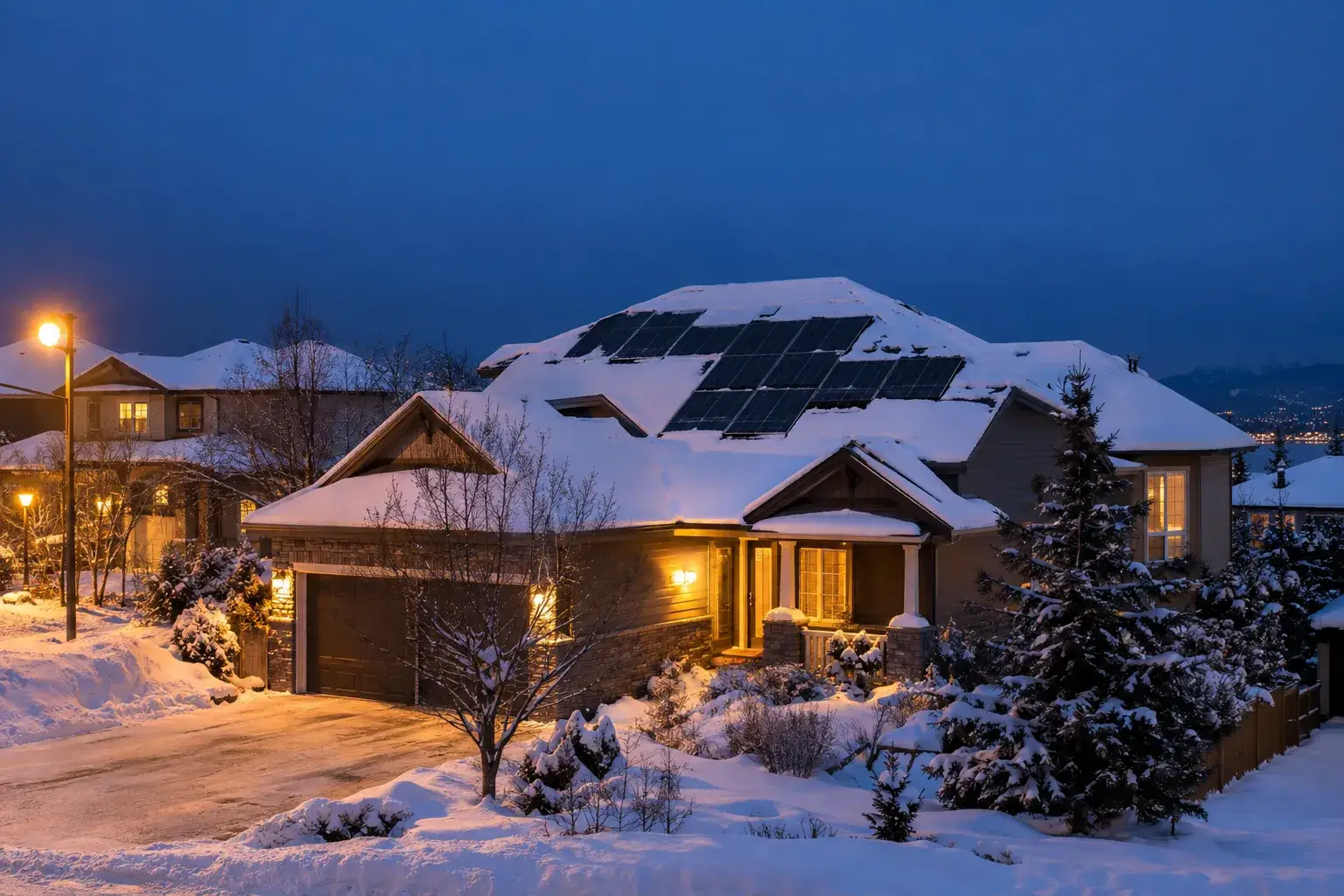
- Night: no sunlight reaches the cells, so they produce no electricity.
These daily swings are why grid connection or storage, covered in the next section, keeps your home supplied around the clock.
Temperature and snow change winter output
Cold does not hurt efficiency. According to Natural Resources Canada, photovoltaic cells perform better at low temperatures, while higher panel temperatures can reduce output. Winter production drops for other reasons: shorter days and lower sun angles limit available light. Snow covering the cells blocks sunlight until enough of the surface clears, with losses depending on tilt, snow type, temperature and roof geometry. Natural Resources Canada also warns that accumulated snow can slide from PV glazing.
The home’s site affects actual production
Your roof shapes your results. Partial shading from trees, roof features or neighbouring buildings reduces the light reaching the cells and can lower system efficiency. A residential assessment therefore checks roof condition, usable area, orientation, pitch and sun exposure. At New Dawn Energy Solutions, we assess roof size, angle and sunlight before designing any home system.
Regional data offers a useful starting point. Natural Resources Canada’s PV maps give monthly and annual production potential in kWh per kWp, meaning expected energy per kilowatt of installed panel capacity. Their monthly results do not capture every site’s snowfall effects, so a site-specific design remains the most reliable way to judge real-world efficiency.
How can grid-tied solar reduce Ontario electricity bills?
Every kilowatt-hour your panels supply is one you do not buy. A grid-tied system blends solar production with utility power automatically, and Ontario’s rules shape how surplus is credited. Batteries, costs and incentives then determine how much of that potential reaches your bill.
Household use and exports affect the bill
A grid-connected home uses solar output first, draws utility electricity when production falls below demand and can export eligible excess electricity when production exceeds it. Three Ontario rules govern that exchange:
- Credits: net metering credits eligible exports against electricity-consumption charges, not unrelated fixed charges.
- Carry-forward: unused credits carry forward for up to 12 months, according to the Ontario Energy Board.
- Agreement: net metering under O. Reg. 541/05 requires an agreement with your local distributor and connection approval.
Connection timelines are set too. For micro-embedded generation, the Ontario Energy Board gives distributors 15 days to make a connection offer at an existing connection without site assessment. That rises to 30 days when an assessment is needed, and to 60 days at a new customer connection.
Optional batteries change use and backup
A battery is optional. A grid-connected system generates electricity and draws from the grid without one. We pair solar with battery storage so households can keep their own daytime production for later use, an approach detailed in our solar plus storage solutions.
Outages are where the difference shows. A conventional grid-tied inverter stops energizing the grid during a utility outage, so panels alone do not keep your house powered, even in full sun. Backup requires a suitable battery-backed inverter and isolation equipment, which we supply in our solar battery storage systems.
Backup capacity depends on the designated loads, the inverter’s continuous and surge power, usable battery capacity and outage duration. During initial setup, New Dawn Energy Solutions lets you choose which appliances and devices stay powered in an outage. Ask us to map those essential circuits with you before sizing the battery.
Installation costs and program rules matter
A solar panel installation covers more than panels and an inverter: mounting, wiring, electrical work, approvals, inspection and utility connection all belong to the project. Ontario’s ESA 2026 Wiring Fee Guide took effect April 1, 2026. For PV systems of no more than 10 kW, it lists a $336 CAD inspection fee with a licensed electrical contractor, or $550 CAD when the property owner installs. Both include up to two visits, and further visits may cost extra.
Incentives can offset part of your project costs, with conditions. Ontario’s Home Renovation Savings solar-and-storage stream offers $1,000 CAD per kW DC for rooftop solar, up to $5,000 CAD. Paired batteries earn $300 CAD per kWh, also capped at $5,000 CAD. Each incentive is limited to 50% of eligible costs, with a combined maximum of $10,000 CAD.
| Program rule | Requirement |
| Equipment | New rooftop PV; any funded battery must be new and paired with that PV |
| Approvals | Written pre-approval and distributor approval before installation |
| Net metering | Subsidized projects cannot also join a local distributor net-metering agreement |
| Eligible costs | HST excluded |
Frequently Asked Questions
How long do solar panels last, and what maintenance do they need?
Solar panels are built to last more than 25 years, and they have no moving parts to wear out. Occasional cleaning and routine system checks are typically all they need to keep operating efficiently.
When should Ontario homeowners get distributor approval for a solar system?
Ontario’s net-metering guidance asks you to obtain distributor approval before buying or installing the system, and before signing a contract. Your municipality may also require building approvals, with requirements and processing times that vary locally.
Can a new rooftop solar system still apply to Ontario’s microFIT program?
No. The microFIT program closed to new applications on December 1, 2017, so it is no longer an application route for a new rooftop system.