Every province and territory runs solar support differently. Some pay a rebate before you install, some after, and some have closed their programs. Applying for a solar rebate in Canada depends on which programs are open, who qualifies, how incentives combine, which approvals come first and which deadlines can cost you the claim. With that order in hand, you can budget the project with confidence.
Which solar rebates are available across Canada?
Solar rebates in Canada are set by provincial utilities and program administrators. The rebate amount usually depends on the system’s capacity, with a cap per home or per project. Several programs also pay separately for battery storage, so the system you design affects the cheque you receive.
Ontario, British Columbia and Manitoba
These three provinces currently pay residential provincial rebates. In each one, the payment is tied to installed capacity and capped as a share of eligible cost. Here is how the solar incentives in each province are calculated:
- Ontario solar PV: the Home Renovation Savings Program pays $1,000/kW for eligible rooftop panels, up to $5,000 CAD and 50% of eligible cost.
- Ontario batteries: an eligible battery earns $300/kWh, up to $5,000 and 50% of eligible cost. Solar and storage together reach a combined maximum of $10,000.
- BC Hydro: the residential solar rebate pays $1,000/kW DC, up to $5,000 and 50% of eligible installed product costs. Batteries earn $500/kWh, up to $1,500 without Peak Saver enrollment or $5,000 with it.
- Efficiency Manitoba: homeowners receive $0.50 per DC watt on up to 10 kW of capacity, capped at $5,000 per home. Businesses receive $0.75 per DC watt for PV connected to the Manitoba Hydro grid.
In Ontario, a battery can double the solar rebate ceiling. We compare the three provinces below, using a residential solar-plus-storage project as the reference.
| Province | Solar rate | Solar maximum | Battery rate and maximum |
| Ontario | $1,000/kW | $5,000 (50% of cost) | $300/kWh, up to $5,000 |
| British Columbia | $1,000/kW DC | $5,000 (50% of cost) | $500/kWh, up to $1,500 or $5,000 with Peak Saver |
| Manitoba | $0.50/DC watt, up to 10 kW | $5,000 per home | No battery rebate listed |
In Manitoba, the 10 kW cap limits only the rebated capacity. A larger system remains possible; the extra kilowatts simply earn no additional payment.
Quebec, Alberta and Saskatchewan
Hydro-Québec’s LogisVert residential solar assistance pays $1,000 per installed kW. The payment cannot exceed 40% of eligible purchase and installation costs, a lower ceiling than in Ontario or BC. Businesses receive the same rate and the same 40% ceiling.
According to the Utilities Consumer Advocate, no Alberta solar panel rebate is currently offered at the provincial level for residential installations; municipal financing and federal business measures must be checked separately. SaskPower also offers no installation rebate, but its net metering program accepts systems up to 100 kW. It credits excess generation at 7.5¢/kWh through March 31, 2029; credits offset energy charges, not basic charges or taxes, and are never paid in cash.
Other regional and commercial offers
The territories run their own renewable energy programs. In the Northwest Territories, support reaches $20,000 for residents, $50,000 for most businesses and non-profits, and $75,000 for community or Indigenous governments. Solar-electric support is calculated at $4/W, subject to program limits. Yukon’s residential rebate, paused in micro-generation communities, pays $800/kW up to $5,000 when open, with separate off-grid rules. Nunavut offers a cabin grant of up to $5,000, once per cabin, covering solar PV and batteries.
Businesses and non-profits have dedicated streams. Nova Scotia’s non-profit pilot pays $0.60/W DC, up to 25% of system cost before HST and $15,000. In Ontario, the Save on Energy Retrofit Program offers a commercial solar incentive of $770/kW AC from June 30, 2026, for specified projects over 10 kW AC. BC Hydro’s commercial and multi-unit residential stream raises the solar maximum to $10,000.
Am I eligible, and can incentives be combined?
Eligibility is set program by program. Your province matters, what the building is used for and which utility serves it. Combining a rebate with export credits or tax measures also follows strict rules, so check both before finalizing the system design.
Match the program to the applicant and property
Support comes as an installation rebate, a business tax credit, financing or a credit for exported electricity. Natural Resources Canada keeps a province-and-territory directory, a useful starting point; the administrator and the utility confirm current intake and terms. Homeowners, businesses, farms, non-profits and multi-unit properties may each need a different stream. Establish ownership or authorization, building use and the serving utility first. Our residential solar installation with government incentives starts from these three facts.
Ontario’s homeowner stream adds precise requirements. The applicant must be at least 18, own the home and be responsible for buying and installing the system. Eligible homes include detached, semi-detached, row or town homes and qualifying mobile homes on permanent foundations, connected to Ontario’s grid. Panels must be rooftop-mounted, new, purchased in Canada and compliant with applicable standards. BC Hydro counts labour and materials as eligible costs, but excludes taxes, electrical-service upgrades, engineering or feasibility studies, consultants and roof or structural upgrades.
Check export credits and other funding
In Ontario, you choose between a rebate and export credits. A system receiving the Home Renovation Savings solar or storage incentive must be designed for load displacement, meaning it serves on-site consumption. It cannot enter a net metering agreement for its whole life. Pairing panels with battery energy storage for your solar system can help you use more of that self-generated power. In BC, new self-generation customers receive 10¢/kWh for excess generation from July 1, 2026; existing net-metering customers keep the former rate for 10 years from their original start date.
Federal solar incentives target businesses. The Clean Technology Investment Tax Credit applies to taxable Canadian corporations and qualifying real estate investment trusts, not homeowners. It reaches up to 30% for solar equipment acquired and available for use from March 28, 2023 through December 31, 2033, then falls to 15% in 2034. Other assistance received or expected reduces the capital cost used for that tax credit. Capital cost allowance, a form of tax depreciation, completes these tax incentives. Municipal property-tax financing is repaid, so do not count it among municipal rebates.
How do I apply for a solar rebate?
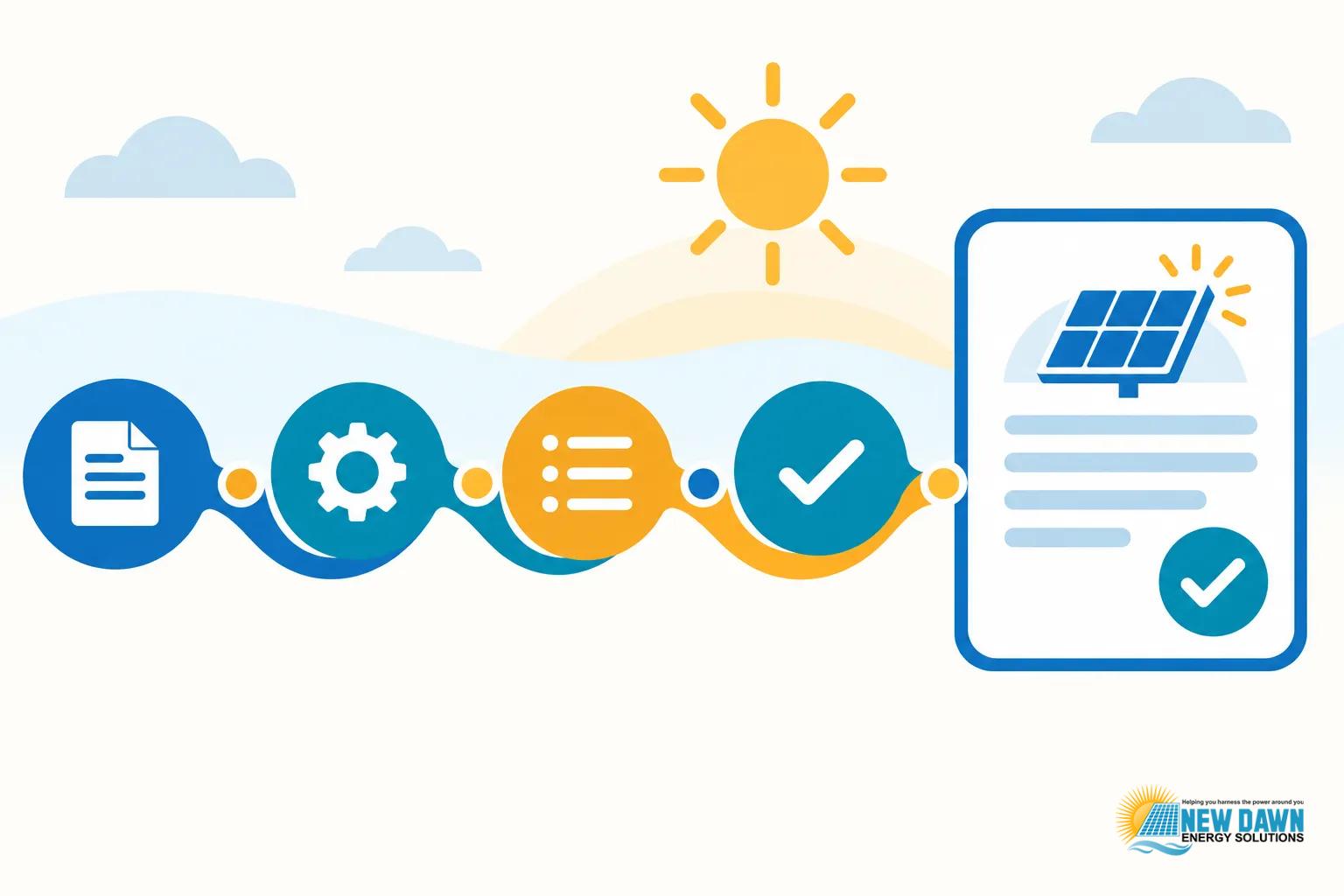
A successful application follows a fixed order: design, installer check, utility approval, program approval, installation, then final claim. Skipping a step, especially buying equipment too early, can make a project ineligible.
Assess the site and assign responsibilities
We begin with a no-obligation evaluation of your energy needs, roof size, roof angle and sun exposure. From it, Newdawn-es prepares a tailored proposal with cost and savings estimates. The system design then fixes the details every application asks for:
- Capacity and generation: proposed size and expected annual solar energy output.
- Electrical service: any panel or service upgrade the connection requires.
- Storage and export: battery capacity for energy storage systems and how surplus power is handled.
Confirm that the installer qualifies before accepting a quote, since a licensed contractor is not automatically eligible for every stream. From June 1, 2026, BC Hydro rebate work must be done by a Home Performance Contractor Network member, and Efficiency Manitoba requires a registered contractor. We handle design, permits and installation, but some utilities need the account holder to submit the connection request. At BC Hydro, only the account holder submits it; contractors prepare technical information without using that login.
Obtain utility and program approvals
Submit the interconnection or self-generation application at the stage your utility requires, and keep its written technical acceptance. Utility review can require a redesign or a grid upgrade. Ontario’s net-metering guidance and Newfoundland and Labrador Hydro both ask customers to apply before buying or installing. In Saskatchewan, you submit electrical-authority information, pay a $315 non-refundable interconnection-study fee and await the study. Alberta’s AUC Rule 024, effective April 1, 2026, sets requirements before constructing and interconnecting.
Learning how to apply for a solar rebate in Ontario means respecting one firm sequence: the contractor supplies pre-installation information, then the homeowner waits for written program pre-approval and local distribution company approval before purchasing anything. Manitoba’s business stream also requires program approval before any purchase or work. Hydro-Québec requires an electrical contractor’s connection request and conditional acceptance before equipment is bought. Ontario’s commercial retrofit route, used for commercial solar installation for Toronto businesses, follows similar logic.
Install, inspect and submit the claim
Rebate approval, utility permission to connect, municipal permits and electrical inspection are separate; one never replaces another. Check building, zoning and heritage rules, then obtain the electrical permit. Install the approved design, clearing any substitution with the administrator first. After inspections, final utility authorization and metering, energize the solar installation. Submit the claim before the solar rebate program deadline, keeping a file with design, credentials, approvals, permits, inspections, equipment details, invoices, proof of payment and photographs.
Which deadlines can affect my rebate claim?
Timing rules differ as much as rebate amounts. Some programs require approval before work, others accept claims only after installation, and several solar grants have already closed. Knowing each window protects your solar rebate from a technical refusal.
Approval and completion windows
No universal rule requires applying before installation. Manitoba’s residential rebate is claimed once the system is inspected, operational and paid for. Other programs attach strict windows to their approvals:
- Manitoba: the registered contractor must apply within 90 days of completion.
- BC Hydro: installation and documentation are due within 18 months of self-generation technical acceptance.
- Northwest Territories: work starts within three months of pre-approval and finishes within 15 months. Final invoices and photos follow within three months of completion; communities served by hydroelectricity are excluded from grid-connected rebates.
- Nunavut and Newfoundland and Labrador: a cabin grant installation occurs within 12 months of approval, and net-metered homes are limited to 15 kW AC. Newfoundland and Labrador Hydro approval expires if generation is not operating within two years.
Record each of these dates in the project file at approval, so the installation schedule stays within the program clock.
Closed programs and remaining claims
The Canada Greener Homes Grant closed to new applicants in February 2024, and existing participants’ documentation was due December 31, 2025. The federal home energy loan, the Canada Greener Homes Loan, closed to new applications after October 1, 2025; previously approved loans continue under their terms.
Nova Scotia’s SolarHomes program stopped accepting homeowner applications on April 17, 2025, and approved projects had to finish by March 31, 2026. Its non-profit pilot remains different: the installer applies before installation, and approval reserves the rebate for up to 12 months.
Some closed programs still accept late claims. Prince Edward Island’s residential rebate ended April 15, 2026, yet purchases made from April 15, 2025 through April 15, 2026 can be claimed within one year of purchase. New Brunswick’s business registration closed May 27, 2026; pre-approved projects must be completed and claimed by January 31, 2027.
Avoid commitments after intake closes
The Edmonton solar rebate for homes is fully subscribed and closed to applications. The city’s Clean Energy Improvement Program offers financing instead of cash, and its pre-qualification submissions were being wait-listed.
A closed or paused program cannot appear in your budget as available money. Build the financial case only on incentives with confirmed open intake.
Frequently Asked Questions
Which homes and installation dates qualify for Hydro-Québec’s residential solar assistance?
Eligible houses, multiplexes and residential buildings of no more than 19 units qualify, for installations dating from June 30, 2025 onward. The claim requires ownership evidence, purchase and installation invoices, installer registration, equipment and conformity documents, photographs and final grid-connection authorization.
Is solar equipment exempt from provincial sales tax in British Columbia?
Yes. British Columbia exempts qualifying solar photovoltaic collector panels and associated equipment from provincial sales tax, provided they are obtained together as part of a qualifying solar system.
How does a business claim the Clean Technology Investment Tax Credit for solar equipment?
A corporation claims it through its tax return, using CRA T2 Schedules 75 and 31, not through a pre-installation rebate application. For covered work from November 28, 2023, the claimant must elect to meet prevailing-wage and apprenticeship conditions to avoid a 10-percentage-point rate reduction.