This article explains Durham green energy financing programs, including loan amounts, eligibility criteria, covered upgrades, rebate-stacking opportunities and the application process. You will see how the available funding can support a home energy retrofit with greater cost clarity.
Durham greener home loan options
The Durham Greener Homes Loan Program provides home energy retrofit financing to eligible homeowners across the Regional Municipality of Durham. With a fixed low interest rate and a broad range of covered measures, it is one of Ontario’s more accessible funding options for energy upgrades.
Loan amounts and property eligibility
Financing for solar heat pump installations in Durham, along with many other eligible energy upgrades, is available through this program at a fixed 2% interest rate. The Durham Greener Homes Loan, Region of Durham is therefore among the least expensive energy efficiency financing options in the province. Eligible homeowners can borrow up to $125,000 CAD and repay the loan over 15 years. It is registered against the property as a Local Improvement Charge rather than attached to the individual owner. If the home is sold before the term ends, the repayment obligation transfers to the future buyer.
- Property age requirement. The program targets homes built between 1970 and 2000. This housing segment represents 46% of Durham’s residential stock and has substantial energy-saving potential.
- Eligible home types. Detached and semi-detached homes, townhomes, row houses and mobile homes on permanent foundations qualify. Stacked townhomes are excluded.
- Pickering exclusion. Although Pickering is within Durham Region, properties in the City of Pickering are not currently eligible for this loan program.
The Regional Municipality of Durham hosts the program, while Windfall Ecology Centre administers it. The initiative is backed by a $3.4-million community efficiency financing initiative delivered through the Green Municipal Fund and supported by the Government of Canada. This municipal and community structure helps keep borrowing costs low without requiring homeowners to arrange private financing.
| Loan feature | Details |
| Maximum loan amount | $125,000 CAD |
| Fixed interest rate | 2% |
| Repayment term | 15 years |
| Charge type | Local Improvement Charge (property-attached) |
| Minimum build year | 1970 |
| Maximum build year | 2000 |
| Initial disbursement | Up to 50% of eligible funds after approval |
| Energy efficiency allocation | Minimum 80% of project cost |
| Weather resiliency allocation | Up to 20% of project cost |
Eligible retrofit and resilience upgrades
The program supports a wide range of energy upgrades. Homeowners researching the average cost of solar panels can use financing of up to $125,000 CAD to make rooftop photovoltaic systems more accessible without a large upfront payment. At least 80% of the financed project cost must support energy-efficiency measures, while up to 20% can fund weather-resiliency work.
Eligible energy-efficiency measures include attic, wall, foundation and basement insulation; high-performance windows; exterior doors; air sealing; heat-recovery ventilators; heat pump water heaters; air-source and ground-source heat pumps; solar PV systems; and battery storage. These systems can reduce energy use, improve comfort and strengthen grid resilience across the local community.
Solar and heat pump project costs
The 20% resilience allocation can cover backwater valves, sump pumps, basement waterproofing and permeable surfaces. These upgrades are relevant to Durham communities facing flooding and extreme heat. Appliances, cosmetic renovations, routine maintenance and work completed before program enrollment are not eligible for funding.
Combining the low-interest loan with available provincial rebates, discussed in a later section, can reduce the net project cost and shorten the system payback period for measures such as cold-climate heat pumps and rooftop solar. This approach supports greener housing while advancing the clean energy transition through practical, local energy efficiency financing.
A guide to retrofit financing applications
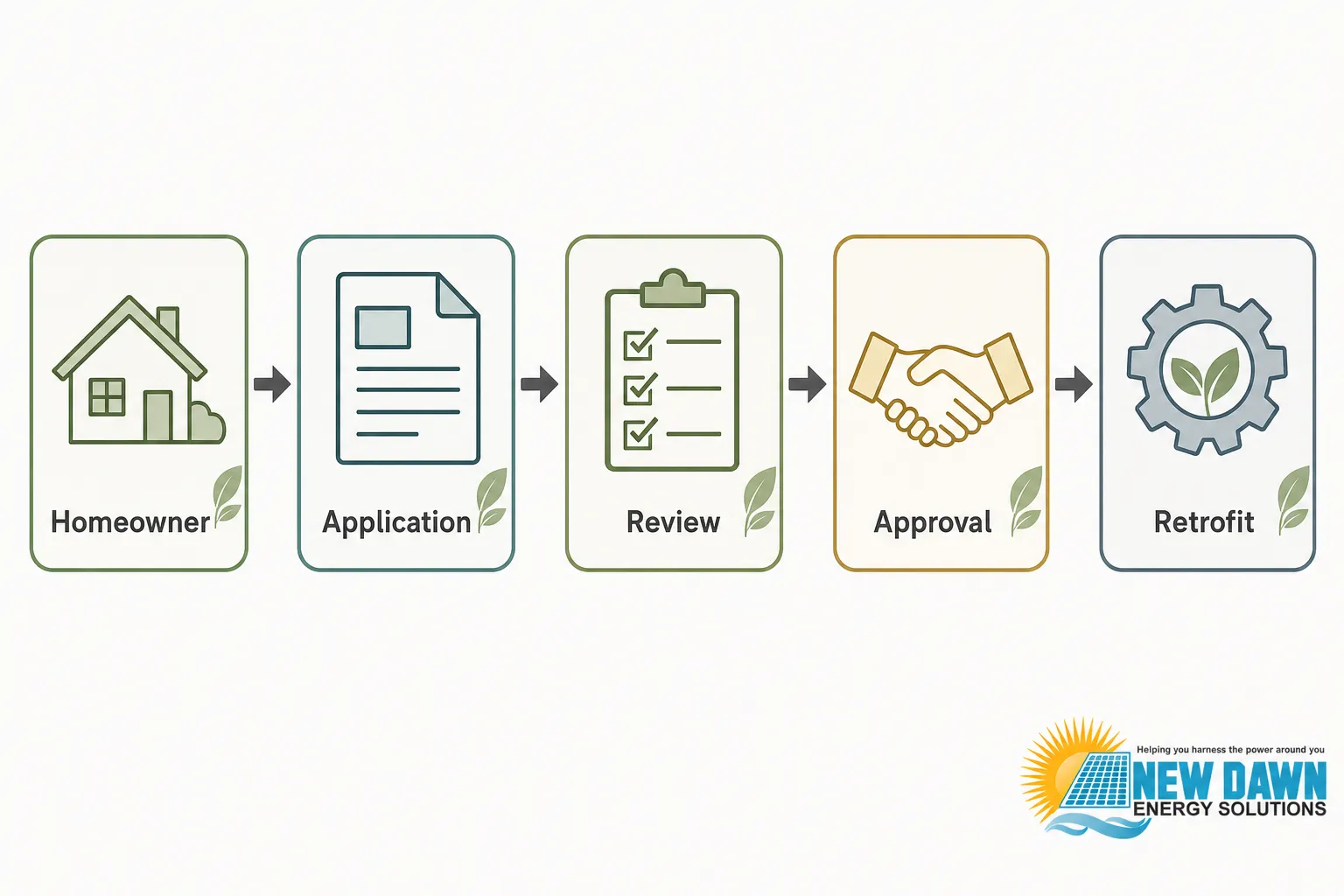
Applying for the Durham Greener Homes Loan follows a clear sequence of assessments, approvals and documentation. Reviewing each requirement first protects your eligibility and helps keep funding on schedule.
Required assessments and enrollment steps
The application begins with a free consultation with a Durham Greener Homes Coach. Residents of the municipality of Whitby should also note that a Whitby solar rebate and deep-retrofit incentives may be combined with the Durham loan. Your coach will identify the municipal and provincial incentives that apply to your property, explain the loan structure and available rebates, and provide an Eligibility Verification Form for upload to the program’s online portal.
- Free coaching consultation Book a no-cost session with a Greener Homes Coach before taking any other step. This consultation is mandatory for all applicants.
- EnerGuide evaluation A pre-retrofit EnerGuide Home Energy Evaluation is required and is eligible only when completed on or after April 28, 2022.
- Eligibility Verification Form Complete the form supplied by the coach and upload it to your personal user portal to advance your application formally.
After approval, you must complete a post-retrofit EnerGuide evaluation following enrollment in the program. Evaluations completed before enrollment do not count. Homeowners pay the cost of both assessments because the loan does not cover these fees. Include that expense in your project budget to avoid disbursement delays.
Disbursements and homeowner obligations
Financing a whole-home battery backup system alongside a solar PV installation qualifies under the loan’s energy-efficiency portion, while staged disbursements can support larger upgrades. Approved homeowners receive up to 50% of eligible funds after enrollment and approval, providing capital for procurement and installation. The balance is released only after completion, submission of the post-retrofit EnerGuide evaluation, and review of the project completion report.
- Initial disbursement Up to 50% of approved eligible loan funds are released after enrollment approval to support early retrofit procurement and contractor costs.
- Final disbursement The remaining funds are released after you submit the completed post-retrofit EnerGuide evaluation and a formal project completion report.
- Data sharing requirement Participants must provide at least 24 months of pre- and post-renovation utility and energy data for program measurement and verification.
- Case study participation Homeowners must agree to participate in program case studies, which may appear in different media formats as part of community reporting obligations.
The Greener Homes Coach will walk you through each requirement.
Free coaching for whole-home planning
Beyond the mandatory consultation, Durham homeowners can use several no-cost planning tools. The Virtual Home Energy Assessment Tool, or vHEAT, lets you explore your home’s energy-saving potential online before committing to upgrades. A Weather-ready Home Assessment examines your property’s readiness for extreme heat, cold, flooding and windstorm events, helping you allocate the 20% resilience portion of your loan.
Brock residents who sign up and speak with a Greener Homes Coach also receive a free rain barrel through the program. Begin with vHEAT, then book your coaching session to confirm eligibility and start the formal application.
Municipal program rebates and energy efficiency
The Durham loan works alongside Ontario and local municipal programs. Their rebates can be stacked with low-interest financing, reducing the net cost of an energy-efficiency retrofit and supporting the clean energy transition in your home.
Ontario rebates for home upgrades
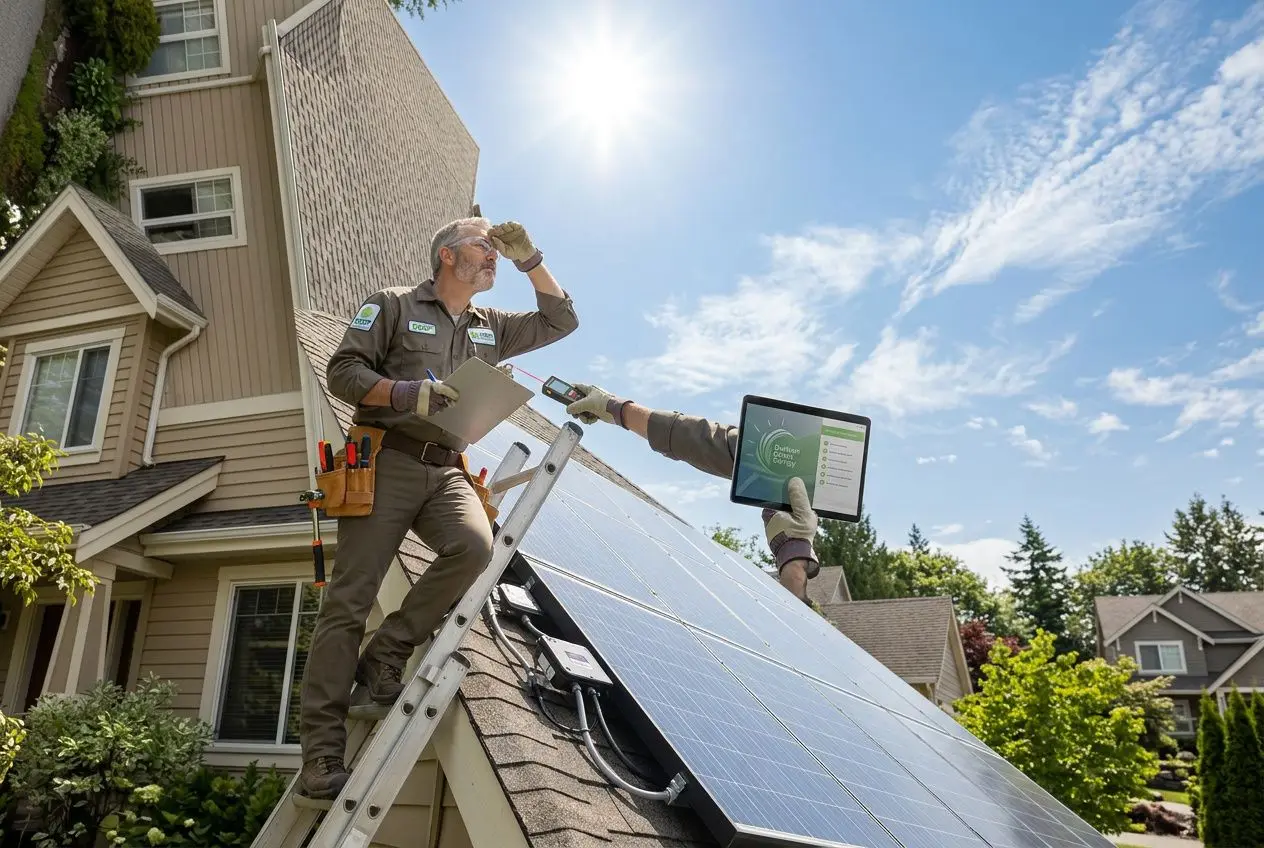
Many homeowners ask whether solar panels work in winter. They do: modern photovoltaic systems generate electricity year-round in Ontario, though output is reduced during cloudy periods and efficiency dips in extreme cold. Ontario’s Home Renovation Savings Program, launched January 28, 2025 and running through 2026, offers rebates of up to 30% on qualifying renovations. Delivered through a partnership among the Ontario government, Save on Energy and Enbridge Gas, the program brings several funding streams together in one online portal. A complete breakdown is available on the Ontario home renovation savings rebates page.
- Natural gas homes Homes using natural gas as their primary heating source may qualify for maximum combined rebates of up to $5,000 CAD.
- Electrically heated homes Homes heated primarily with electricity, propane, oil or wood may qualify for maximum combined rebates of up to $10,000 CAD.
- Assessment-based track benefits This participation route includes a $600 credit toward audit fees, plus an additional $500 rebate when three qualifying energy upgrades are completed.
Key amounts include up to $7,500 CAD for cold-climate air-source heat pumps, up to $12,000 CAD for ground-source heat pumps, up to $7,700 CAD combined for insulation across all zones, and $100 CAD per rough opening for ENERGY STAR certified windows and doors. Under the Ontario home renovation saving program’s Load Displacement Program, solar panels and battery storage each qualify for an additional rebate of up to $5,000 CAD when the electricity generated is consumed on-site rather than exported to the grid. Income-qualified households may also receive free upgrades through the Energy Affordability Program and Home Winterproofing Program. Full Details about income thresholds and coverage are available through Save on Energy.
Whitby deep retrofit rebate
Whitby residents can access a local incentive for deep, whole-home energy performance improvements. The rebate is tied to verified energy reduction: the greater the improvement in modelled annual energy use, the higher the payment.
- Minimum rebate A $2,500 CAD rebate is available for a 50% reduction in modelled annual energy use between pre- and post-retrofit EnerGuide evaluations.
- Incremental increase The rebate rises by $50 CAD for each additional percentage point of energy reduction above 50%, up to the program maximum.
- Maximum rebate A $5,000 CAD rebate is available for a 100% modelled reduction in energy use, representing a complete transformation of the home’s energy profile.
- Minimum project cost A retrofit project must total at least $30,000 before taxes to qualify for the Whitby deep retrofit rebate.
Eligibility and application details for the Whitby deep retrofit rebate are listed on the Durham Greener Homes portal. The pre-retrofit EnerGuide evaluation used for the Durham loan is also required here. Coordinating both applications from the outset can avoid duplicate assessment costs and keep the project timeline efficient.
Closed federal loan and current financing
Two major national programs are no longer open to new applicants. A broader guide to available national support is in the federal solar funding guide.
- Canada Greener Homes Grant Closed to new applicants in February 2024. Existing participants have until December 31, 2025 to submit final documentation.
- Canada Greener Homes Loan Stopped accepting new applications on October 1, 2025. It had offered interest-free financing of up to $40,000 over 10 years for major home retrofits.
- Greener Homes Affordability Program This $800-million federal replacement initiative is rolling out province by province. It targets income-eligible households with no-cost retrofits, while solar inclusion depends on each province’s implementation plan.
- Current best option for Durham The Durham Greener Homes Loan at 2% over 15 years, combined with Ontario’s Home Renovation Savings Program rebates and applicable municipal incentives, is currently the strongest green home energy efficiency financing pathway available in the region.
The federal closures have shifted the funding landscape toward provincial and local sources. Durham homeowners who apply before the Home Renovation Savings Program ends in 2026 can still combine low-interest loan capital, provincial rebates and municipal incentives. That combination can shorten the system payback period and make a comprehensive home retrofit more attainable.
Frequently asked questions
Is the Canada Greener Homes Loan still available to Durham homeowners in 2026?
No. The Canada Greener Homes Loan stopped accepting new applications on October 1, 2025, while the Canada Greener Homes Grant closed to new applicants in February 2024. In 2026, Durham homeowners seeking retrofit financing should consider the Durham Greener Homes Loan. It provides up to $125,000 CAD at a fixed 2% rate over 15 years, alongside rebates from Ontario’s Home Renovation Savings Program.
The federal Greener Homes Affordability Program is being introduced for income-eligible households, although its scope and solar coverage vary by province. For new applicants, local and provincial programs are now the main funding sources for energy-efficiency upgrades, including solar systems and other measures that support a greener home.
What are the key details of the Durham Greener Homes Loan program?
The Durham Greener Homes Loan offers eligible homeowners in the Regional Municipality of Durham up to $125,000 CAD at a fixed 2% interest rate, repayable over 15 years. It is structured as a Local Improvement Charge attached to the property rather than the homeowner, so the obligation transfers to a future buyer when the property is sold.
Eligible homes must have been built between 1970 and 2000. Properties in the City of Pickering are currently excluded. At least 80% of project costs must support energy-efficiency upgrades, such as solar PV systems, heat pumps, insulation and heat-recovery ventilators. Up to 20% may fund weather-resiliency measures. Windfall Ecology Centre administers the program with support from the Community Efficiency Financing Initiative.
Can Durham homeowners combine the greener homes loan with provincial rebates?
Yes. Combining financing and rebates can lower the net cost of a home retrofit. The Durham Greener Homes Loan can be used with Ontario’s Home Renovation Savings Program, launched January 28, 2025, which runs through 2026. It offers rebates of up to $10,000 CAD for electrically heated homes and up to $5,000 CAD for natural-gas-heated homes.
Cold-climate heat pumps qualify for up to $7,500 CAD, while ground-source systems qualify for up to $12,000 CAD. Through the Load Displacement Program, solar panels and battery storage can each receive up to $5,000 CAD. Whitby residents may also add a local deep-retrofit rebate of up to $5,000 CAD.
A Greener Homes Coach can assess your application, property and project scope, then identify the available incentives. This approach helps homeowners choose a practical combination of loan financing, municipal support and provincial rebates while improving energy savings and grid resilience.