How often should you clean solar panels? Ontario sets no fixed interval. Each array has its own answer, based on its exposure, its tilt and what its production data shows.
How often should Ontario solar panels be cleaned?
Ontario has no single cleaning frequency. Your array needs a wash when observed soiling, its location, the manufacturer’s instructions, safe access and measured performance all point that way. In practice, the interval depends more on inspection than on the calendar.
Start with an assessment, not a fixed wash
No province-wide cleaning schedule applies to residential or commercial arrays. You decide when to wash once the evidence shows a need for it.
An annual assessment is a sound habit. It does not mean your panels need regular cleaning or a wash every year. The inspection might find clean glass and steady production, and then nothing needs to be done.
Some guides suggest one or two cleanings a year as a starting point. Other examples include every 3 to 4 months in dusty, dry areas and about every 6 months in polluted urban areas. These are examples for those specific conditions, not schedules for every property from Brampton to Whitby.
Match checks to the type of property
Solar panels have no moving parts, so a home system needs very little upkeep. New Dawn Energy Solutions notes that occasional cleaning and routine system checks are typically needed to keep residential panels running efficiently. For a home in Richmond Hill or Oakville, that usually means a look and a review of the data, not a wash every season.
Commercial and industrial rooftops call for a plan written for that site. It can start with monthly monitoring reviews and inspections during scheduled maintenance visits, with cleaning added when measured losses justify it. Schools, hospitals, universities and municipal buildings can fold solar panel maintenance into their facility inspections and energy reporting. Their plan should account for roof access, occupancy and safety.
Let monitoring refine the interval
Ground-mounted solar panels are generally easier to check by eye than rooftop panels that are hard to see. Solar farms can combine field inspections with inverter monitoring, which tracks the electricity each inverter delivers, and set cleaning dates from measured losses.
A useful system performance baseline compares production with seasonal expectations, weather, known shading and equipment faults. Comparing with last month’s output alone can mislead you. The City of Toronto advises owners to check generation regularly, use monitoring notifications and investigate abnormal results. Routine upkeep is also covered with our residential solar installations for homeowners.
How do Ontario seasons change cleaning needs?
Each season leaves a different kind of deposit on the glass. Pollen in spring, dry spells in summer, falling leaves in autumn and snow in winter call for different checks. Matching your inspections to the season helps you avoid both unnecessary washes and missed losses.
Inspect after snowmelt and spring pollen
Plan a spring inspection once the snow has melted and after heavy local pollen or tree debris has built up. It can reveal grime left over from winter. A wash after winter is not automatically necessary.
- Loose dust: rain often rinses it off, especially on well-tilted panels.
- Stubborn deposits: bird droppings, sticky organic matter, oily films and deposits at module edges can survive a shower.
- Thin film: rainfall can leave a residue even when the glass looks clean at first glance.
One manufacturer says rain may help self-clean modules tilted at least 15°. That angle helps, but it does not guarantee an Ontario array will stay clean without manual cleaning. Check whether deposits remain after the next downpour.
Watch dry summers and autumn debris
A seasonal guide suggests inspecting as often as every few weeks during dry, windy summers, when dust and pollen build up quickly. How often depends on location. A home near open fields in Caledon may need closer attention than one in a sheltered North York street.
During high-production summer periods, compare energy production with reasonable expectations. Investigate deposits that persist before you book a wash. In autumn, check for leaves, seeds and branches under nearby trees. Whether to clean before winter depends on what that inspection finds, not on the calendar.
Treat winter snow as a separate issue
Solar panels still generate electricity in winter, at reduced output. Snow can block light until it melts or slides off. How well it sheds depends on pitch, temperature, snow conditions and the array’s configuration.
Track snow-related changes in production remotely rather than climbing an icy roof. Chipping ice or pouring hot water on cold modules can cause damage. On industrial and institutional roofs, snow buildup, drainage, roof-load limits and safe access are building-maintenance concerns too. Freeze-thaw residue and airborne road-salt film call for checks specific to each site.
What signs call for earlier cleaning?
Some warning signs justify an inspection before the next scheduled check. Knowing them lets you act on evidence instead of guessing, and keeps your energy savings on track between visits.
Look for deposits that remain
Visible grime, bird droppings that remain after rain, debris blocking light or an unexplained, ongoing drop in output are all reasons to inspect dirty solar panels. Each type of deposit affects production differently.
- Bird droppings: they shade individual cells and load the electrical circuit unevenly.
- Tree residue: pollen, sap and leaves stick to the glass, especially under overhanging branches.
- Growing branches: they cast new shade that no amount of cleaning will correct.
Droppings that keep coming back are more than a cosmetic problem. Repeated shading in the same spot can contribute to hot spots, which are cells that run hotter than the rest. That is why fouling under perches, chimneys or roof edges needs targeted attention.
Shade from trees needs a different fix. When branches grow over the array, the solution is to manage the vegetation, not to wash the panels.
Account for local exposure and panel angle
Construction, quarries, unpaved roads, traffic, industrial activity and farming can all add dust to nearby panels. That exposure matters along busy highways in Vaughan or near farmland in Uxbridge. Shallow or nearly flat panels hold more debris and water residue than steeper ones, so low-angle arrays deserve closer inspection. Roof obstructions, drainage paths and panel frames can also leave local bands of dirt rather than an even layer.
Rule out other causes of lost output
Dirt is only one possible cause. If output declines gradually over several weeks, compare it with weather-adjusted expectations, then inspect for deposits and new tree shade. If production drops suddenly on comparable sunny days, check inverter alarms, grid interruptions, monitoring communications and shade before blaming dirt.
A large difference in output between comparable sections of the array calls for a qualified investigation. Also confirm that your monitoring system is online. Missing data alone does not prove that your panels have stopped generating.
When does paying for cleaning make sense?
A wash is worth paying for when it recovers more value than it costs. That calculation helps you protect your system payback period instead of spending on cleanings that do not pay for themselves.
Estimate the recoverable energy
Solar panel cleaning pays off when the value of the energy you recover, plus any damage avoided, exceeds the full cost and risk of the work. Three points shape the estimate.
- Time window: count only the energy recovered before the panels get dirty again.
- Temporary gain: the efficiency boost after a wash does not last forever.
- Global context: the IEA PVPS, in its September 2025 fact sheet, puts average global solar-energy losses from soiling at 4–7%.
That global average is neither a forecast for a Mississauga rooftop nor a trigger for cleaning. Your own monitoring data gives a far better estimate for your site.
Calculate a realistic break-even point
Divide the cleaning cost in CAD by the actual value of each recovered kWh. In a hypothetical example, a C$300 wash at C$0.15 per recovered kWh needs 2,000 kWh to break even. The C$0.15 rate is an assumption, not an Ontario tariff. The full cost of cleaning services also includes access, water, safety, operating costs and lost production during the work. Fixed charges on your electricity bill do not change, so they do not count as savings.
Net metering also affects the value of each kWh. According to the Ontario Energy Board, net-metering credits offset eligible electricity-consumption charges and expire after 12 months. What recovered output is worth to you therefore depends on your usage, your exports and your agreement.
Adjust the decision for larger arrays
A commercial array needs a more detailed calculation. Account for capacity, the timing of production, on-site consumption, export arrangements and access costs when you value recovered energy production. The National Renewable Energy Laboratory lists rainfall, dust characteristics, cleaning cost and the value of delivered electricity as the factors that set an economic cleaning interval.
No percentage loss automatically triggers a cleaning in Ontario. A 20% threshold claimed in one guide is no substitute for a diagnosis of your own site.
How can panels be cleaned safely?
A careless wash can do more harm than the dirt it removes. Scratched glass, damaged seals or a fall from a roof cost far more than a slightly lower kWh reading. These precautions protect both the equipment and the people doing the work.
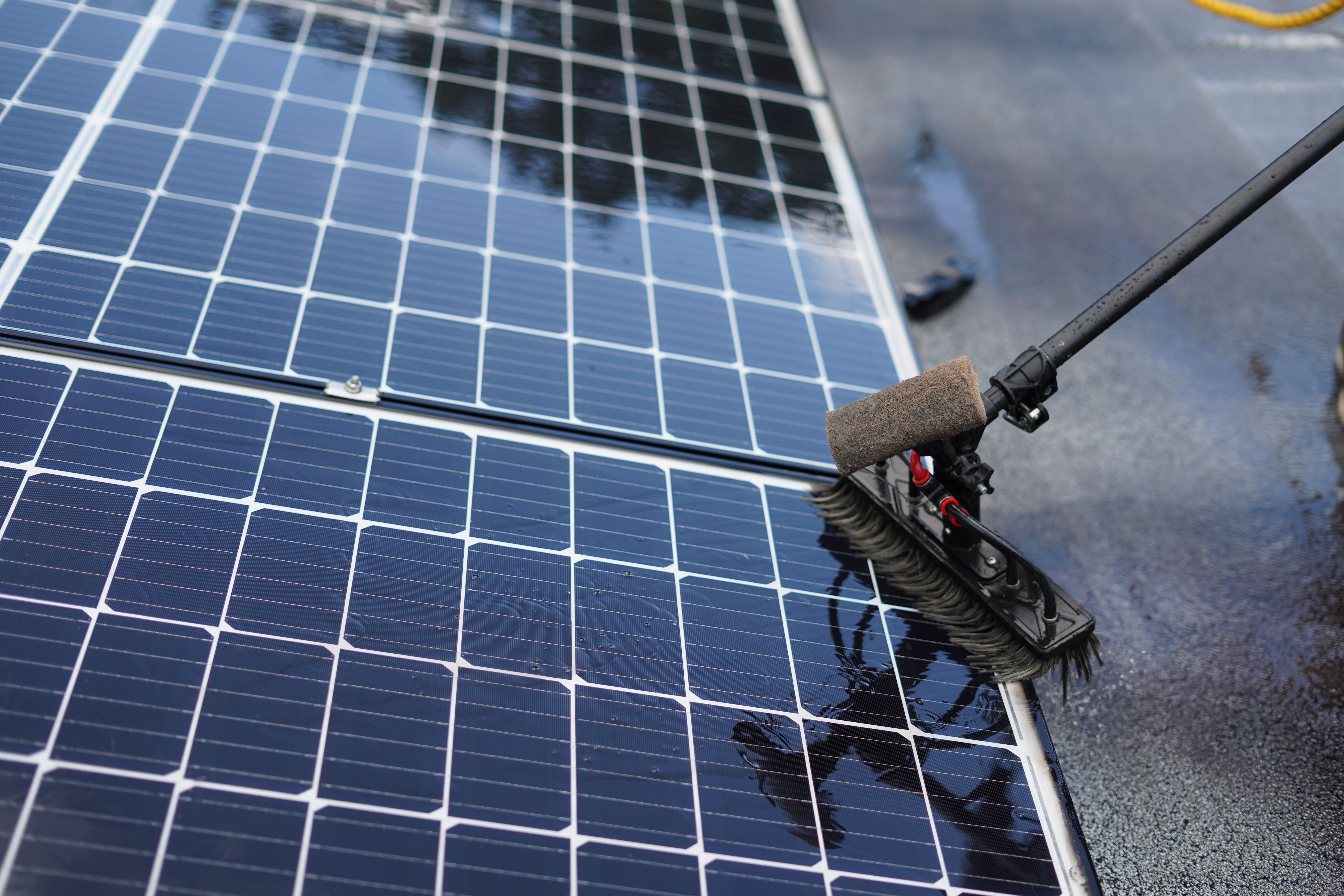
Check instructions and hazards first
Before cleaning solar panels, read the instructions from your installer and from the exact module manufacturer. Knowing how to clean solar panels starts with that document, because it sets the water, tools and products your warranty allows. Inspect for cracked glass, damaged wiring or loose components. Damaged electrical equipment needs a qualified assessment, not a wash.
Modules in daylight still generate electricity even when the inverter or main breaker is switched off. Turning those off therefore does not make the modules and DC wiring safe.
- Electrical parts: never open enclosures, disconnect connectors or change bonding during routine washing.
- Water exposure: keep water away from inverters, junction boxes, connectors and damaged cables.
- Runoff: control where the water drains to avoid slip hazards.
- Extension tools: a pole that reaches from the ground does not make working on the roof safe.
Use module-compatible water and tools
Use water that is compatible with your modules. Low-mineral water can reduce spotting, and one manufacturer recommends low-mineral, near-neutral-pH water. For deposits that water cannot remove, use only an approved clean, soft, non-abrasive brush or sponge. Rubbing dry grit across the glass can scratch it. Never walk or kneel on the modules.
Do not assume household cleaning solutions are approved. Research from the University of Turku found that dishwashing liquid changed the optical properties of solar glass with an anti-reflective coating, and light transmission did not fully recover after rinsing. The study did not test every formula. Avoid pressure washers, scrapers and harsh chemicals too, unless the module instructions allow them.
Know when professional cleaning is needed
Book professional cleaning for steep, high, fragile or hard-to-reach roofs. The same applies to work that needs fall protection or a lift, suspected electrical damage, and deposits that approved manual cleaning cannot remove safely.
Ontario’s photovoltaic safety alert identifies hazards during PV maintenance, where falls, electrical risks and slips combine. The Occupational Health and Safety Act requires employers to protect their workers. Regulation 851 may apply at industrial establishments, and Regulation 213/91 applies where the work counts as a construction project.
When you compare providers, check that the solar panel cleaning service has trained staff, insurance, safe-work procedures and methods the manufacturer approves. Ask for a written record of the cleaning method, any defects observed and performance before and after the work.
Frequently Asked Questions
Is there a legal requirement to clean solar panels in Ontario?
No Ontario-wide legal cleaning interval was found, nor a government inspection specific to cleaning or a penalty for not washing panels on a set schedule. A system connected to the grid or a building’s distribution system does need Electrical Safety Authority Connection Authorization and an inspection under the Ontario Electrical Safety Code. That rule covers the connection, not routine washing.
Do workers cleaning rooftop solar panels need working-at-heights training in Ontario?
Since April 1, 2015, Ontario has required working-at-heights training for construction-project workers who use specified fall-protection systems. Not every cleaning visit is a construction project. Employers must still protect workers under the Occupational Health and Safety Act, and Regulation 851 or 213/91 may apply depending on the site and the type of work.
Should snow be cleared off solar panels?
Not automatically. Clearing snow mechanically can damage modules or wiring, and the production you recover does not always justify the work. Light snow may melt and slide off smooth, tilted panels. Persistent snow on shallow-pitch or flat-roof arrays may not clear the same way.