Do solar panels need maintenance? Yes, but not much. Cleaning, performance monitoring and professional servicing keep an Ontario system productive, each on its own schedule, and some jobs belong to a qualified technician.
What does solar panel maintenance involve?
Maintaining a solar array comes down to four tasks: watching production, looking for visible damage, cleaning only when needed and booking qualified service. How often each task is due depends on the equipment you own and the site it sits on.

Why are panels low-maintenance?
Panels have no moving parts, so they need little care. For most owners, solar panel maintenance means occasional cleaning, regular monitoring of production and checks for visible damage. Panels generally have a lifespan of 25 to 30 years and can keep producing after that. Routine maintenance helps you catch problems early in that long working life.
Each site still has its own schedule. Your solar panel installation follows its component manuals and site conditions, including tilt, roof design, nearby trees, road dust, inverter type and battery chemistry. A south-facing roof in Oakville and a tree-lined lot in Aurora will need different amounts of attention. We cover these options in our residential solar installation service, from grid-tied systems to battery-backed ones.
How often should owners check the system?
We recommend checking your production data every month. Every six months, also look at the array from the ground. Monitoring catches gradual changes, while a visual check finds physical damage that the data cannot explain.
- Monthly: compare your energy readings with the same month last year.
- Every six months: look from the ground for cracked glass, mounts that look loose, pests and debris.
- Yearly: review annual production, fault history, cleaning needs, roof and vegetation changes, warranty status and emergency contacts.
- Every time: write down the date of each cleaning, visual check, monitoring alert and technician visit.
Keep this log with your commissioning documents, shutdown instructions and component warranties. When everything is in one place, the instructions for each installed component are always available.
When are professional inspections needed?
New Dawn Energy Solutions recommends a professional inspection every year, or at the interval set for your equipment, and sooner if a problem appears. A technician can assess panels, frames, mounting hardware, roof attachments and penetrations, cable support, connectors, labels and protective devices, plus the visible condition of the inverter or battery. Large industrial and institutional systems normally need a documented preventive-maintenance plan. We also recommend a qualified electrical and wiring check near the end of the installation-workmanship warranty, generally 5 to 10 years after installation. The technician chooses tests to suit your equipment and any fault found.
When and how should panels be cleaned?
Cleaning depends on the site, not the calendar. Before you pick up a brush, check the deposits you can see and your production trend. When cleaning is justified, a gentle method protects the glass and its coatings.
When is cleaning necessary?
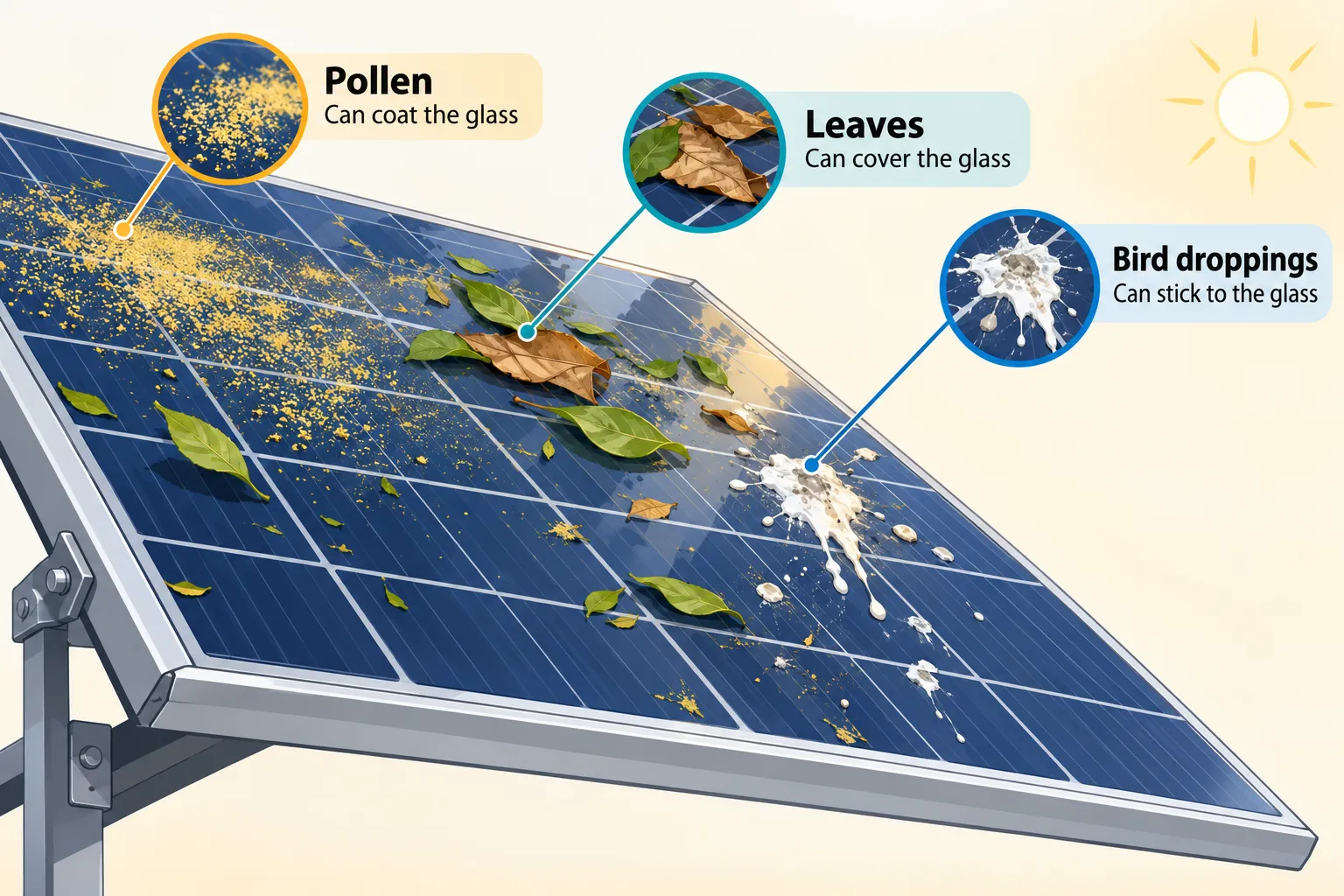
Dust, pollen, bird droppings and leaves block light and reduce energy output. When dirt builds up on one part of a module, it can also cause mismatch, where some cells produce less than others, and hot spots, which are areas of local overheating that cut efficiency further.
Rain often cleans tilted panels well enough, but stubborn deposits can stay. One module maker’s November 2025 manual says its modules tilted at at least 15° may generally need no washing. Persistent soiling still needs attention, and that guidance applies only to the modules it covers.
We recommend cleaning once or twice a year, and more often near trees, major roads or construction sites. A house beside Highway 401 in North York collects more grime than a rural property in Uxbridge. The actual need depends on the debris you can see and your production trend. Our solar panel service frequency in Markham shows how these factors apply to local homes.
How do you clean panels safely?
Start with the manual for your exact module. Safe solar panel cleaning begins by confirming which methods the manufacturer allows and any isolation steps it requires. Then, from a safe position, look for cracks or loose connections before you wet anything.
Clean during a cool part of the day, such as early morning or evening. Use low-mineral water and a soft, non-abrasive brush, sponge or cloth that the manufacturer permits. A gentle, low-pressure rinse can remove loose dust before you touch the glass.
- No dry scraping: abrasive tools scratch glass and coatings.
- No harsh cleaners: corrosive products can damage the module surface.
- No pressure washer: a concentrated spray can damage seals, especially on older systems.
- No walking on modules: concentrated loads can crack the glass, and water must stay away from electrical components.
If you cannot reach the array safely, hire a crew equipped for PV and roof work. Do not lean from a ladder with a pole. After cleaning, confirm in your monitoring app that production has recovered.
Is paid cleaning worth it?
Only when the data supports it. Before you pay for regular cleaning, compare a persistent production shortfall with output from similar weather in the same season. Then estimate how much energy a wash could recover. There is no universal Ontario figure for cleaning gains, so the decision depends on your own readings.
No single price fits every array. The job changes with array size, roof height and pitch, water access, how dirty the panels are, fall protection, isolation needs and repeat visits. A 2023 NREL study summary found that rain did not fully remove pollen at the North Carolina plants studied. Its measured losses do not predict efficiency in Ontario, but they show that rain alone does not guarantee clean panels.
How can you spot problems and get help?
Proactive monitoring can reveal many problems before they show up on your utility bill. When you know what your monitoring shows and which warning signs need urgent attention, you can tell a seasonal dip from a real repair.
What can monitoring reveal?
New Dawn Energy Solutions includes online monitoring with every solar or solar-plus-storage installation. Depending on the equipment, the platform shows energy production, electricity use, battery status, alerts and sometimes panel-level performance. Systems with optimizers or microinverters can report each panel separately. Our guide to solar and battery monitoring explains how to read these views.
- Soiling: a slow decline during dry weather.
- Shading: losses at certain times of day caused by growing trees or new buildings.
- Snow cover: production drops to near zero after a storm.
- Inverter or string fault: a sudden drop, or one string producing less than the others.
Compare system performance with historical data from similar weather and the same season, not with one sunny-day rating. For larger sites, monitoring performance can include irradiance and temperature readings, using the PV monitoring methods set out in IEC 61724-1, dated 21 July 2021.
Data shows that something changed, but not why. A portal can stop reporting while the system keeps generating. Check the inverter status, your internet connection and any utility outage before you assume production has stopped.
Which warnings need prompt assessment?
Some signs need a professional, even if production looks normal. Cracks, discoloration, corrosion, burn marks, exposed wiring, displaced mounts, pest activity and roof leaks all justify an assessment. According to research published in Scientific Reports on cell cracks, cracks covering 11% to 34% of a cell can encourage hot spots and speed up local degradation.
- Electrical warnings: repeated inverter faults, protective trips or new electrical noises.
- Heat and smoke: overheating equipment, smoke or a burning smell.
- Water ingress: moisture inside any electrical enclosure.
If any of these appear, keep people away and do not keep resetting a fault that returns. A lasting, unexplained drop in production after you have accounted for weather and shade should be diagnosed by a solar professional. When one module underperforms, the cause may be local dirt, shade, a failed device or a connection fault. It is not a reason to touch the wiring yourself.
What happens during professional servicing?
Good preparation makes the visit shorter. Before the technician arrives, save the fault codes and timestamps, note when the problem first appeared, the weather and any recent work, and take photographs from a safe place.
Qualified solar panel servicing may include electrical output measurements, thermal imaging to find hot spots, or connection testing, chosen to suit the fault. Do not open equipment, unplug DC connectors or take live measurements yourself. After a repair, ask for the findings, test results, restored settings, any electrical or connection documents, and confirmation that monitoring is back to normal.
What changes for maintenance in Ontario?
Ontario winters, spring pollen and summer heat each affect your system differently. Provincial rules on electrical work and grid connection also set limits on who can do what.
How should owners handle snow?
Snow can reduce or stop production for a while without meaning there is a fault. A two-winter study in Kingston, Ontario, published in 2013, found that losses varied with panel angle and technology. No single percentage can predict the loss at your Brampton or Newmarket home.
- Let it melt: do not climb onto the roof just to recover winter production.
- Critical loads only: if an off-grid or backup system truly needs snow removed, follow a safe access plan and use a soft tool approved for your modules. Never chip at ice.
- Watch the eaves: keep people clear of snow and ice sliding off the panels.
A ladder against an icy roof is a serious hazard. Short periods of snow cover cost far less than an injury, and production comes back once the snow slides off.
What should seasonal and storm checks cover?
Each season brings different risks. Much of this seasonal checking can be done from the ground.
- Spring: pollen and bird fouling that rain has not washed off.
- Summer: clear inverter ventilation so the unit does not overheat and reduce its output.
- Autumn: leaves, blocked drainage, clamps and visible wiring.
- All year: growing vegetation that creates new shade. Have encroaching branches trimmed.
After strong wind, hail or ice, wait until it is safe, then look from the ground for displaced panels, damaged glass and conduit that looks loose, and check for new alerts. Suspected electrical damage needs an inspection by a Licensed Electrical Contractor. After a flood or fire, stay away from wet or damaged equipment and tell responders that PV or storage is on site. Panels in light, and the wiring leading from them, stay live even when disconnects are switched off.
Which rules and costs apply?
Ontario sets no universal legal inspection interval for PV systems. Your plan is governed by component instructions, site risk, insurance and your connection agreement. Hydro One’s April 2026 requirements for eligible micro-embedded systems up to 12 kW make owners responsible for maintenance. Customers of other distributors should check their own agreements. Under Ontario Regulation 350/12, certain eligible small ground-mounted facilities must follow manufacturers’ maintenance recommendations. They must also keep specified inspection, maintenance and repair records for five years. This does not apply to every rooftop system.
Ontario warns that panels produce DC electricity whenever light reaches them, even in low light. Switching off the main breaker does not de-energize the array. For workers, roof access, fall protection, rescue and lockout measures depend on the job and the site. For electrical work offered to the public, hire an ECRA/ESA Licensed Electrical Contractor, and check notification and reconnection requirements for the specific repair. ESA’s 2026 Wiring Fee Guide, effective 1 April 2026, sets a $92 CAD minimum notification fee for notifiable work. The actual charge depends on the work and the applicant.
Frequently Asked Questions
Why does a grid-tied solar system stop working during a power outage?
Your inverter may be applying anti-islanding protection, which is normal. It stops the system from sending power into lines that utility crews may be working on. Backup power is only possible with a system designed and commissioned for it. Never alter the interconnection protection to export power during an outage.
How can birds and rodents damage a solar panel installation?
Rodents can chew through wiring under the panels. Birds nesting beneath the array can cause electrical and structural damage over time. Droppings around the installation, or a sudden problem with a single panel in your monitoring data, can be signs of pests.
What maintenance does a solar inverter need?
It depends on the model, and not every inverter has a fan. Keep the air paths clear and look at the outside for unusual heat, noise, corrosion or water. A soft fan hum is normal. New electrical noises or a burning smell need prompt attention. Work on internal fans, conductors, grounding and protective devices is for qualified personnel only.