Planning an EV charger installation in Newmarket comes down to four decisions: which charger suits your driving and electrical capacity, what the full installed cost will be, which approvals apply, and which licensed contractor will be accountable for the work. Each section below gives you the figures, rules and questions you need to compare installers on the same scope before you book.
Which home charger fits your electrical capacity?
The right charger depends on three things: how far you drive, what your vehicle can accept, and what your home’s service can supply. Choosing the charger first and checking the panel afterwards often leads to quotes that cannot be compared. If you work through those three factors in order, the circuit size and the cost follow from them.

Match charging speed to your driving
Start with the kilometres you drive each day and the hours your car stays parked. Level 1 charging on a standard 120 V outlet adds roughly 3–8 km of range per hour. Residential Level 2 charging at about 240 V adds an estimated 16–50 km per hour. Actual results vary with the vehicle, the temperature and the battery’s state of charge.
If your car sits parked for long hours and your daily distance is short, you may not need Level 2 at all. Drivers who need to recover more range overnight are the ones who benefit most from a Level 2 home EV charger. Once you know which level you need, check the equipment against these points:
- Connector match: the charger must fit your vehicle’s inlet, such as J1772 or NACS. Confirm any adapter with both the vehicle and charger manufacturers.
- On-board limit: your vehicle’s AC charging limit caps the speed, whatever the charger is rated for.
- Approval mark: buy only equipment for electric vehicle charging that carries an electrical approval mark recognized in Ontario. An online listing does not prove approval.
- Site fit: check cable reach, the mounting surface, the outdoor rating, and whether the unit will be hardwired or plugged into a receptacle.
Tesla owners face the same connector and on-board limit checks, and New Dawn Energy Solutions is a Certified Tesla Installer.
Check the panel before choosing output
A proper load assessment looks at your electrical panel’s rating and condition, your existing loads, available circuit space, service capacity and the demand the new charger will add. Spare breaker spaces on their own do not prove you have enough capacity. Some older Newmarket homes, particularly those built before the 1970s, still have 60–100 A service.
Whether you need panel upgrades depends on a load calculation, not a blanket 100 A or 200 A rule. The same applies to a Tesla EV charger installation in Newmarket: the calculated load sets the design, not the brand of charger. If capacity is tight, compare the charging time and installed cost of three options: a lower configured current, an energy-management system, or an upgrade.
Design the circuit and charger location
A Level 2 charger normally runs on a dedicated, properly sized 240 V circuit. Because charging is a continuous load, a 40 A charger uses a 50 A circuit and a 48 A charger uses a 60 A circuit. The conductors, breaker and programmed output must all match, which matters for both safety and reliable charging.
ESA’s May 2025 EV-charging bulletin generally calls for a separate branch circuit. It does allow the circuit to be shared with other loads under its energy-management rule. For a 14-50R or 6-50R receptacle serving cord-connected equipment, the bulletin specifies a 50 A overcurrent device. We design home installations around your layout and energy needs, including overnight charging and smart demand management. A charger can also be paired with our residential solar and battery systems.
What will installation cost in Newmarket?
No one can give a defensible single price for a Newmarket installation without a site assessment. The total depends on the installation scope, the ESA fees and HST, and sometimes Town or utility charges. If you look at all three together, you can tell a realistic quote from an advertised starting price.
Compare installed prices, not hardware prices
A dataset of more than 100 completed residential projects in Toronto and the GTA puts a straightforward Level 2 installation at about $850–$1,500 CAD before HST and charger hardware. These are market examples, not a tariff. Within that dataset, one job cost $900 CAD, while a longer wiring run brought another to $1,425 CAD. A third project reached $4,430 CAD because it needed a 100 A panel replacement, load management and other electrical work. Another Toronto-area contractor estimates most home installations at $1,200–$2,500 CAD and usually quotes hardware separately. That is why the EV charger installation cost in Newmarket should always be compared on a fully installed basis, kept apart from hardware-only prices.
| Scope item | Typical range (CAD) |
| Straightforward Level 2 installation (before HST and hardware) | $850–$1,500 |
| Most home Level 2 installations (one contractor’s estimate) | $1,200–$2,500 |
| Energy-management equipment | $500–$1,500 |
| 100 A-to-200 A panel or service project | $2,000–$5,500+ |
A panel replacement and a full service upgrade are different scopes. Check which one each proposal actually prices.
Account for ESA fees and tax
Under ESA’s 2026 Wiring Fee Guide, effective April 1, 2026, a Licensed Electrical Contractor pays $86 CAD for the first residential EV charger or receptacle item. A $92 CAD notification minimum applies. Each additional related item installed at the same time costs $30 CAD. Non-contractors pay $93 CAD and $33 CAD for the same items. Separately required service work at an existing home is listed at $86 CAD for a contractor, subject to the same minimum, or $212 CAD for a non-contractor. Commercial work has no single flat EV-site fee and also carries the $92 CAD minimum.
If a wiring-plan review is required, it costs $350 CAD for the first two hours or part of an hour, then $175 CAD for each further hour. An additional site visit costs $177 CAD per hour or part of an hour. A separate visit to check corrected defects costs $89 CAD, and re-inspecting uncorrected defects costs $177 CAD. Ontario’s 13% HST generally applies to equipment and installation, and ESA adds HST to its fees under CRA rules. Purely electrical work has no Town building-permit charge. Where related building work does need a permit, the Town’s schedule effective January 1, 2026 sets the minimum downpayment at $200, $500 or $1,000 CAD, depending on construction value, with no HST.
Identify conditional Town and utility costs
Right-of-way charges apply only when work reaches public land. Newmarket’s schedule effective January 1, 2026 lists municipal consent at $668.73 CAD before HST per street. A Road Occupancy Permit costs $167.17 CAD before HST per road segment. The related inspection adds $195.04 CAD per segment, and a security deposit may apply depending on the scope.
NT Power does not publish one universal EV fee. It issues site-specific connection offers and may require customer contributions. Ask your installer to flag both possibilities before you approve a quote.
Which approvals are needed, and how long?
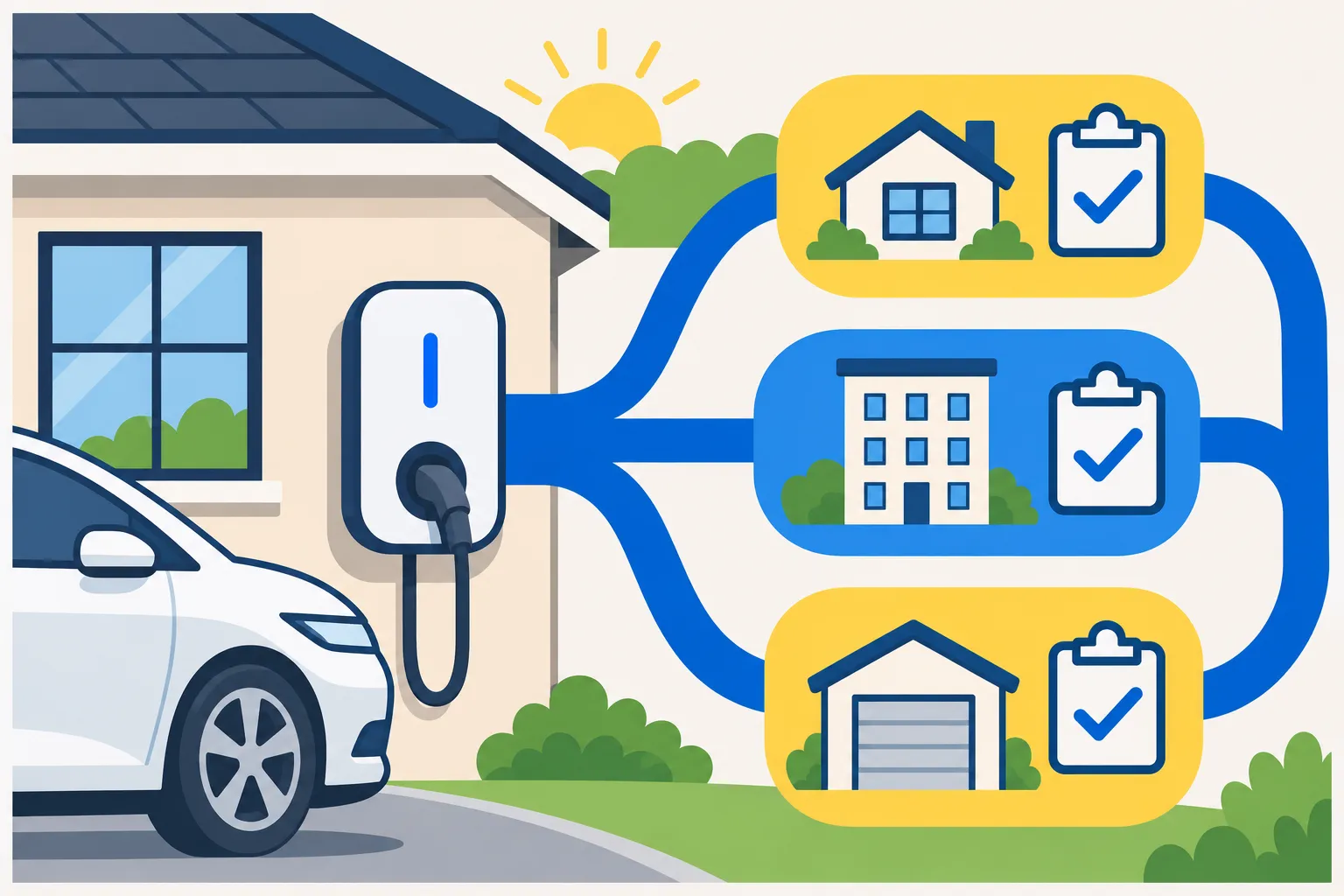
Every hired installation in Newmarket goes through ESA. Town, utility and excavation approvals apply only to certain projects. Knowing which ones your project triggers lets you set a realistic timeline before booking, and keeps work from starting before the right approvals are in place.
Complete the ESA notification and acceptance
The person doing the electrical work must file an ESA notification before starting, even when the Town requires no building permit. The work must meet the current edition of the Ontario Electrical Safety Code, which took effect May 1, 2025. In the filing, your contractor should identify the EV charging system and arrange a review at the right stage, including a rough-in review before concealed wiring is covered.
ESA can accept work without sending an inspector to the site. Once the installation is accepted, keep the Certificate of Acceptance with your property records. If ESA finds a defect, your contractor corrects it and arranges the follow-up, because a filed notification does not prove the work was accepted.
Allow time for Town and utility approvals
The Town of Newmarket does not require a building permit for work that is purely electrical. Structural alterations, a new structure or other related building work may need one. Initial review takes about 10–15 working days after the Town receives a complete application and fees.
When a service-panel upgrade or a new EV supply connection is needed, NT Power asks for a service request listing the existing and proposed service ratings and the proposed load. Its connection offer, utility work and scheduling run separately from ESA acceptance. Once every condition is met, connection takes five working days below 750 V and ten working days above 750 V. Design, approvals and construction come before those periods, and NT Power does not guarantee a requested date.
Plan for excavation and installation time
Trenching to a detached garage or an outdoor pedestal brings its own steps. Get underground locates before anyone digs, and wait for every response. The Ontario Dig Authority states five business days for a standard single-address locate.
Infrastructure placed or upgraded in Newmarket’s right-of-way requires municipal consent. Work that occupies a road or boulevard may also need a Road Occupancy Permit. The Town says consent processing takes four to six weeks, or two to three weeks when the submission is complete.
Once assessment, design and approvals are done, the electrical work for a straightforward home installation can take up to several hours. Concealed wiring, trenching, service work and utility scheduling can stretch the overall project well beyond that.
Which Newmarket charger installation contractor should you hire?
Two contractors can quote very different prices for what looks like the same charger installation. The difference usually comes down to licensing, accountability and what the written scope actually includes. You can check all three before you sign.
Verify licensing and accountability
For hired work, use an ECRA/ESA Licensed Electrical Contractor and check the business’s licence number in ESA’s online lookup. Someone described only as an electrician, an “ESA-certified installer” or an individual Master Electrician does not replace that business-licence check.
ESA says Licensed Electrical Contractors carry liability insurance and Workplace Safety and Insurance Board coverage. Before booking, get clear answers to these points:
- Insurance: ask for written proof of liability coverage.
- References: request contacts from similar EV projects.
- Who does the work: confirm who will physically do the electrical installation.
- Paperwork: confirm who files the ESA notification and who will provide the Certificate of Acceptance.
A contractor who cannot name the business licence holder has not met the basic standard of accountability.
Compare written scope and services
A written estimate you can compare identifies the charger, the calculated load, circuit and breaker sizing, cable route, conductors, conduit, mounting, labour, commissioning, and any panel or service work.
Ask whether the price includes ESA notification and review, tax, drilling, trenching, outdoor equipment, wall repairs, utility work and responsibility for correcting defects. A short advertised starting price does not tell you what your particular property will need.
We begin with a no-obligation assessment of your energy needs, then handle system design, permitting and installation. Our broader services also include financing and long-term maintenance.
Check fit for commercial projects
A commercial property needs charging infrastructure designed around site-wide capacity, vehicle dwell time, distribution equipment and future expansion. A residential panel solution does not scale to that. For workplace or fleet sites, settle who requests the utility connection, who funds upstream work and who operates the equipment. Accessibility and payment requirements may also apply.
Our commercial EV charging installations serve offices and fleets, with scalable charging stations for employees, customers and fleet vehicles. Ask any contractor to show how their proposed charging stations can grow with your demand.
What changes for a condo or townhouse?
A townhouse with its own electrical panel can be much like a detached-home installation. A condo may need board approval and coordination with shared building infrastructure. If you sort out access and approval first, the installation itself becomes a much shorter step.
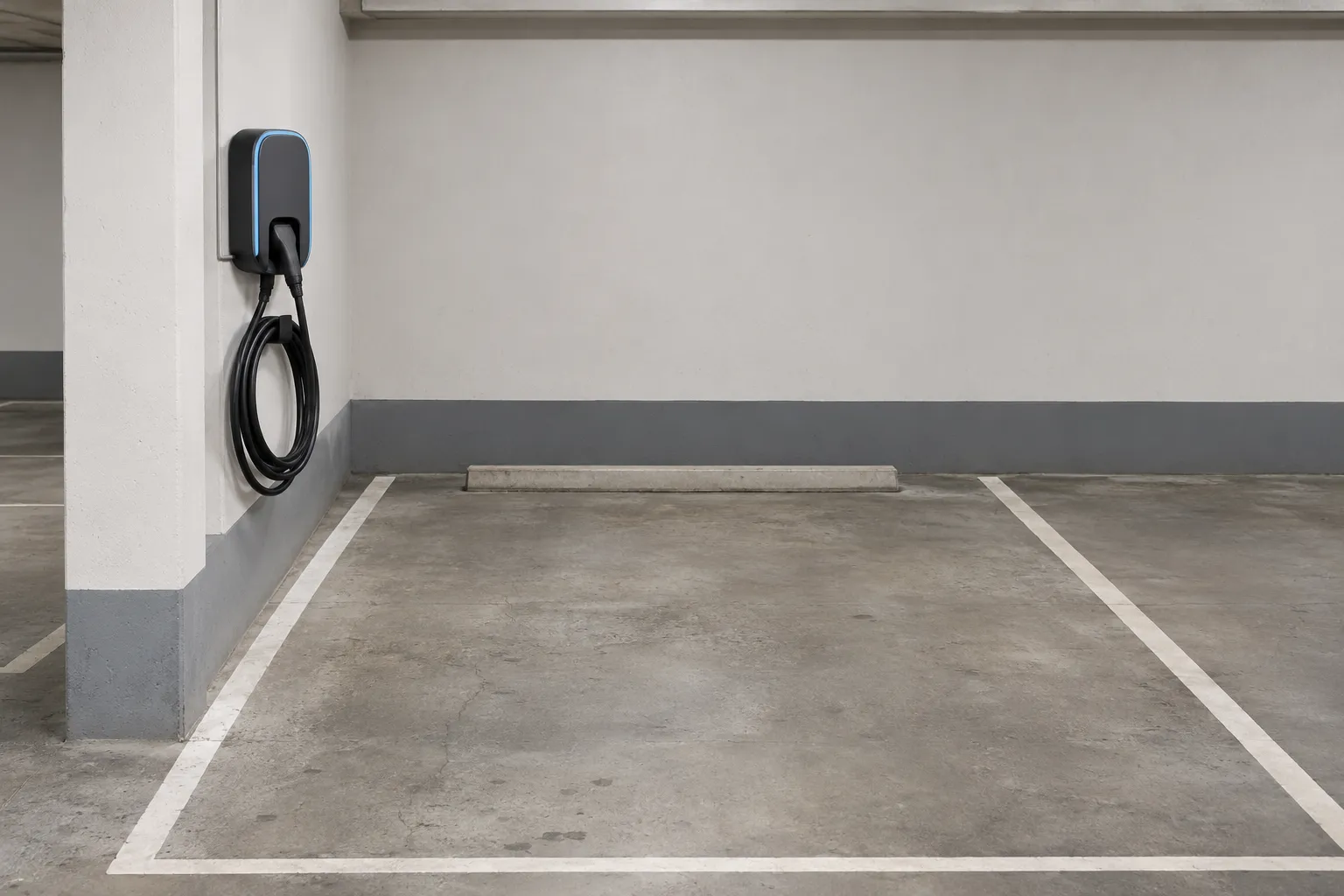
Establish parking and electrical access
Before you ask for a condo quote, settle the facts the board and installer both depend on:
- Parking rights: whether you own the space or only have use rights.
- Cable route: the proposed path from the power source to the space.
- Shared wiring: what building infrastructure the circuit would rely on.
- Charging policy: the building’s existing rules for EV charging.
The condo corporation must also decide how charging electricity will be measured and billed, and who carries insurance and ongoing maintenance.
Follow the condo application process
For an owner-requested installation, the Condominium Authority of Ontario describes a signed written application with identifying information, drawings and specifications. Your installer can supply the technical drawings and specifications.
The corporation generally has 60 days to respond, unless both sides agree in writing to a different period. A rejection must rest on specified legislative, structural-integrity or health-and-safety grounds, backed by a qualified professional’s opinion given to the owner. After acceptance, owner and corporation generally have 90 days to sign a written agreement on responsibilities and costs. It takes effect once registered on the unit’s title.
Resolve shared-system and occupancy constraints
A building’s shared electrical system may need coordinated management of charging demand, even when units have their own panels or meters. Tenants need permission and a solution that works with the building’s system. In apartment buildings, management decides what can be installed.
Under the Condominium Authority of Ontario process, a dispute must go to private mediation and arbitration within six months, or the application is treated as abandoned. Board approval time is separate from installation time, a distinction our guide to EV charger installation across the GTA also covers for condos and rentals.
Frequently Asked Questions
Do I need a panel upgrade to install an EV charger?
Not automatically. A 100-amp service may be enough for a smaller home with standard appliances, but adding central air conditioning, an EV charger or basement circuits can change that. A load calculation shows whether you need load management, panel changes, a subpanel or a full service upgrade.
When does a commercial EV charging project need an ESA plan review?
Under ESA Rule 2-010, the plan-review threshold for certain EV charging installations rose from 10 kW to 12 kW on July 6, 2026. We recommend asking your Licensed Electrical Contractor to confirm whether your commercial project exceeds that threshold.
Can a business claim capital cost allowance on commercial EV chargers?
Possibly. The Canada Revenue Agency identifies chargers supplying more than 10 kW but less than 90 kW of continuous power as potentially eligible for Class 43.1, which carries a 30% rate.