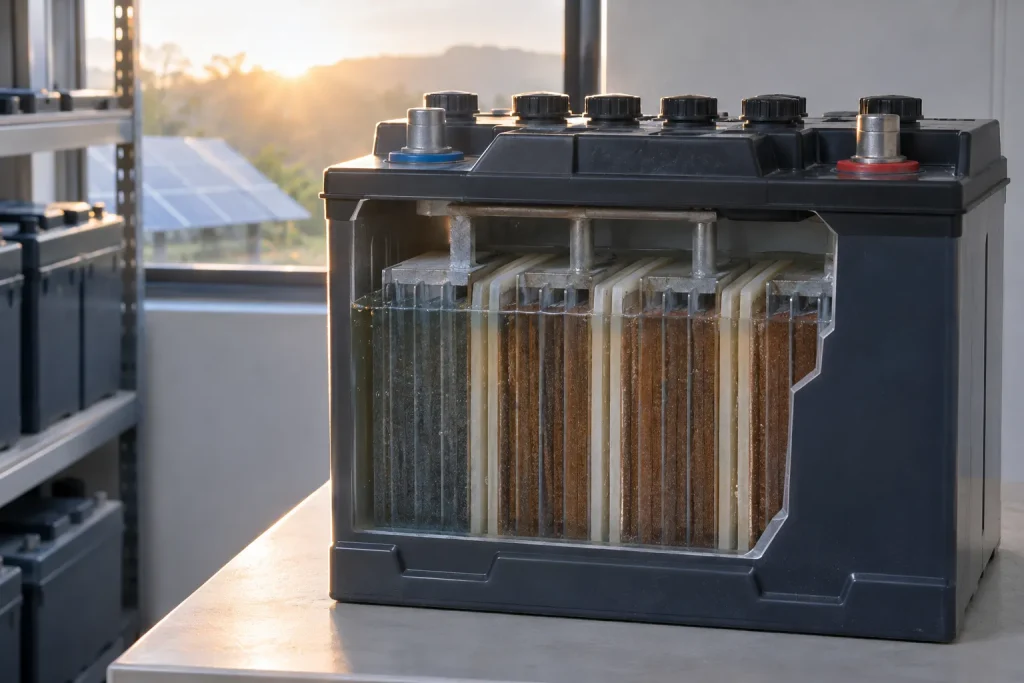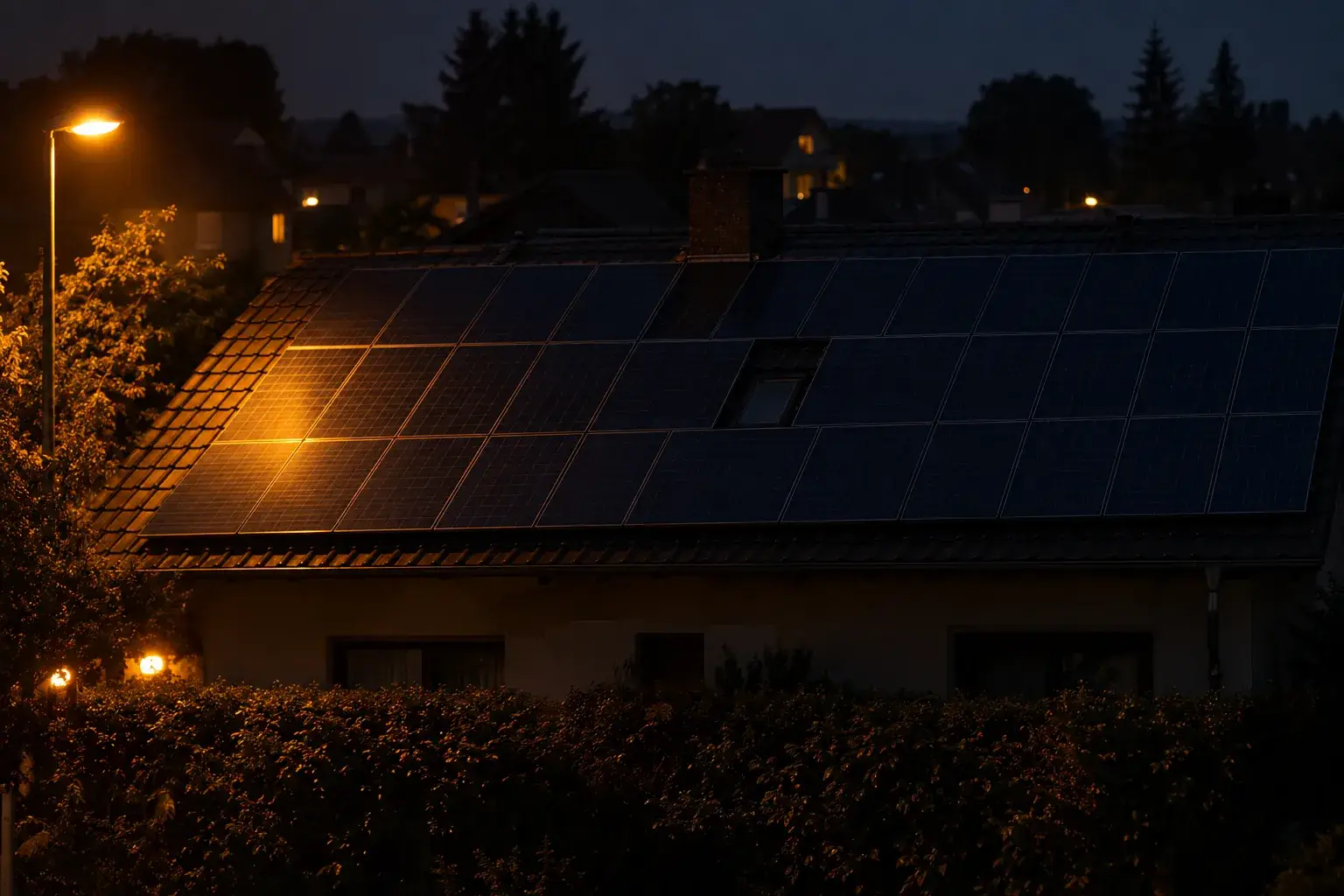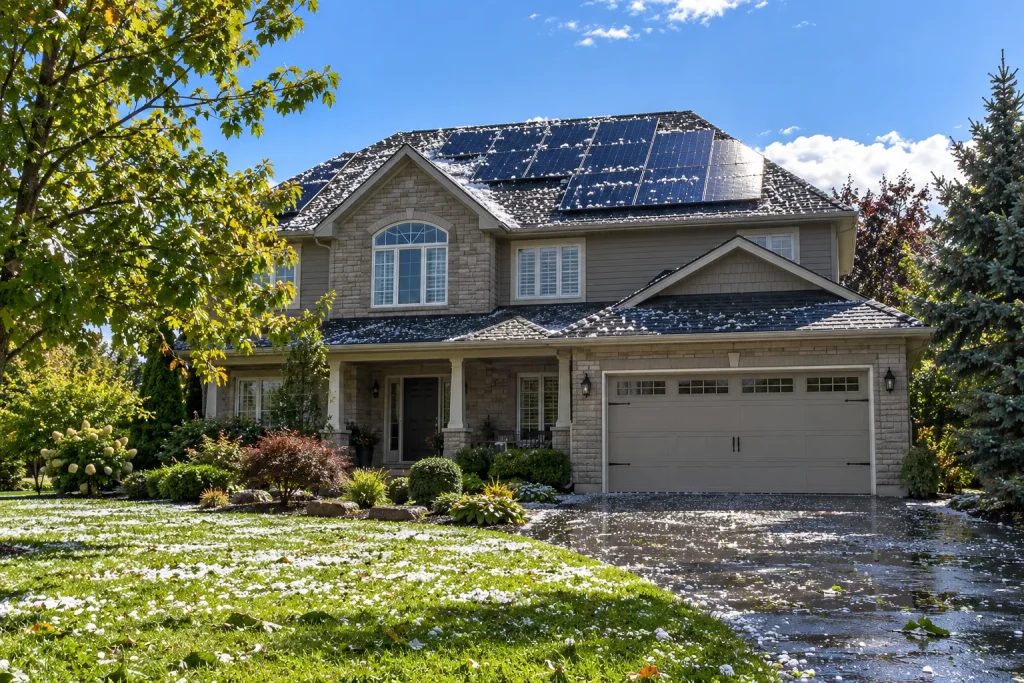
A flooded lead-acid battery remains a dependable, low-cost choice for solar storage when you can maintain it properly. Its cells need regular watering, inspection and complete charging, and AGM or gel models can suit homes, cabins and microgrids across Ontario where that care is impractical.
What is a flooded lead-acid battery?
Lead-acid chemistry is one of the oldest forms of energy storage, and off-grid solar installations have relied on it for decades. The “flooded” version is reliable when you operate and maintain it properly. It is also heavy and has a limited cycle life. When charging and discharging, it is less efficient than lithium-based batteries.
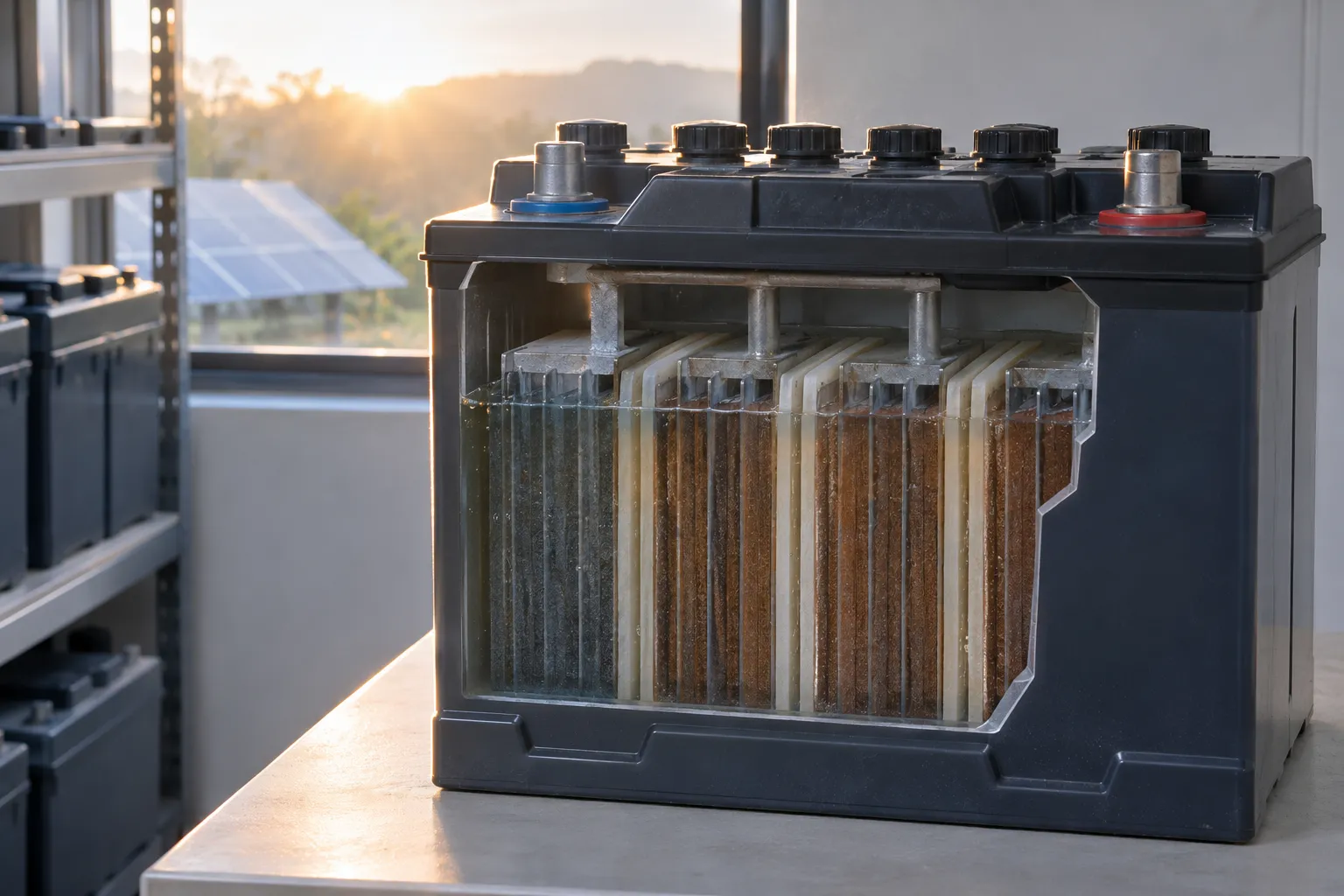
Inside a deep-cycle flooded battery
The difference between a flooded battery and a lead-acid battery is one of construction, not chemistry. A flooded unit is a lead-acid battery whose lead-based plates sit in a free-flowing electrolyte of sulfuric acid and water. As the battery discharges, lead sulphate forms on both plates and the electrolyte’s specific gravity (its density) drops. Charging reverses both changes.
A nominal 12V deep-cycle battery holds six cells of about 2 V each. Banks are also built from 6 V deep-cycle batteries or from individual 2 V stationary cells.
Sizing a 12 V deep-cycle battery bank
Sizing starts with your load profile, not the battery catalogue. A sound load profile identifies daily energy use, peak and starting loads, essential circuits and future demand before the bank is selected for a home or a standalone microgrid. Our home solar battery storage systems offer a lithium iron phosphate alternative to weigh against that profile.
A 48 V, 400 Ah bank holds 19.2 kWh of nominal energy. At 50% depth of discharge, about 9.6 kWh of nominal DC energy is available before inverter losses, cold-weather derating and ageing. A deep cycle flooded battery handles repeated cycling better than a starting battery. Compare amp-hour ratings at the same discharge rate, and check each model’s charging and cycle-life specifications.
Battery groups, marine batteries and dual-purpose batteries
A battery group designation defines case dimensions and terminal layout. Two batteries in the same battery group can still behave very differently in cycling service. A dual purpose battery handles both engine starting and accessory loads. A marine battery may be built for a different balance of starting and cycling. Before you put either one into solar service, get cycle-life data for that duty, whatever its battery group.
Flooded lead acid batteries must stay upright because their liquid electrolyte can spill. Your solar installation therefore needs room for restrained batteries, connections you can reach easily and a properly designed enclosure.
How do I maintain a flooded battery bank?
Flooded lead-acid batteries need significant care. Most of the routine work involves the electrolyte level, connections and cell condition. Skipping these tasks can shorten the life of your bank.
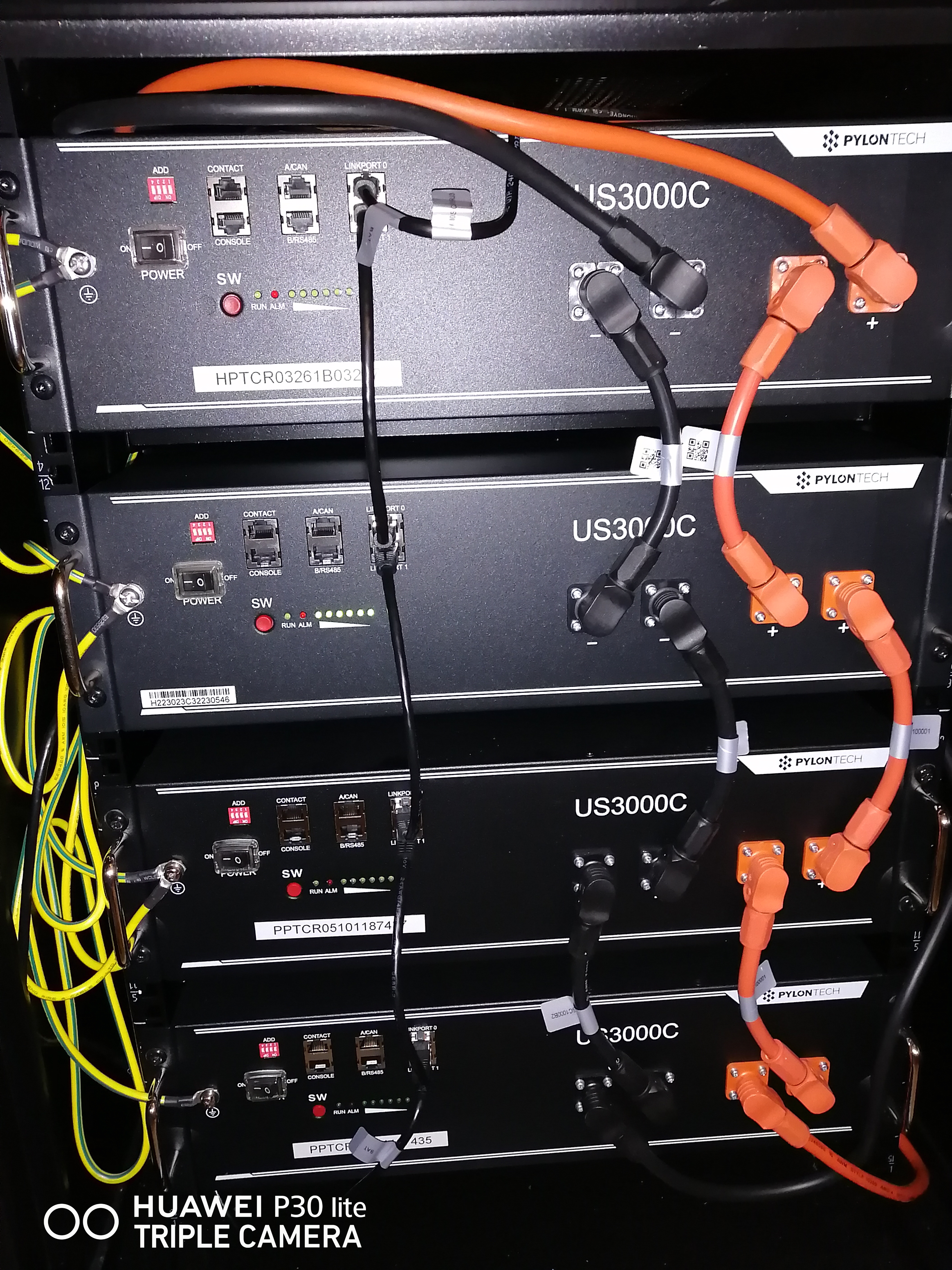
Watering serviceable cells
Charging uses up water, so flooded batteries require regular electrolyte-level checks. Top up serviceable cells with distilled water or deionized water approved by the manufacturer. Never add acid as part of routine care. Follow this order:
- Check before charging: if plates are exposed, add only enough water to cover them.
- Charge completely: finish the full charge before you top up, because electrolyte expands and can overflow.
- Fill to the model’s level: one manufacturer specifies 3 mm below the vent well, while another specifies roughly 6–13 mm below the vent tube.
- Close up: secure every vent cap after watering.
Overwatering causes overflow, so stop at the specified mark. Investigate if water use is unusually high or if one cell keeps needing more than its neighbours. Do not simply keep refilling it.
Inspection and safe access
Records help you spot problems. One manufacturer’s first-year schedule calls for monthly logs of voltage, electrolyte level, specific gravity and ambient temperature. Every quarter, it adds checks of ventilation, cables, charger voltage and damaged cells.
Flooded cells can release hydrogen during charging, so the enclosure must never be airtight. Basic safety measures include acid-resistant containment, ventilation, chemical-resistant gloves and splash-proof eye protection. If acid gets on your skin or in your eyes, the Canadian Centre for Occupational Health and Safety advises flushing with gently flowing water for at least 30 minutes and getting urgent medical help. Before any electrical work, a competent person must isolate every source and confirm there is no voltage.
Condition checks and end-of-life decisions
A hydrometer measures electrolyte density, and it can reveal a weak cell. Record each cell’s temperature-corrected specific gravity and compare it with the baseline for that model. Take readings at rest, not during charging. One manufacturer’s 12 V chart lists 12.73 V and 1.277 at full charge. At 50% charge, it lists 12.10 V and 1.172.
Short run time can point to undercharging or sulphation. Start by inspecting the case, terminals, electrolyte and charger settings. Then run a full charge approved by the manufacturer, followed by a capacity test. Never recharge a battery that is frozen, cracked or leaking.
When a large lead-acid battery is spent, take it to a receiver that accepts that battery type. It does not belong in household rubbish. Transport it upright with the terminals protected against short circuits, and contain any unit that leaks.
How should a flooded solar battery be charged?
Charging has a direct effect on the life of a flooded bank. Good charging depends on correct settings for your exact model, a charge that actually finishes, and attention to Canadian winters.
Charging stages and model-specific settings
The bulk stage restores discharged capacity. Absorption then holds a controlled voltage while the current tapers off. Float maintains the charge at a lower voltage. A display that reads 100% does not prove that absorption has finished.
The right charging voltage for a flooded lead-acid battery depends on the exact model and on its temperature. One guide gives about 14.4 V bulk and 13.4 V float for a 12 V flooded battery. A different manufacturer specifies 15.0 V absorption and 13.5 V float at 25°C. Any charge controller or inverter-charger you use as a flooded lead-acid battery charger must match the model’s voltage, current and temperature-compensation requirements.
| Setting | Example value | Source type |
| Bulk, 12 V flooded | About 14.4 V | Charging guide |
| Float, 12 V flooded | About 13.4 V | Charging guide |
| Absorption at 25°C | 15.0 V | One manufacturer’s profile |
| Float at 25°C | 13.5 V | One manufacturer’s profile |
| Bulk current | About 10% of 20-hour Ah rating (range 5–20%) | One manufacturer |
| Example: 100 Ah battery | 10 A at 10% | Calculation |
When equalization is appropriate
Repeated incomplete charging can cause stratification, where denser acid settles at the bottom of a cell. It can also leave lead sulphate that is hard to convert back. Controlled gassing approved by the manufacturer can mix the electrolyte. Equalization is a separate controlled overcharge, not routine absorption.
One manufacturer suggests considering equalization when cell specific gravities differ by more than 0.030 at full charge. Its procedure requires you to monitor temperature and gravity, and to stop as cells rise above 46°C toward 52°C. Give a low-reading cell a normal full charge and retest it first. Equalization cannot fix an internal short, major plate damage or an inadequate charging source.
Winter charging and seasonal storage
A field study of a solar-generator system in British Columbia linked severe capacity loss to deep discharge, snow-covered panels and generator runs too short to finish charging. Periodic full charges helped performance recover over the following three months.
Discharged electrolyte can freeze at warmer temperatures than fully charged electrolyte. Canadian electrical-code commentary lists about −15°C at specific gravity 1.150, −20°C at 1.175 and −27°C at 1.200. If a battery freezes, let it thaw and have it inspected before you charge it. Before seasonal storage, fully charge the bank and remove unnecessary loads. One manufacturer gives two options: keep the system online, or disconnect it and refresh the charge about every 60 days. Another recommends recharging about every three months for one of its series.
Flooded, AGM or gel for solar storage?
AGM and gel are both valve-regulated lead-acid batteries. They are sealed and use valves to control off-gassing. Compared with flooded batteries, they need little to no maintenance. Different battery chemistries suit different environments.
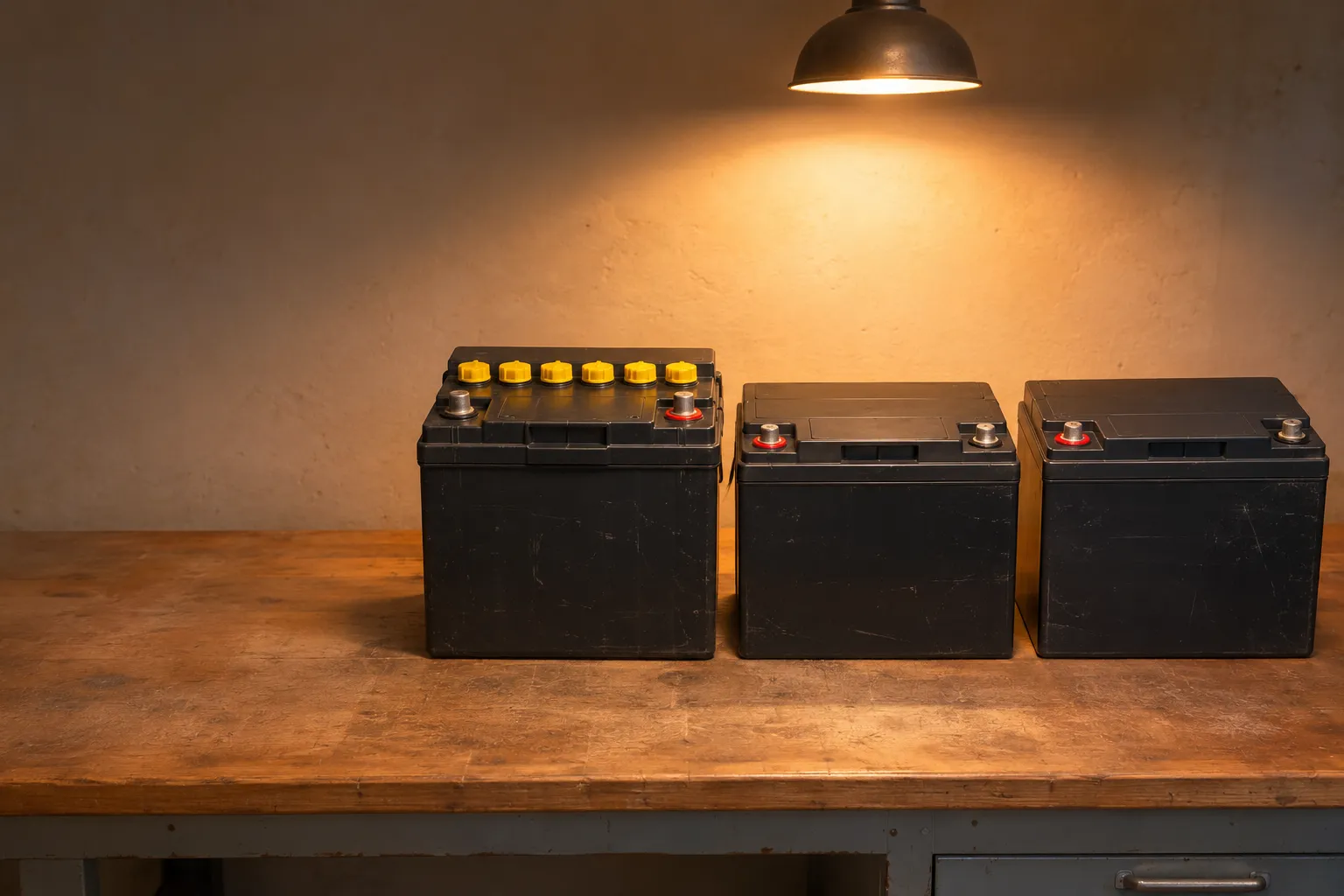
How AGM differs from flooded
An AGM battery is a lead-acid design in which a fibreglass mat holds the electrolyte. It does not need routine watering, but you still need to inspect its case, terminals and performance. AGM and flooded batteries also place different demands on the installation:
- Spill resistance: AGM resists spills and permits more flexible orientation, subject to manufacturer restrictions.
- Vibration: AGM generally holds up better to vibration and shock.
- Self-discharge: AGM generally loses charge more slowly when idle.
- Cold performance: AGM generally delivers better power in extreme cold.
A maintenance-free label does not prove that a battery is AGM, because some flooded designs have vents you cannot reach. Identify the construction from the model documentation. Do not try a hydrometer test on sealed AGM cells. Our guide to solar battery chemistries compares these lead-acid formats with other options.
Where gel batteries differ
Gel batteries hold their electrolyte in a gel. Like AGM, they are valve-regulated and need no routine watering.
A gel battery needs its own charging profile and is particularly sensitive to excessive voltage. Never apply flooded-battery equalization settings to AGM or gel unless that model’s manufacturer explicitly allows it.
AGM batteries normally recombine their charging gases internally, but they can vent under abnormal conditions. A sealed design does not remove the need to assess ventilation at the installation site.
Choosing for access, lifetime and cost
A Nunavut cabin-solar guide gives flooded lead-acid batteries about 5–7 years and 500–1,000 cycles. It gives AGM about 5–10 years and 1,000–2,000 cycles. Actual life depends on use, temperature and maintenance. Flooded storage suits an accessible, ventilated site where watering and full charges are practical. A cabin you rarely visit may favour AGM or gel.
Comparing a flooded lead-acid battery with a lithium battery adds another dimension. Lithium-ion is lighter, offers a longer cycle life and never needs refilling, but cost and application still matter. Weigh lifetime delivered energy and maintenance effort alongside purchase price when you compare a flooded bank with our solar plus storage offering for residential and remote systems.
Frequently Asked Questions
How can I tell whether my battery is flooded or AGM?
Serviceable flooded batteries have vent caps that let you inspect the electrolyte and add water. Their free liquid moves inside the cell, and charging gases escape through the vents. A “maintenance-free” label proves nothing, because some flooded designs hide their vents. Check the model documentation instead.
Can a weak flooded battery be brought back to life?
Sometimes. It depends on why it failed, how long it stayed discharged, its age and whether the plates are permanently damaged. Aspirin, Epsom salts and added acid are not restoration methods. A normal charging voltage does not prove the capacity has recovered. Replacement is generally appropriate for a cracked case, a shorted cell or capacity below your needs.
How long does a flooded lead-acid battery typically last?
No single service life applies to every flooded battery. Cycle life counts charge-discharge cycles until capacity falls below a set threshold, and it depends mainly on depth of discharge. Calendar life measures elapsed time and depends on temperature, full charging, water level and cell balance.