Understanding whether solar panels store energy, and how surplus electricity can be saved for later use, is essential before investing in a solar system for your Canadian home or business.
Do solar panels store energy in Canada?
Solar panels generate electricity from sunlight, but they cannot retain that electricity on their own. To understand how solar battery storage in Ontario works, you need to follow the electricity your panels produce throughout the day.
How solar panels generate electricity
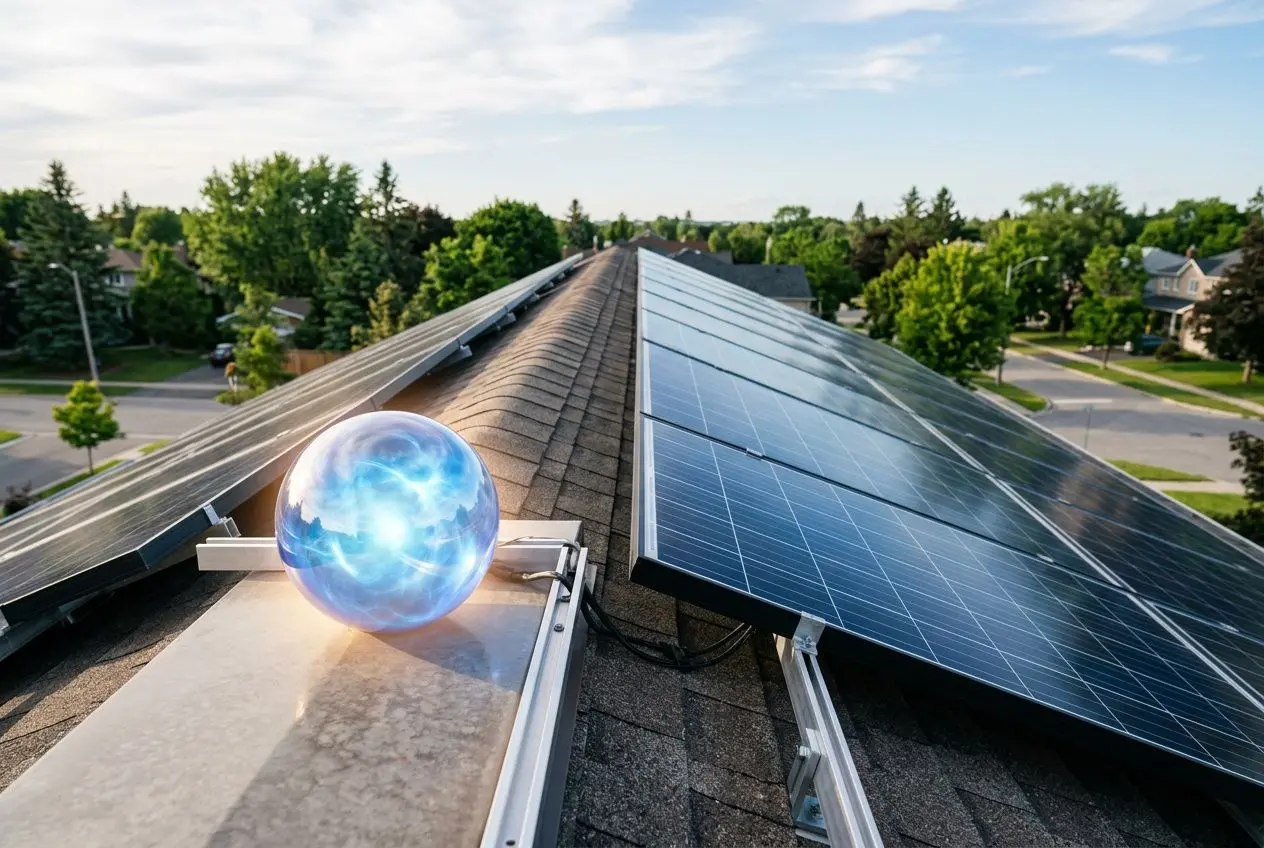
Photovoltaic cells convert sunlight into direct-current electricity through the photovoltaic effect. An inverter then transforms that DC output into alternating current for your building’s electrical panel. Solar panels generate electricity, but they cannot retain it on their own. Peer-reviewed solar energy research articles consistently confirm this distinction.
- Photovoltaic effect: Sunlight strikes silicon cells, freeing electrons and creating a flow of direct-current electricity across the panel circuit.
- Inverter conversion: A solar inverter converts DC output to AC electricity, making it compatible with standard household appliances and the utility grid.
- Immediate consumption: Generated electricity powers active loads in the building first, reducing the amount drawn from the grid in real time.
- Grid dependency at night: Without a battery, a solar-only property draws electricity from the utility grid after sunset or whenever clouds reduce panel output below demand.
When production exceeds demand, the surplus must go somewhere. Excess solar power either flows into a battery, if one is connected, or is exported to the utility grid. Without either pathway, a grid-connected inverter limits or stops production instead of allowing unused electricity to accumulate in the panels.
Why solar stops during outages
A standard grid-connected solar system automatically shuts down when the utility grid goes offline. This safety mechanism protects utility workers repairing lines from an unexpected energized circuit. Many homeowners in Canada ask whether solar panels can store energy in a way that keeps the lights on during a blackout. The answer is no, not without a battery. Resources such as solar battery storage Toronto options explain what a properly designed backup configuration requires. Even on a bright, sunny day, panels without a connected storage system provide no power to the building during an outage.
Where unused solar power goes
When a grid-tied solar system produces more electricity than the building consumes, the surplus does not disappear.
- Grid export: Surplus electricity flows back to the utility grid, and net metering or net billing programs may credit your account for that contribution.
- Battery charging: A connected home battery captures surplus generation for use after sunset, during peak-demand periods, or when the grid fails.
- Inverter curtailment: Without a battery or grid connection to absorb excess production, the inverter limits panel output to match the building’s live consumption.
The most economical option depends on your local net metering terms, household energy profile, and the frequency of outages in your area. Ontario homeowners facing more frequent utility disruptions are increasingly choosing a solar battery storage system to store excess energy on-site and improve resilience when the centralized network fails.
How solar energy storage works at home
Adding a battery turns a solar system from a daytime-only power source into a round-the-clock energy solution. An energy storage system captures electricity that panels produce beyond immediate demand, then makes it available when sunlight fades or the grid goes down.
How batteries store solar energy
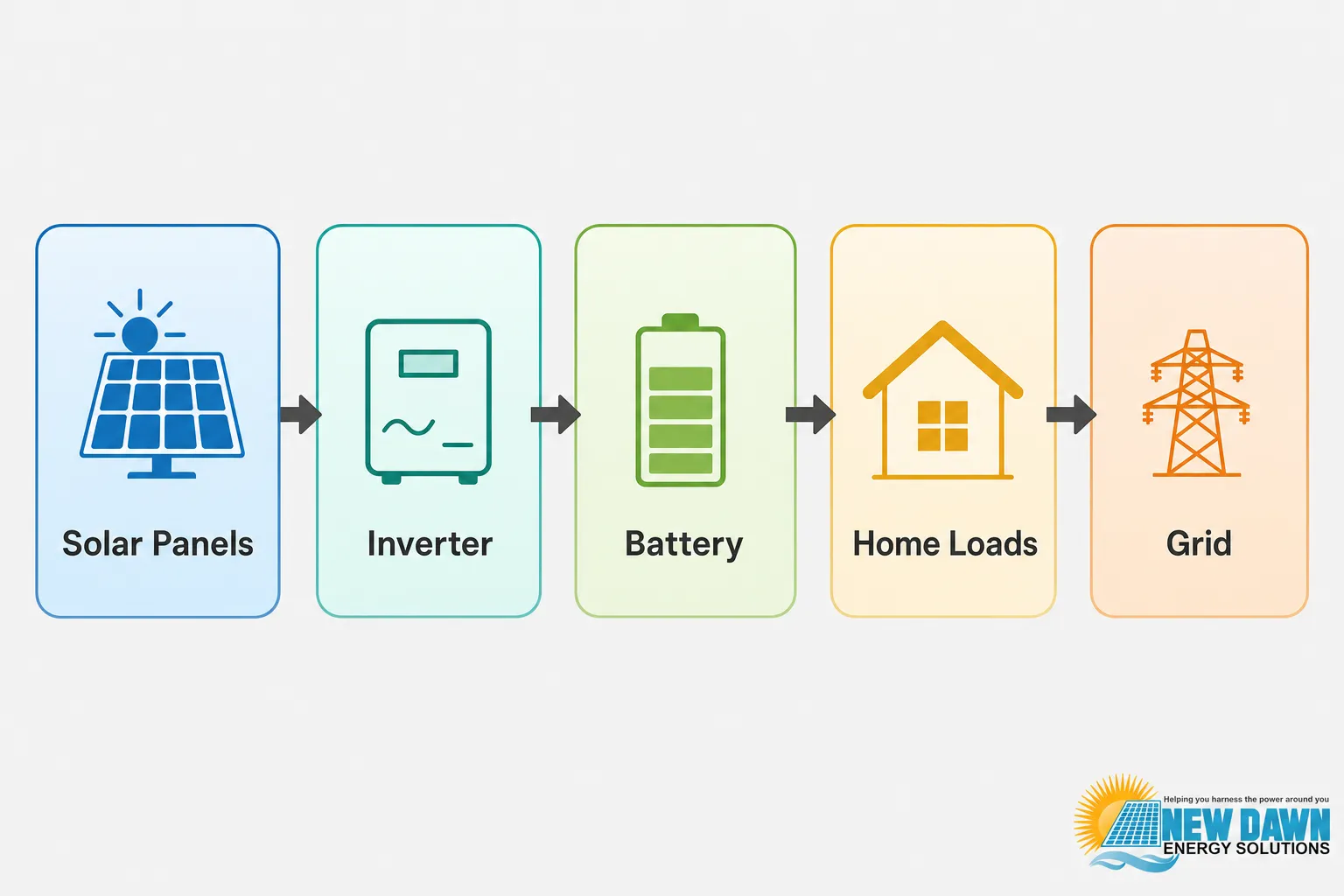
A solar battery storage system receives surplus solar energy from your panels and converts it into stored chemical energy. However, a battery connected to the system stores solar energy and automatically supplies power after sunset. Residential solar storage systems commonly use lithium iron phosphate chemistry, abbreviated LiFePO₄ or LFP.
- LFP chemistry. Lithium iron phosphate batteries deliver over 6,000 charge-discharge cycles with minimal capacity loss, making them highly durable for daily home cycling.
- Thermal stability. LFP cells have a low risk of fire or thermal runaway, providing an important safety advantage over other lithium-ion batteries in residential settings.
- Eco-friendly design. These batteries contain no heavy metals and use non-toxic electrolytes, making them recyclable and well suited to the clean energy transition.
- Smart energy management. Intelligent software controls when stored electricity is released, helping Ontario homeowners avoid buying power during higher-priced peak periods under time-of-use pricing.
In photovoltaic systems that require one, a charge controller manages electricity flowing into the battery pack. Modern home solar battery installations often integrate this function into a hybrid inverter, simplifying the design and reducing the number of separate components requiring maintenance over the system payback period.
Battery storage for night and outages
A properly designed solar-plus-storage system with islanding capability switches to battery power as soon as the grid goes offline, without manual intervention. The answer depends on battery capacity, household consumption, and solar production during daylight hours.
Most residential lithium-ion batteries support essential loads for roughly one to five days, depending on those factors. Battery systems operate quietly, require little maintenance, and avoid the fuel costs and emissions associated with propane or gasoline generators.
How long stored power lasts
A single home battery usually supports selected critical circuits rather than every appliance at once. Essential loads commonly include refrigeration, lighting, internet equipment, sump pumps, security systems, communications devices, and certain medical equipment. Prioritizing these circuits allows one battery to provide meaningful coverage during a multi-day outage without requiring an oversized, costly system. The capacity of a battery backup system can be scaled to match specific critical-load requirements as your needs grow.
Home solar energy storage duration is not fixed. It changes daily according to how much surplus solar energy the panels produced that morning and how much electricity the household consumed the previous evening. A well-sized solar storage system recharges from the panels on each sunny day, effectively resetting the backup window.
Solar storage systems can also expand through additional battery modules. For Ontario homeowners, that flexibility makes it easier to increase backup coverage as grid disruptions become longer and more frequent across the province. A home battery can therefore support energy savings, stronger grid resilience, and more dependable home solar energy storage without replacing the complete system.
Solar storage options beyond a home battery
A dedicated battery is not the only way to manage electricity produced by a solar system. Depending on your location, energy use, and utility programs, the grid can support your solar energy storage strategy, with or without a physical battery on site.
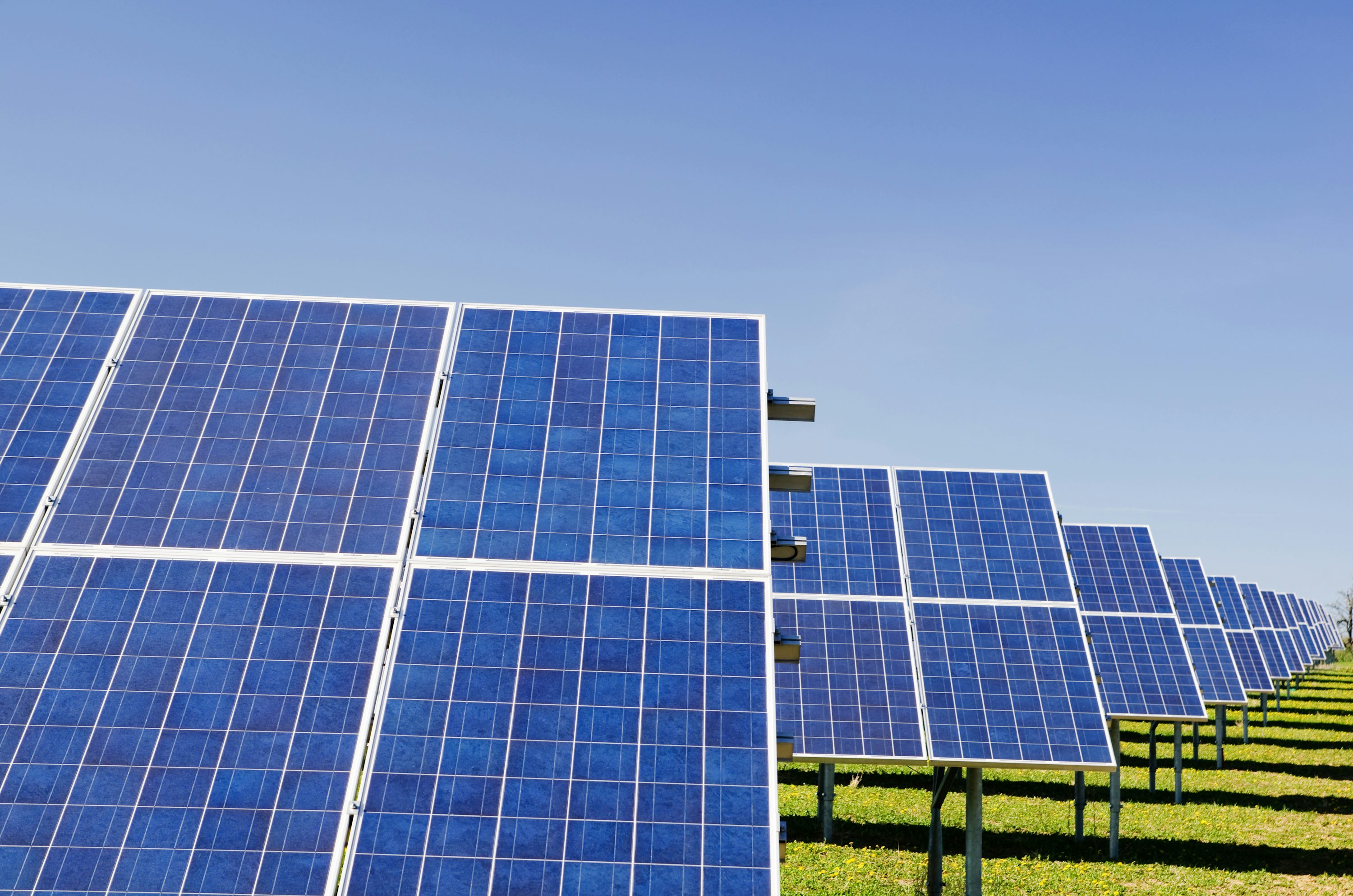
Using the grid for solar energy
Storing solar energy without batteries is possible through grid export. Excess electricity flows to the utility and is credited against future consumption. With net metering, exported electricity receives the same per-kWh credit as imported power, on a one-to-one basis. Net billing uses a separate, often lower, export rate. Program terms vary across Canadian jurisdictions, so the financial value differs between provinces and utilities.
- Net metering Exported surplus solar energy earns a one-to-one per-kWh credit, allowing the utility grid to function as a virtual account for daytime solar power.
- Net billing Export credits use a separate compensation rate. Depending on local tariffs, this can reduce the financial return compared with net metering.
- Grid dependency trade-off Grid export provides no backup during outages. A grid-tied system without battery storage shuts down automatically when the utility supply fails.
In some Ontario situations, exporting excess solar power is financially sensible because it can improve the system payback period without the added cost of batteries. Where outages are frequent or peak rates are high, however, a home solar battery can provide more value than export credits alone.
| Approach | Backup during outage | Surplus energy handling | Suitable for |
| Grid export (net metering) | No | Credited at 1:1 rate | Low-outage areas, favourable tariffs |
| Grid export (net billing) | No | Credited at lower rate | Properties where battery cost exceeds credit gap |
| Solar + battery storage | Yes | Stored on-site for later use | Outage-prone areas, time-of-use rate management |
Battery-ready solar system choices
Choosing a solar power storage configuration means comparing DC-coupled and AC-coupled connections, or selecting a hybrid inverter that supports both. DC-coupled solar storage sends direct current from the panels to the battery before conversion. Electricity changes from DC to AC only once, reducing losses. This design is efficient but usually requires an integrated installation from the beginning. A hybrid inverter combines the solar and battery inverter functions in one device.
AC-coupled solar storage is usually easier to retrofit onto an existing solar installation because it works with the current design without replacing the inverter. It can also charge batteries from the grid, allowing rate arbitrage: storing grid power during off-peak periods and using it during expensive peak hours. The trade-off is slightly lower efficiency because of the additional conversion steps. When reviewing solar energy storage solutions, confirm whether the existing or planned inverter is hybrid-ready. That decision can reduce future retrofit costs if you add a battery later.
Choosing solar storage in Ontario
Solar storage systems vary in quality, and selection criteria have a direct effect on long-term performance. Evaluate automatic grid-down switching, LFP battery chemistry, appliance power capacity, warranty coverage, and intelligent energy management software. Many leading battery systems offer warranties of up to 10 years, reflecting expected performance and service life during daily cycling in Ontario’s climate. Peer-reviewed solar energy research articles in journals such as Solar Energy, published by the International Solar Energy Society, can provide a reliable technical foundation for understanding the engineering behind these systems.
To store solar energy effectively, match battery capacity to your actual critical loads rather than choosing the smallest available option. A qualified Ontario contractor can assess whether a home battery, additional batteries, or another battery storage approach suits the property. A turnkey installation assessment is the right next step before selecting a specific design.
Frequently asked questions
What happens to unused power from solar panels?
Excess solar power that exceeds a building’s immediate demand has two main destinations. In a grid-tied solar system without a battery, surplus energy flows back to the utility grid, where net metering or net billing programs may credit your account. With a battery, the storage system captures this electricity for use at night, during peak-demand periods, or when the grid goes offline. Without either option, the inverter limits panel output to match real-time consumption. The panels do not retain electricity.
Do solar panels work during a power outage?
A standard grid-connected solar power system shuts down automatically during a utility outage, even on a sunny day. This protects workers repairing the grid. Solar panels alone cannot power a home or business during a blackout.
A solar-plus-battery system with islanding capability and smart controls can switch to backup power when the grid fails. It can keep essential circuits operating, including refrigeration, lighting, sump pumps, and communications equipment, without manual intervention from the homeowner.
Is a battery required for solar panels to work in Ontario?
No. A battery is optional for a grid-connected solar system to operate in Ontario. Your panels can generate and supply electricity to the building as usual, while any surplus solar energy is exported to the grid under applicable net metering or net billing terms.
A home solar battery becomes useful when you want backup during outages, store electricity for higher-priced evening peak hours, or reduce reliance on the grid. This added flexibility can strengthen energy resilience and support long-term energy savings. It also allows you to use stored solar energy when your panels are not producing.