Understanding how bidirectional electric vehicle charging works means looking at V2H, V2G and V2L, along with compatible vehicles, charger requirements, home energy benefits, Canadian standards and real costs. This article covers each point so you can assess your next energy investment with confidence.
How bidirectional charging works
Most EV owners know how to plug in and replenish a vehicle’s battery. Two-way charging reverses that relationship: stored energy can flow from the vehicle to a home, a load or the electricity grid.
From the EV battery to AC power
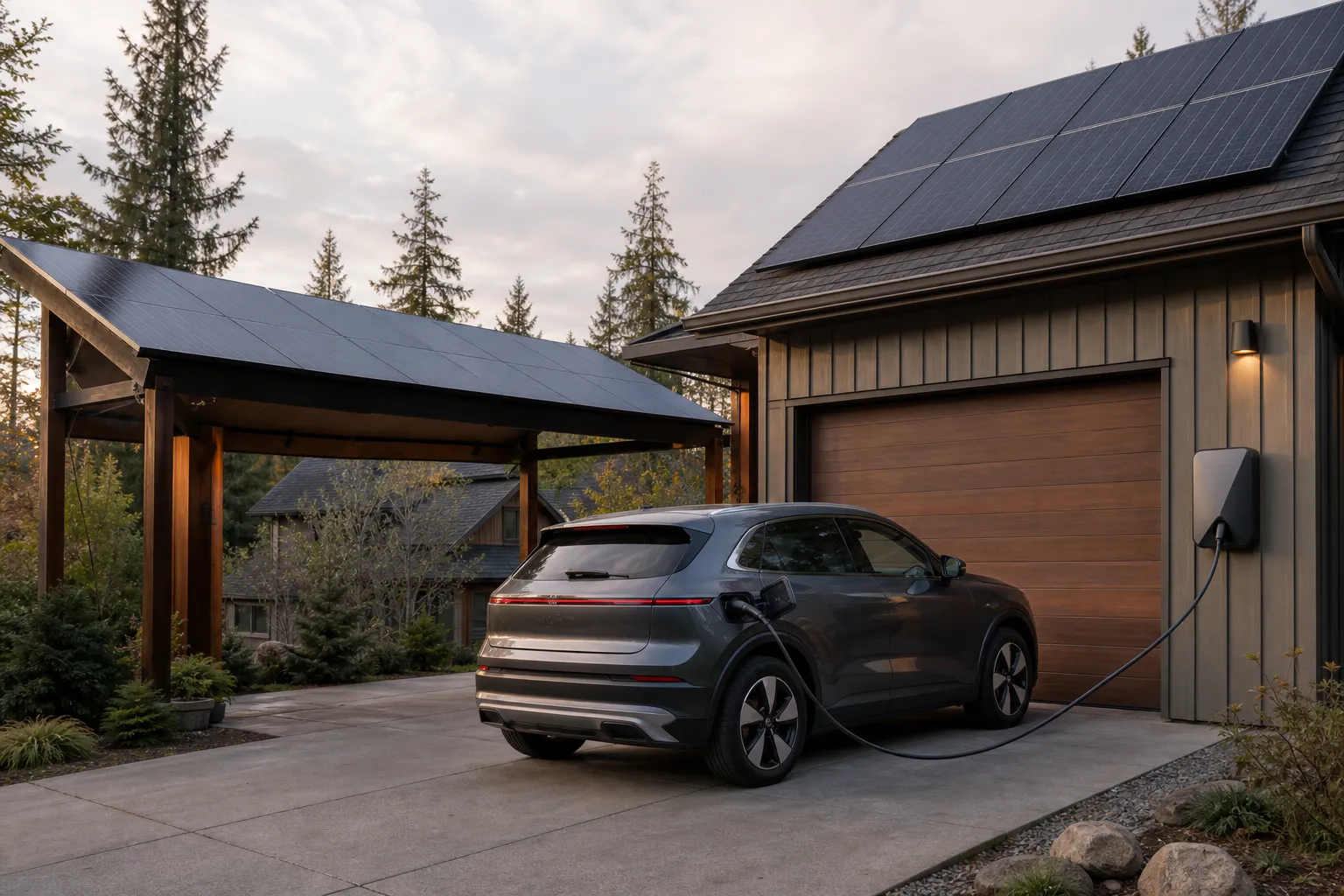
The technology behind bidirectional electric vehicle charging relies on a straightforward conversion process. An EV battery stores direct current (DC), but a home circuit, appliance or utility network generally requires alternating current (AC). That DC-to-AC inversion occurs either in the vehicle’s onboard electronics or in the charger, depending on the system design.
- DC off-board conversion The charger accepts DC directly from the vehicle’s battery pack and converts it to AC for use on the property or grid. This is the most common approach for home and grid-export installations today.
- AC on-board conversion The inversion hardware is built into the vehicle, allowing power export through a standard AC connection. Not every EV includes this additional equipment, even when it can accept AC charging.
- Smart charging controls Smart charging software manages when the vehicle draws electricity and when it exports power. It can protect a reserved battery level while responding to real-time electricity prices or grid operator commands.
- Dual compatibility requirement Both the EV and the charging equipment must support two-way energy flow. Installing a bidirectional charger alone does not make every connected vehicle capable of export.
Canada’s bidirectional charging market was valued at approximately US$2 million in 2025 and is projected to reach around US$12 million by 2030, representing a compound annual growth rate of 23.4%. DC charging is the fastest-growing segment, with a projected CAGR of 28.3% over the same period. Ontario and British Columbia are leading V2G infrastructure deployment through active utility partnerships, placing both provinces at the forefront of the clean energy transition.
Understanding V2X energy flow
V2X describes every direction in which an EV can export power. Properly equipped bidirectional charging stations provide the required hardware on-site, but the application still depends on the vehicle’s capabilities. For more detail on grid resilience, the bidirectional V2G technology overview on Wikipedia explains efficiency considerations and global implementation examples.
- V2H (vehicle-to-home) The vehicle supplies a home directly, operating like a stationary battery system. It can reduce grid dependence during normal operation or provide backup during an outage.
- V2G (vehicle-to-grid) Stored energy is exported to the utility network during periods of high demand. The vehicle can recharge when demand and prices decline, supporting demand response and grid balancing.
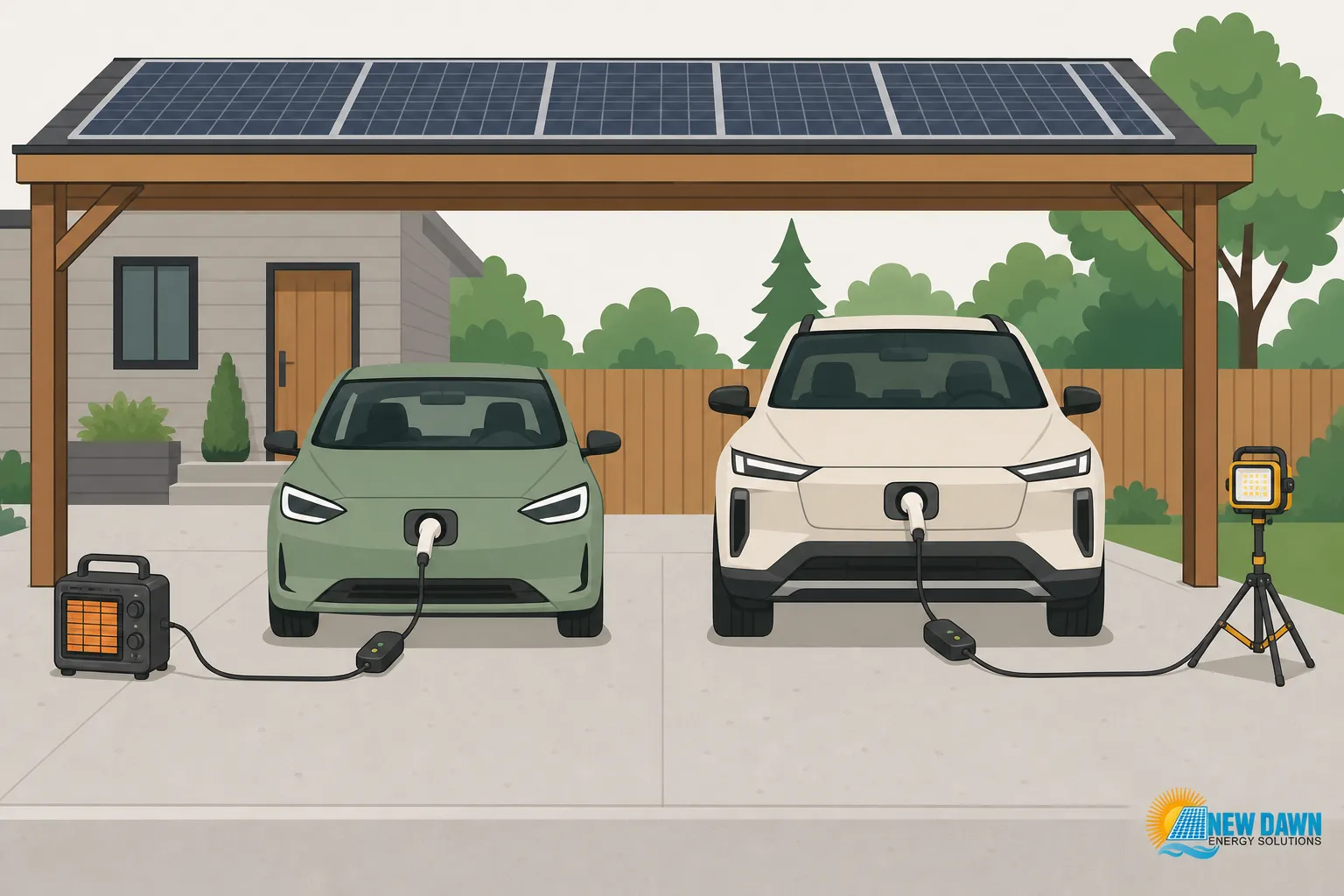
- V2L (vehicle-to-load) The EV becomes a portable power source for appliances or tools through an onboard outlet or adapter. No bidirectional home charger is required.
V2L is available today with a compatible adapter and vehicle. V2H and V2G require a correctly installed bidirectional charger, a compatible EV and compliance with Canada’s evolving certification and safety standards.
Which EVs offer V2L power
Not all EVs can discharge stored energy for external use, and export capability varies considerably among models available in Canada. V2L is the most accessible option because it generally requires a compatible adapter rather than a dedicated bidirectional home charger. Verify the vehicle’s exact capability by model year and trim before purchasing equipment or planning an installation.
Cars with bidirectional charging
The selection of cars with bidirectional charging in Canada is expanding, although capabilities differ between V2L-only models and vehicles that support V2H or V2G. Several models in Canada now support V2L export through an adapter.
- Hyundai Ioniq 5 / Hyundai Ioniq 6 V2L output reaches 3.6 kW through interior power points and external adapters. The exact configuration depends on the model variant and trim sold in Canada.
- Kia EV6 / Kia Niro EV Both provide V2L output of up to 3.6 kW. Depending on the variant, interior outlets and external adapters can support campsite or worksite power needs.
- MG ZS EV / MG 4 V2L operates through a front charging-port adapter with a maximum load of 2.2 kW. This suits smaller appliances and electronics away from a fixed supply.
- BYD Atto 3, Dolphin and Seal V2L operates through an adapter at the front-right charging port. Vehicle capability reaches 3.6 kW, while the included adapter is rated at 2.2 kW for the Atto 3 or 3.3 kW for the Dolphin and Seal.
CHAdeMO-based EVs, led by the Nissan Leaf, have the longest record in V2H and V2G deployments because the standard incorporated bidirectional power flow relatively early. CCS-equipped EVs are gaining similar functionality through ISO 15118, which is progressively enabling two-way energy exchange in newer vehicles. As more models certify bidirectional capability through CCS, the pool of compatible EVs in Canada should grow substantially over the next few years.
| Model | V2L output | V2H / V2G capable | Connector / adapter |
| Hyundai Ioniq 5 | 3.6 kW | Varies by market | Internal outlet + external adapter |
| Kia EV6 | 3.6 kW | Varies by market | Internal outlet + external adapter |
| MG ZS EV / MG 4 | 2.2 kW | No | Front port adapter |
| BYD Atto 3 | 3.6 kW (2.2 kW adapter) | No | Front-right port adapter |
| BYD Dolphin / Seal | 3.6 kW (3.3 kW adapter) | No | Front-right port adapter |
| Nissan Leaf (CHAdeMO) | N/A | Yes (V2H / V2G) | CHAdeMO bidirectional charger |
Tesla and other compatibility checks
Tesla compatibility requires careful checking for the specific Canadian variant, model year, and approved equipment. Export functions and hardware readiness vary by configuration and regional rollout. Tesla has identified bidirectional capability as a development priority, but Canadian owners should verify the current status with a dealer and confirm which certified equipment supports export before planning a V2H or V2G installation.
- Model and trim verification Export capability can differ between trim levels of the same vehicle nameplate. Check the precise configuration rather than relying on the brand name.
- Charging-port standard The connector standard—CHAdeMO, CCS, or a proprietary format—determines which bidirectional charger or adapter is compatible and which export protocols the vehicle supports.
- Manufacturer warranty position Confirm the automaker’s current warranty terms for bidirectional use. Some manufacturers specify conditions for using export functions without affecting battery coverage.
- Wallbox Quasar compatibility The Wallbox Quasar charger, one of the first commercially available bidirectional home chargers, is designed for CHAdeMO-compatible EVs. Confirm protocol support before buying any charger.
A qualified renewable energy contractor can cross-reference your specific EV with certified bidirectional equipment available in Ontario and across Canada, supporting reliable grid resilience and a sound system payback period.
For a home energy system, the battery inside the vehicle can act as stored energy when the load is managed correctly. Bidirectional charging controls the bidirectional power flow between the vehicle and the home, while V2L can supply appliances directly. A suitable wallbox and charger are essential for V2H or V2G operation; the Quasar is one example. During discharge, the vehicle must follow the equipment manufacturer’s limits and utility requirements.
Powering a home with V2H
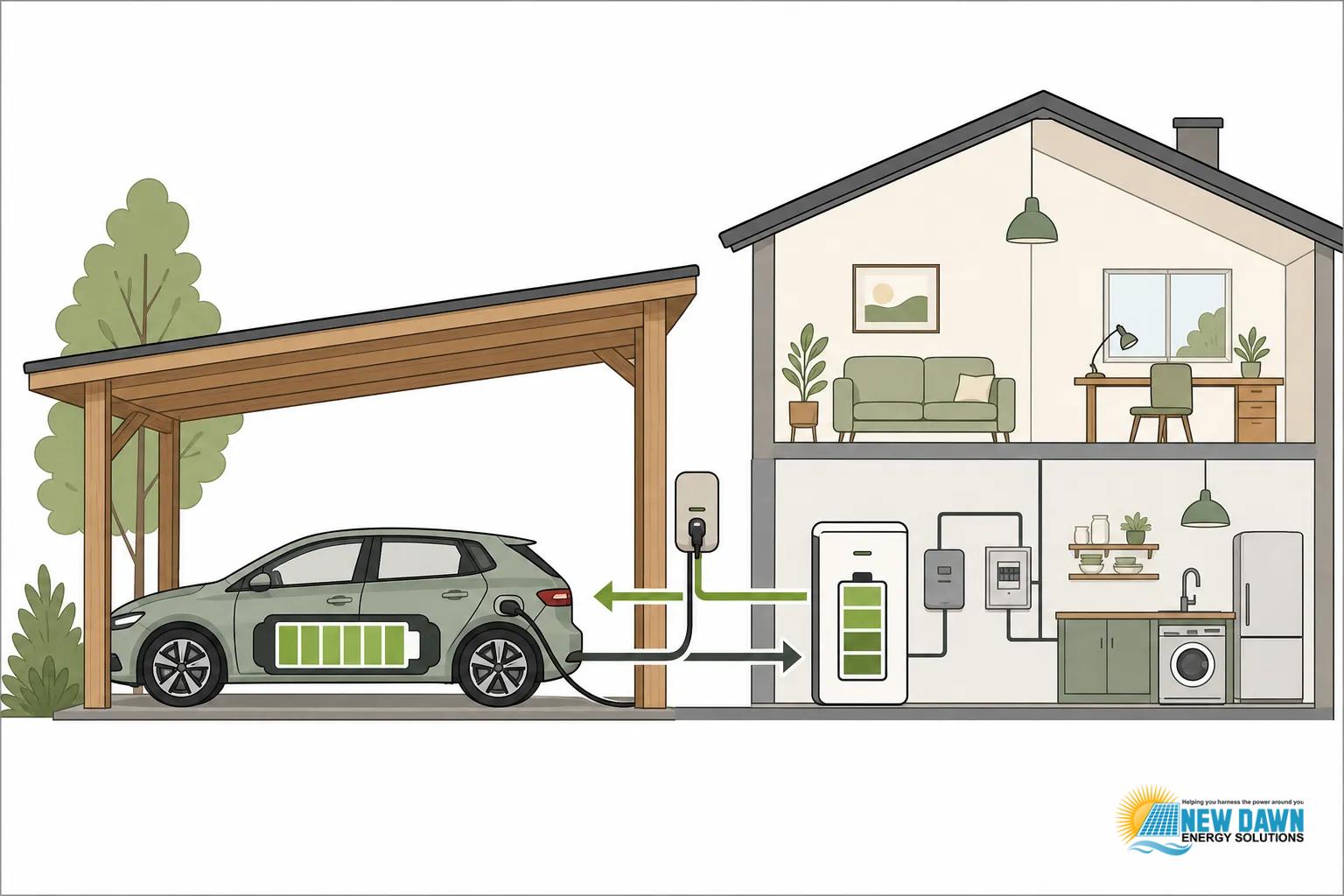
V2H turns an electric vehicle into mobile energy storage for the home. It can provide power during a grid outage or reduce electricity use during peak-price periods. The arrangement works much like a stationary home battery, except the battery travels with the vehicle already parked in your driveway. A CSA-recognized bidirectional charger and Ontario electrical permits are two requirements to confirm before purchasing.
Backup power from your vehicle
As a backup source, a properly installed V2H system can supply critical circuits, including refrigeration, lighting and heating controls. Depending on the design, it may also support a larger share of the home. The key technical hurdle is finding a bidirectional EV charger in Canada with CSA recognition and compatibility with your specific vehicle model, as certification continues to develop under the SPE-1000 field evaluation process.
- Battery capacity and runtime A typical EV battery holds roughly 60 kWh of electricity. Actual runtime depends on household consumption and the reserve level configured in the system.
- Transfer and isolation equipment A transfer switch or isolation device prevents exported EV power from backfeeding utility lines during an outage. This protects utility workers and home equipment from dangerous voltage.
- Current-transformer metering A current-transformer meter at the main grid connection point is required for V2H installations managing loads above 100 amps. It keeps operation within safe electrical parameters.
Using your EV as a power source for whole-home or partial-home backup requires an electrical panel with enough capacity for the connected loads. Panel upgrades, additional wiring and local building-permit compliance form part of the complete project scope. A licensed electrical contractor familiar with Ontario’s electrical safety requirements can ensure that exported energy remains within the property boundary and meets applicable codes.
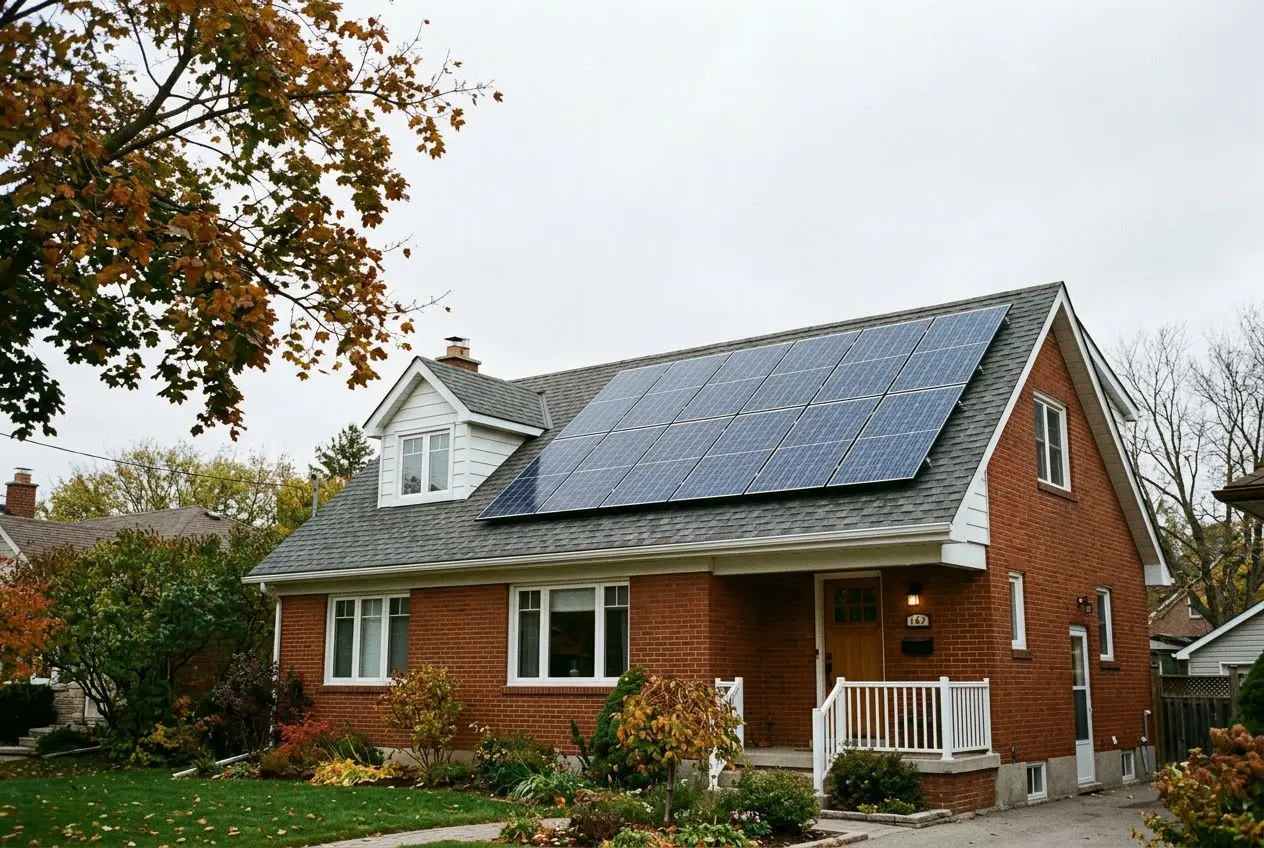
V2H can also work effectively with solar PV and battery storage. When the vehicle remains parked during daylight hours, smart charging can prioritize rooftop solar generation. Then the vehicle provides power to the home during evening peaks. On-site energy use rises. Grid reliance drops. Outage resilience for Ontario homeowners with solar systems strengthens.
Charger and installation cost factors
Assessing the cost of bidirectional electric vehicle charging for a Canadian residential project requires more than pricing the charger itself. Equipment, electrical upgrades, permits, labour and solar integration can all affect the final investment. Since the certified bidirectional-charger market is still maturing, availability and pricing vary by region and by the vehicle’s charging-port standard.
- Charger hardware Bidirectional home chargers, including CHAdeMO-compatible models such as the Wallbox Quasar, cost more than standard Level 2 chargers. Their higher price reflects the extra power-electronics hardware required for two-way energy management.
- Electrical panel work Older or undersized panels may need an upgrade to handle the added load and export capacity.
- Permitting and inspection Ontario requires permits and inspections for EV charger installations. Because bidirectional systems interact with the grid, they may also require additional review by the electrical safety authority and the local utility.
- Solar and storage integration Adding V2H to an existing solar-plus-storage system requires design coordination so components communicate correctly and the project qualifies for applicable net metering or grid-interconnection agreements.
The system payback period depends on how often the vehicle is available at home, local electricity rates, the selected backup coverage and eligibility for provincial or federal incentives. An itemized quote from a turnkey installation provider offers the clearest financial picture before you finalize the project scope.
V2G benefits and Canadian readiness
It allows stored energy to support broader grid resilience during periods of high demand. For Canadian homeowners and commercial operators, V2G can create a potential revenue stream while supporting the province’s clean energy transition, although regulatory and certification frameworks are still developing.
How V2G supports the grid
V2G enables a compatible vehicle to discharge stored energy to the electricity grid when demand peaks, then recharge during off-peak periods when electricity prices are lower. A utility or energy aggregator typically sends a signal through a smartphone app, prompting the EV to export power. It may also help prevent brownouts across a utility service area.
- Frequency regulation V2G-enrolled vehicles respond quickly to minor changes in grid frequency, providing a stabilizing service that supports reliable electricity delivery throughout the network.
- Time-of-use arbitrage Owners charge the vehicle overnight at lower rates and export electricity during afternoon peaks, creating a financial return while reducing pressure on the grid.
- Demand cost reduction For commercial and institutional sites, V2G and vehicle-to-building applications can lower peak demand charges. They can also increase the value of on-site solar by consuming locally produced electricity instead of exporting it at a curtailed rate.
Canadian pilot projects aim to establish comparable frameworks. Electric school buses and commercial EV fleets offer especially strong opportunities for institutional operators in Ontario, where grid modernization initiatives are seeking distributed energy resources to support peak-period supply.
Canadian standards
- CSA C22.2 No. 348 This standard for electric vehicle power export equipment has been published. It establishes a technical baseline for bidirectional EV charger certification in Canada and marks an important industry milestone.
- Testing-laboratory certification A nationally recognized testing-laboratory certification program for bidirectional chargers had not been confirmed as of the cited market status. Product availability therefore remained limited compared with conventional Level 2 chargers.
- Provincial leadership Ontario and British Columbia are leading V2G infrastructure deployment through utility partnerships. Both provinces are positioned to benefit early from projected market growth toward approximately US$12 million by 2030.
The gap between published standards and available certified products remains the main short-term barrier for Canadian homeowners and businesses pursuing V2G installations. Monitor CSA certification announcements and work with contractors who follow regulatory developments. Ask your contractor to document which exceptions or interim approvals apply so that the installation can be brought into full compliance once certification becomes available.
Battery life and warranty considerations
Frequent bidirectional cycling raises legitimate concerns about long-term battery health. Lithium-ion cells in modern EVs can achieve round-trip efficiency greater than 90%, while reported full V2G system efficiency, including losses from inverters and other components, ranges from approximately 53% to 70% across published studies. Most losses occur outside the battery, particularly in the power electronics responsible for DC-to-AC conversion.
Repeated discharge and recharge cycles for grid services add cumulative wear, and some automakers state that bidirectional use may affect or void battery warranty coverage. Manufacturers are exploring lithium iron phosphate (LFP) chemistry as a more cycle-resistant option. Slower V2G discharge rates also reduce degradation compared with rapid, high-power export cycles, and one study suggested that managed, low-rate vehicle grid storage could improve battery longevity under certain conditions.
- Warranty review Read your EV’s battery warranty before joining a V2G program. Confirm whether the manufacturer permits bidirectional use and the conditions required to preserve coverage.
- LFP chemistry advantage EVs equipped with lithium iron phosphate batteries offer greater resistance to cycle-related degradation. This makes them a preferred platform for frequent bidirectional applications where long battery life is important.
- Managed discharge strategy A managed discharge strategy can control depth and rate, reducing the additional wear on the batteries compared with unmanaged export cycles.
Assess the financial return from V2G against possible effects on battery longevity and warranty protection. Your decision should account for the specific vehicle, warranty terms and local utility compensation structure.
Frequently asked questions
Is bidirectional charging available in Canada?
Yes, bidirectional charging is available in Canada, although the market is still maturing. As of June 2024, most deployments were proceeding under the SPE-1000 field evaluation process rather than through fully CSA-certified product pathways. CSA C22.2 No. 348, covering electric vehicle power export equipment, has been published, but a nationally recognized testing-laboratory certification program had not yet been confirmed.
Ontario and British Columbia are leading V2G pilot projects through utility partnerships. The market is projected to grow significantly by 2030 as standards and certified products become more widely available.
Which EVs support bidirectional charging in Canada?
The most established V2H- and V2G-capable EVs in Canada are older Nissan Leaf models equipped with CHAdeMO, a standard that incorporated bidirectional power flow at an early stage. For V2L applications, the Hyundai Ioniq 5, Kia EV6, Kia Niro EV, MG ZS EV, MG 4, and BYD Atto 3, Dolphin and Seal provide export capability through compatible adapters, with outputs ranging from 2.2 kW to 3.6 kW.
CCS-equipped EVs are gaining bidirectional capability through the ISO 15118 protocol. The pool of compatible vehicles should expand as more models receive certification, giving homeowners and businesses additional options for backup power, energy savings and participation in utility programs.
How much does a bidirectional EV charger cost in Canada?
The total cost of bidirectional electric vehicle charging for a Canadian residential installation varies considerably. Equipment selection, vehicle compatibility, electrical panel capacity and the chosen scope of backup coverage all affect the final budget.
Bidirectional charger hardware, including CHAdeMO-compatible units, generally costs more than a standard Level 2 charger because it requires additional power electronics. The project may also include electrical panel work, a transfer or isolation switch, permits, inspection fees and labour. Obtain itemized quotes from qualified turnkey installation contractors in your province to establish a reliable project budget and assess the expected system payback period.