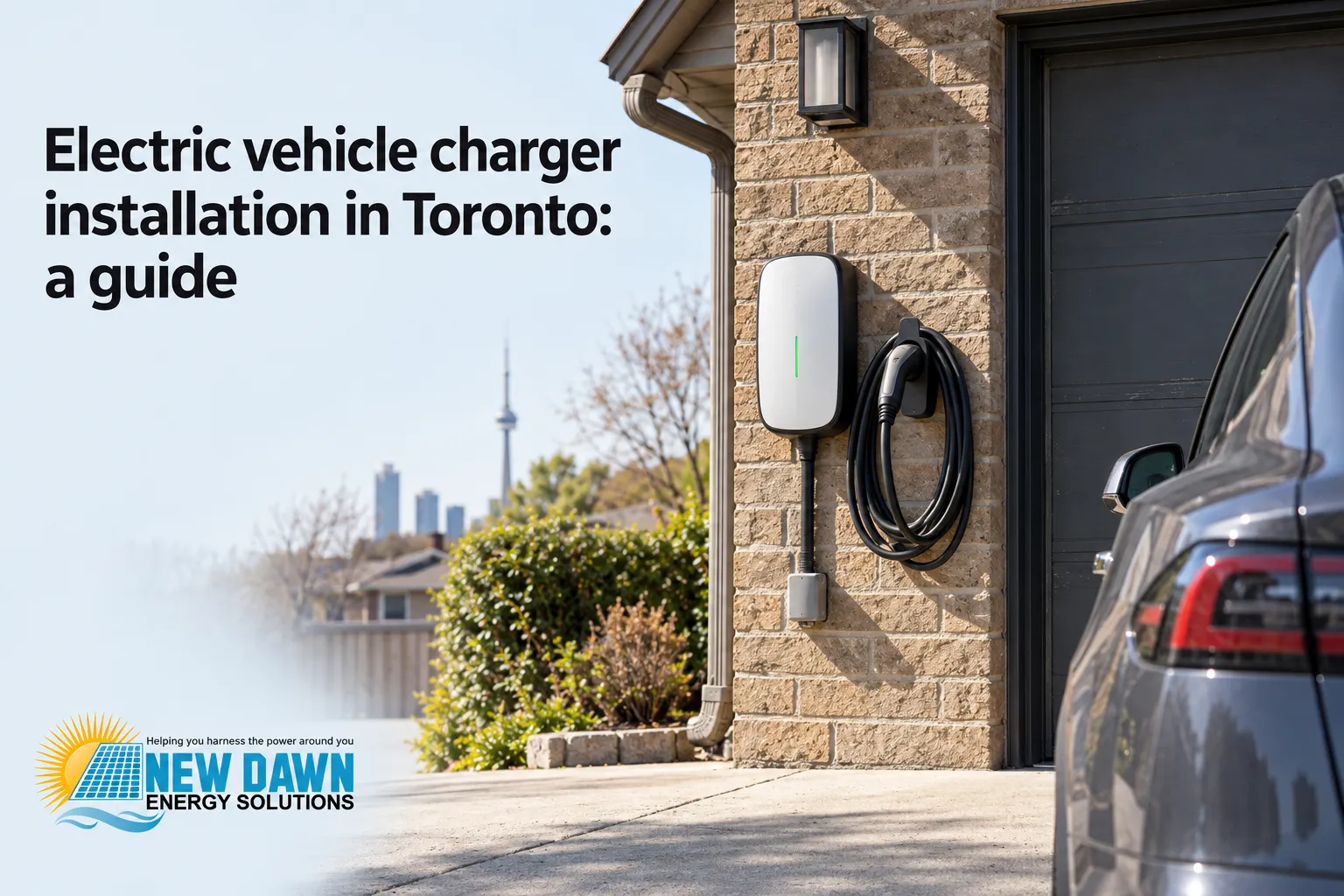
Electric vehicle charger installation in Toronto starts with three decisions: what the job should cost, what your home or building can supply, and which licensed contractor you hire. GTA price ranges, capacity checks, ESA approval and condo or rental rules all shape the scope of the job.
How much does EV charger installation cost in Toronto?
A standard installation usually falls between a few hundred and a few thousand dollars. The final amount depends mostly on the electrical work around the charger, not on the charger itself. Your first job is to separate the basic circuit from panel upgrades and other extras.
Typical installation prices
A market dataset of more than 100 completed residential projects in Toronto and the GTA puts a straightforward Level 2 job at roughly $850–$1,500 before HST and charger hardware. These figures describe what the market charges. They are not an official tariff.
The same dataset shows how scope affects the final EV charger installation cost in Toronto. One project came in at $900. Another cost $1,425 because it needed a longer wiring run. A $4,430 job added a 100A panel replacement, load management and other electrical work.
| Project scope (Toronto/GTA dataset) | Installation cost (CAD) |
| Straightforward Level 2 installation, before HST and hardware | $850–$1,500 |
| Level 2 project with short run | $900 |
| Level 2 project with longer wiring run | $1,500 |
| 100A panel replacement, load management and other work | $4,430 |
What changes the estimate?
Contractor pricing sets a wider range. One Toronto-area contractor’s estimate places most Level 2 home jobs at $1,200–$2,500, with charger hardware usually quoted separately. This is a contractor figure, not a municipal or provincial price schedule. Four factors explain most of the spread.
- Energy management: add-on devices that control charging demand typically cost $500–$1,500, depending on the work involved.
- Panel or service work: a 100A-to-200A panel upgrade or service project generally runs $2,000–$5,500+.
- Cable route: the distance from panel to charger sets how much conductor, conduit and labour the job needs.
- Site conditions: outdoor exposure, finished basements, walls and trenching all add time and materials.
An installation-only price and an all-in price cannot be compared directly. When you compare quotes for charger installation in Toronto, first check whether each one includes upgrades and hardware.
Rebates and financing that apply
Toronto Hydro’s current residential offers include no general rebate for home EV charger installation. Ontario’s Home Renovation Savings program does not list EV chargers as an eligible measure either. Natural Resources Canada recommends checking which provincial and utility programs apply before counting on any incentive.
Transport Canada’s Electric Vehicle Affordability Program pays up to $5,000 in 2026 toward qualifying vehicle purchases or leases, not toward charger installation. ChargeON funds public charging infrastructure, and its 2025 intake has closed. The City of Toronto’s Home Energy Loan Program offers low-interest financing that can cover EV charging stations, so the cost is spread out rather than removed.
Which charger and electrical capacity does your home need?
Your daily driving and your home’s electrical capacity decide the scope of the job. When the charging level and the circuit design match, you avoid paying for upgrades you do not need, and you avoid ending up with a charger that cannot keep up.
Choose a charging level
Start with two numbers: how many kilometres you drive each day, and how many hours the car sits parked. According to Natural Resources Canada charging estimates, recovery rates differ sharply between levels, and results vary with vehicle, temperature and battery state.
- Level 1: uses a standard 120V outlet and adds about 3–8 km of range per hour. It suits light daily driving with overnight charging.
- Level 2: uses about 240V and adds an estimated 16–50 km per hour, which gives faster charging for longer commutes.
- Level 3 (DC fast charging): needs high-power public or commercial infrastructure and is not a typical home option.
Level 2 suits daily drivers who need more range back overnight. Depending on your home’s capacity, it may require electrical upgrades.
Assess panel capacity and circuit design
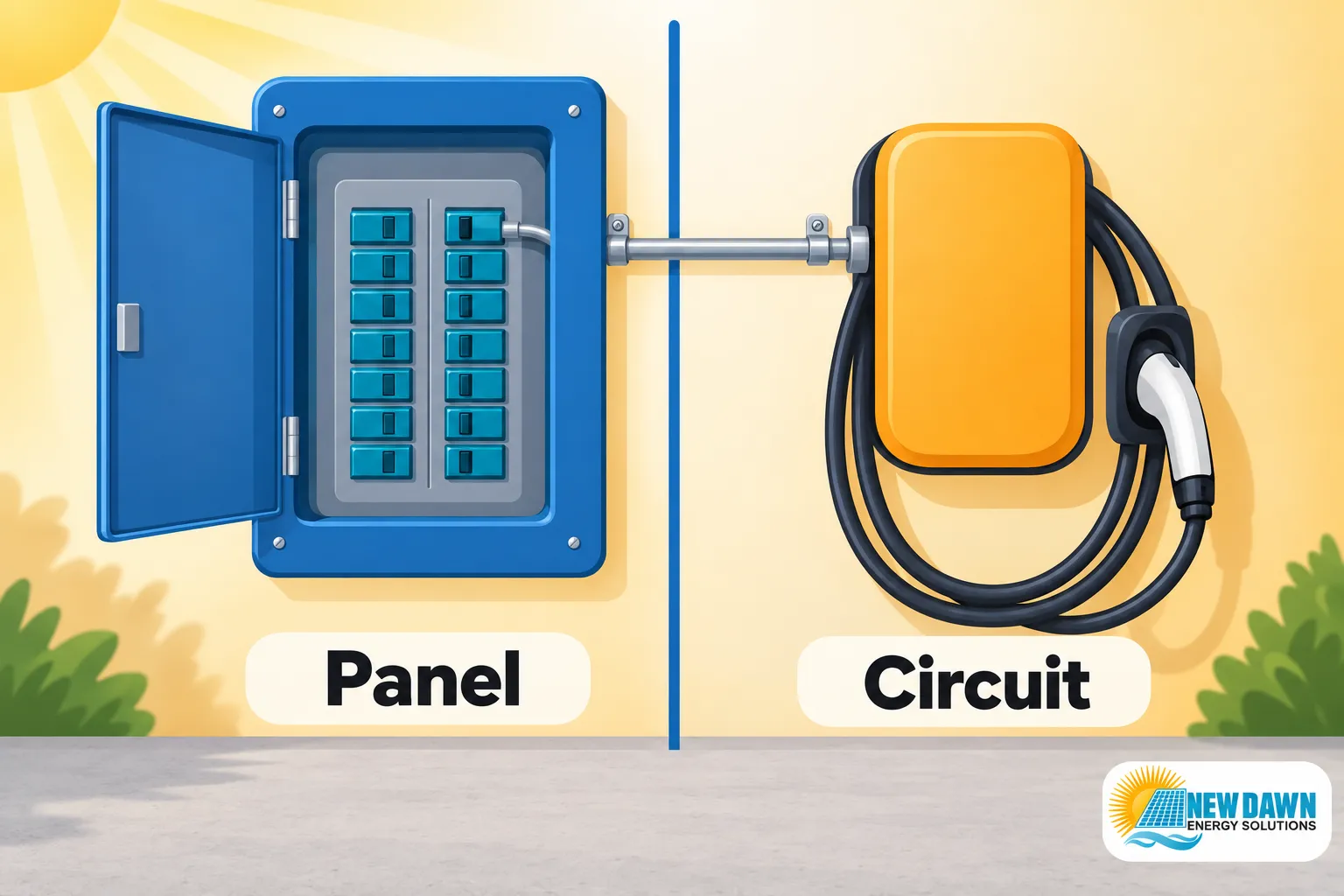
A residential EV charger installation in Toronto normally needs a dedicated 240V circuit sized for the equipment and the calculated load. Because charging counts as a continuous load, a 40A charger runs on a 50A circuit and a 48A charger on a 60A circuit. The breaker, conductors and programmed output must all match. An existing 100A service does not automatically need replacing with 200A. Toronto Hydro Green Button tool provide your current hourly electricity usage needed for the load calculation to decide whether you need load management, panel changes, a subpanel or a full service upgrade. A full service upgrade is different from a panel replacement and may require a Toronto Hydro service-connection request.
Select equipment and possible solar integration
New Dawn Energy Solutions designs each home installation around the property’s layout and energy needs. We also offer chargers that can pair with solar power. Before you buy a charger, check these points:
- Certification: ESA requires an appropriate Canadian certification or evaluation mark on the charging equipment.
- Connection type: hardwired and receptacle-connected models have different connection requirements.
- Outdoor suitability: an exterior unit must be rated for its exposure, and its wiring needs proper protection.
- Two-way capability: bidirectional charging works only if both the vehicle and the charger support it.
In Keswick, we built a solar-and-battery system with an integrated EV charger using a SolarEdge inverter, so the homeowner charges without adding grid dependency. A backup setup built on bidirectional EV charging in Canada may also need panel work and a transfer or isolation device. Its costs can therefore run above those of a standard Level 2 installation.
How do you compare installers and arrange approval?
Two installers with similar prices can deliver very different results. The contractor’s licence, the detail in the written quote and who handles ESA approval decide whether the finished job is code-compliant and properly documented.

Verify who will perform the work
For hired EV charger work in Ontario, ESA directs homeowners to a Licensed Electrical Contractor holding an ECRA/ESA licence. Search the contractor in ESA’s online lookup and confirm that the business name matches the licence before you compare prices.
Ask every candidate four questions: who will do the work, who will file the ESA notification, whether the job will be inspected, and who will provide the Certificate of Acceptance.
As a Certified Tesla Installer, New Dawn acts as an EV charger installer in Toronto for both homes and businesses. We start with a no-obligation energy-needs assessment, and our team handles the permits and the installation. Our residential and commercial EV charging solutions also cover commercial EV charger installation that scales to employee, customer and fleet charging.
Compare assessments and written quotes
A reliable quote starts with detail information collected. The electricians should check the panel’s rating and condition, available capacity, existing demand, breaker space, desired output, circuit sizing, cable route and parking location. Then confirm that each written quote states whether these items are included:
- Hardware and design: the charger, load calculation, breaker and circuit sizing.
- Installation work: conductors, conduit, labour and commissioning.
- Approvals and tax: ESA notification, inspection fees and HST.
- Upgrades: any panel work, load management or utility work.
A detached garage or a difficult route needs extra checks. Confirm whether trenching, drilling, wall repairs and outdoor equipment are included in the price. Also check whether each proposal calls for a panel replacement or a full electrical-service upgrade.
Follow the notification and inspection process
ESA requires an electrical notification of work, often called a permit, before any EV charger installation begins. For hired work, the Licensed Electrical Contractor files it. This notification is separate from a municipal building permit. The charger installation process then follows three steps:
- Notification: the contractor files with ESA before any work begins.
- Installation and testing: the circuit and charging station are installed and checked under the 29th edition/2024 Ontario Electrical Safety Code, in force since May 1, 2025.
- Acceptance: after ESA inspection, the contractor provides the Certificate of Acceptance once the work is accepted as compliant.
ESA’s 2026 Wiring Fee Guide sets a $92 minimum notification fee, effective April 1, 2026. That amount is not a flat charge for every charger and is not the total project cost, so check which fee applies to your job. An owner-occupier of a single-family home may do certain electrical work personally, subject to code, notification and inspection requirements.
What changes in a condo, apartment or rental?
In shared buildings, the parking space, the electrical supply and the approvals belong to more than one party. Plan for permissions and building-level checks before any wiring is installed.
Establish access to the parking space
Whether a home charging setup is simple or complicated depends on where the car is parked. Confirm which of these situations applies to you:
- Private garage or driveway: usually the easiest setup. Where no suitable outlet is nearby, a Licensed Electrical Contractor can assess a Level 1 or Level 2 installation.
- Condo parking: options depend on the building’s charging policy and infrastructure.
- Apartment parking: the building manager sets what is possible.
- Rental unit: tenants need permission and an arrangement the building’s electrical system can support.
Toronto Hydro advises talking to the condo corporation or building manager before buying an electric vehicle. Tenants do not control shared electrical systems, so getting permission comes first.
Obtain condo corporation approval
Before any electrical work begins in a condo, the Condominium Authority of Ontario sets out a formal process:
- Preparation: confirm the parking-space arrangement, the charging policy and the proposed cable route.
- Written application: submit drawings, specifications and the other required information to the corporation.
- Response: the corporation generally has 60 days to reply, and certain grounds for refusal must be supported by a qualified professional.
- Agreement: once the application is accepted, the owner and corporation have 90 days to sign a written agreement.
Your contractor can supply the drawings and specifications that the application requires.
Resolve building capacity and billing
A condo installation is a different job from charging beside a detached house. Four issues usually shape the project:
- Shared capacity: the building’s electrical panel and service supply every unit.
- Load management: shared control of charging demand may be needed to stay within capacity.
- Metering: the building must decide how charging electricity will be measured and billed.
- Operator: the owner, a charging provider or the building itself may run the system.
Toronto Hydro’s requirements can allow separate EV metering in some multi-residential configurations, depending on eligibility and equipment.
When a building owner or charging provider operates the charging station network, the project follows Toronto Hydro’s non-residential connection pathway. Its feasibility assessment looks at available capacity, possible upgrades and project complexity.
Frequently Asked Questions
Can a plug-in Level 2 charger on a 50A receptacle be protected by a 40A breaker?
No. ESA’s EV guidance requires a 50A overcurrent device for a 50A 14-50R or 6-50R receptacle that serves cord-connected charging equipment, and the earlier 40A allowance has been revoked. Hardwiring avoids having a receptacle as an extra connection point.
When does a commercial or workplace EV charging installation in Ontario need ESA plan review?
Under ESA Rule 2-010, the plan-review threshold for specified EV charging installations rose from 10 kW to 12 kW on July 6, 2026. The Licensed Electrical Contractor you hire should confirm whether your project exceeds it.
Can a business claim capital cost allowance on EV charging stations?
Possibly. The Canada Revenue Agency identifies stations supplying more than 10 kW but less than 90 kW of continuous power as potentially eligible for Class 43.1, which has a 30% rate. That is not a blanket 30% credit for ordinary home chargers.